Q49YZ1
Gene name |
agrB |
Protein name |
Accessory gene regulator protein B |
Names |
|
Species |
Staphylococcus saprophyticus subsp. saprophyticus (strain ATCC 15305 / DSM 20229 / NCIMB 8711 / NCTC 7292 / S-41) |
KEGG Pathway |
ssp:SSP0842 |
EC number |
|
Protein Class |
|
Descriptions
The autoinhibited protein was predicted that may have potential autoinhibitory elements via cis-regPred.
Autoinhibitory domains (AIDs)
Target domain |
|
Relief mechanism |
|
Assay |
cis-regPred |
Accessory elements
No accessory elements
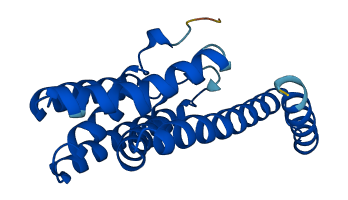
Autoinhibited structure

Activated structure
1 structures for Q49YZ1
| Entry ID | Method | Resolution | Chain | Position | Source |
|---|---|---|---|---|---|
| AF-Q49YZ1-F1 | Predicted | AlphaFoldDB |
No variants for Q49YZ1
| Variant ID(s) | Position | Change | Description | Diseaes Association | Provenance |
|---|---|---|---|---|---|
| No variants for Q49YZ1 | |||||
No associated diseases with Q49YZ1
No regional properties for Q49YZ1
| Type | Name | Position | InterPro Accession |
|---|---|---|---|
| No domain, repeats, and functional sites for Q49YZ1 | |||
2 GO annotations of cellular component
| Name | Definition |
|---|---|
| integral component of membrane | The component of a membrane consisting of the gene products and protein complexes having at least some part of their peptide sequence embedded in the hydrophobic region of the membrane. |
| plasma membrane | The membrane surrounding a cell that separates the cell from its external environment. It consists of a phospholipid bilayer and associated proteins. |
1 GO annotations of molecular function
| Name | Definition |
|---|---|
| peptidase activity | Catalysis of the hydrolysis of a peptide bond. A peptide bond is a covalent bond formed when the carbon atom from the carboxyl group of one amino acid shares electrons with the nitrogen atom from the amino group of a second amino acid. |
2 GO annotations of biological process
| Name | Definition |
|---|---|
| proteolysis | The hydrolysis of proteins into smaller polypeptides and/or amino acids by cleavage of their peptide bonds. |
| quorum sensing | The cell-cell signaling process in which single-celled organisms carry out coordinated responses by monitoring their own population density, and often also that of other microbes, by producing small, diffusible, signal molecules, detecting the concentration of these molecules, and triggering a signal transduction pathway when a certain threshold is reached. Quorum sensing can occur amongst microbial communities in the environment or within host organisms. |
No homologous proteins in AiPD
| UniProt AC | Gene Name | Protein Name | Species | Evidence Code |
|---|---|---|---|---|
| No homologous proteins | ||||
| 10 | 20 | 30 | 40 | 50 | 60 |
| MVKFIDAKID | NFAKQLQQRN | NLDRIEYLKM | RLGMQVVVNN | FFKTIVIYGV | SLLCHMFLYT |
| 70 | 80 | 90 | 100 | 110 | 120 |
| LTVHLTFFFI | RHFAHGAHAK | NSLLCYIQSV | IYFVLLPWIV | GYVQVSSLIM | YTLALVGLII |
| 130 | 140 | 150 | 160 | 170 | 180 |
| ISIYAPSATK | KQPIPERLRR | GKKIKAICLT | LIFLLISLFL | NEPYQQLMLL | GIVIISILQF |
| PIFFPKEDY |