Q49WH7
Gene name |
pgcA (SSP1737) |
Protein name |
Phosphoglucomutase |
Names |
PGM, Alpha-phosphoglucomutase, Glucose phosphomutase |
Species |
Staphylococcus saprophyticus subsp. saprophyticus (strain ATCC 15305 / DSM 20229 / NCIMB 8711 / NCTC 7292 / S-41) |
KEGG Pathway |
ssp:SSP1737 |
EC number |
5.4.2.2: Phosphotransferases (phosphomutases) |
Protein Class |
|
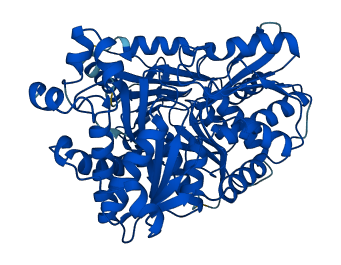
Descriptions
The autoinhibited protein was predicted that may have potential autoinhibitory elements via cis-regPred.
Autoinhibitory domains (AIDs)
Target domain |
|
Relief mechanism |
|
Assay |
cis-regPred |
Accessory elements
No accessory elements
Autoinhibited structure

Activated structure
1 structures for Q49WH7
| Entry ID | Method | Resolution | Chain | Position | Source |
|---|---|---|---|---|---|
| AF-Q49WH7-F1 | Predicted | AlphaFoldDB |
No variants for Q49WH7
| Variant ID(s) | Position | Change | Description | Diseaes Association | Provenance |
|---|---|---|---|---|---|
| No variants for Q49WH7 | |||||
No associated diseases with Q49WH7
Functions
| Description | ||
|---|---|---|
| EC Number | 5.4.2.2 | Phosphotransferases (phosphomutases) |
| Subcellular Localization |
|
|
| PANTHER Family | ||
| PANTHER Subfamily | ||
| PANTHER Protein Class | ||
| PANTHER Pathway Category | No pathway information available | |
No GO annotations of cellular component
| Name | Definition |
|---|---|
| No GO annotations for cellular component |
2 GO annotations of molecular function
| Name | Definition |
|---|---|
| magnesium ion binding | Binding to a magnesium (Mg) ion. |
| phosphoglucomutase activity | Catalysis of the reaction: alpha-D-glucose 1-phosphate = alpha-D-glucose 6-phosphate. |
2 GO annotations of biological process
| Name | Definition |
|---|---|
| enterobacterial common antigen biosynthetic process | The chemical reactions and pathways resulting in the formation of the enterobacterial common antigen, an acidic polysaccharide containing N-acetyl-D-glucosamine, N-acetyl-D-mannosaminouronic acid, and 4-acetamido-4,6-dideoxy-D-galactose. A major component of the cell wall outer membrane of Gram-negative bacteria. |
| glucose metabolic process | The chemical reactions and pathways involving glucose, the aldohexose gluco-hexose. D-glucose is dextrorotatory and is sometimes known as dextrose; it is an important source of energy for living organisms and is found free as well as combined in homo- and hetero-oligosaccharides and polysaccharides. |
No homologous proteins in AiPD
| UniProt AC | Gene Name | Protein Name | Species | Evidence Code |
|---|---|---|---|---|
| No homologous proteins | ||||
| 10 | 20 | 30 | 40 | 50 | 60 |
| MKALWLENIN | ESLVKDFYET | QTEEEQNAGF | EGVLSFGTAG | IRSTFGLGPA | RLNAFTVRKV |
| 70 | 80 | 90 | 100 | 110 | 120 |
| ALGLAQYLNH | NVDDASVVIH | FDTRFLSKAF | SQEMASVLAN | NGITAIISDN | YKSTPELSFA |
| 130 | 140 | 150 | 160 | 170 | 180 |
| VRHLQVNAGI | MITASHNPKN | YNGIKIYNEK | GGQLLPEASE | QLSEYINSIE | TPLNIEKGDF |
| 190 | 200 | 210 | 220 | 230 | 240 |
| NAFVENGKIK | YMSNEVTESY | KKEVKSLVGS | IDAHDAKVIL | TSLHGTSLPL | VSDILTELDY |
| 250 | 260 | 270 | 280 | 290 | 300 |
| HNFVIEKEQS | EPNGNFPTVA | IANPEDEAAF | TLGKQLADKT | DAQLIIATDP | DADRLGFIER |
| 310 | 320 | 330 | 340 | 350 | 360 |
| YGDNDFRYFN | GNEIGLLLMK | LRFQDLTEDS | TPQYMIKSIV | TSELAERLAT | SLNVEVNDVL |
| 370 | 380 | 390 | 400 | 410 | 420 |
| TGFKFISDLI | EHKQKDDDKQ | LLLAFEESHG | YLAQPISRDK | DAIQMVPLLV | KYKNLLDKNG |
| 430 | 440 | 450 | 460 | 470 | 480 |
| ITFKETIEDI | YENIGYFKDR | TLAPTFEGKA | GVKKIESIMS | QFRNEQVFSI | CGMDVLKIED |
| 490 | 500 | 510 | 520 | 530 | 540 |
| YHVGEVRDMI | TGHTEKLTLP | KTNLIRFIFE | NGFIALRPSG | TEPKIKLYFS | LEVENIDEIT |
| 550 | |||||
| QQFEANYINN | IV |