Q49SP5
Gene name |
|
Protein name |
Germacrene A synthase |
Names |
PatTpsCF2 |
Species |
Pogostemon cablin (Patchouli) (Mentha cablin) |
KEGG Pathway |
|
EC number |
4.2.3.23: Acting on phosphates |
Protein Class |
|
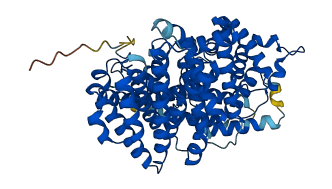
Descriptions
The autoinhibited protein was predicted that may have potential autoinhibitory elements via cis-regPred.
Autoinhibitory domains (AIDs)
Target domain |
|
Relief mechanism |
|
Assay |
cis-regPred |
Accessory elements
No accessory elements
Autoinhibited structure

Activated structure
1 structures for Q49SP5
| Entry ID | Method | Resolution | Chain | Position | Source |
|---|---|---|---|---|---|
| AF-Q49SP5-F1 | Predicted | AlphaFoldDB |
No variants for Q49SP5
| Variant ID(s) | Position | Change | Description | Diseaes Association | Provenance |
|---|---|---|---|---|---|
| No variants for Q49SP5 | |||||
No associated diseases with Q49SP5
Functions
| Description | ||
|---|---|---|
| EC Number | 4.2.3.23 | Acting on phosphates |
| Subcellular Localization |
|
|
| PANTHER Family | ||
| PANTHER Subfamily | ||
| PANTHER Protein Class | ||
| PANTHER Pathway Category | No pathway information available | |
1 GO annotations of cellular component
| Name | Definition |
|---|---|
| cytosol | The part of the cytoplasm that does not contain organelles but which does contain other particulate matter, such as protein complexes. |
3 GO annotations of molecular function
| Name | Definition |
|---|---|
| germacrene-A synthase activity | Catalysis of the reaction: 2-trans,6-trans-farnesyl diphosphate = (+)-(R)-germacrene A + diphosphate. |
| magnesium ion binding | Binding to a magnesium (Mg) ion. |
| sesquiterpene synthase activity | Catalysis of the reaction: trans,trans-farnesyl diphosphate = a sesquiterpene + diphosphate. Sesquiterpenes are terpenes containing three isoprene units, i.e. 15 carbons. |
3 GO annotations of biological process
| Name | Definition |
|---|---|
| diterpenoid biosynthetic process | The chemical reactions and pathways resulting in the formation of diterpenoid compounds, terpenoids with four isoprene units. |
| farnesyl diphosphate metabolic process | The chemical reactions and pathways involving farnesyl diphosphate, an intermediate in carotenoid, sesquiterpene, squalene and sterol biosynthesis, as well as a substrate in protein farnesylation. |
| sesquiterpene biosynthetic process | The chemical reactions and pathways resulting in the formation of sesquiterpenes, any of a class of terpenes of the formula C15H24 or a derivative of such a terpene. |
No homologous proteins in AiPD
| UniProt AC | Gene Name | Protein Name | Species | Evidence Code |
|---|---|---|---|---|
| No homologous proteins | ||||
| 10 | 20 | 30 | 40 | 50 | 60 |
| MAVQISETVR | PFANFSPNPS | LWGDQFINHK | SKTQQISRIY | LEEIEGLKNE | VKCMLTSTPE |
| 70 | 80 | 90 | 100 | 110 | 120 |
| GKMADTVNLI | DTLERLGVSY | HFEKEIEEKM | KHLFNLIKAD | NYKDHEGCDL | YTDALHFRLF |
| 130 | 140 | 150 | 160 | 170 | 180 |
| RQHGYPISSG | IFNKWMDGNG | KFKESIKSDA | KGLLSLYEAC | CLRTHGDTLL | DEALVFATAS |
| 190 | 200 | 210 | 220 | 230 | 240 |
| LKSMAANLAS | PLRKQVEHAL | FQHLHFGIPR | VEARHFITFY | EEEEHKNEML | LRFAKLDFNA |
| 250 | 260 | 270 | 280 | 290 | 300 |
| LQALHKEELS | EISKWWKDLD | LISKLPYARD | RVVESYFWAV | GVYYQPKYSR | ARIMLTKTIA |
| 310 | 320 | 330 | 340 | 350 | 360 |
| MTAILDDTYD | SYGTLEELDV | LTKAIERWDI | KEINGLPEYI | KGFYKQVLKL | YQQLEEELAK |
| 370 | 380 | 390 | 400 | 410 | 420 |
| EGRSYAVYYA | IEACKELARS | YAVEAKWFKK | GYLPGFEEYL | INSLVTSTAG | YLNIISFFGV |
| 430 | 440 | 450 | 460 | 470 | 480 |
| ESVTKEDFEW | FSKKPRIAVA | TQIITRVIDD | IATYEVEKEK | GQSATGIDCY | MKEHGVSKEK |
| 490 | 500 | 510 | 520 | 530 | 540 |
| AMQRFYEMST | NAWKDINEEG | LSWPSSFSRD | IFVQLRNFSR | MVDVTYGKNE | DGYSKPEKIL |
| 550 | |||||
| KPLIIALFVD | QIKL |