Q499V3
Gene name |
Rad9b |
Protein name |
Cell cycle checkpoint control protein RAD9B |
Names |
DNA repair exonuclease rad9 homolog B |
Species |
Rattus norvegicus (Rat) |
KEGG Pathway |
rno:363924 |
EC number |
|
Protein Class |
|
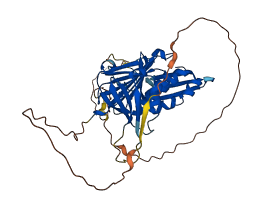
Descriptions
The autoinhibited protein was predicted that may have potential autoinhibitory elements via cis-regPred.
Autoinhibitory domains (AIDs)
Target domain |
|
Relief mechanism |
|
Assay |
cis-regPred |
Accessory elements
No accessory elements
Autoinhibited structure

Activated structure
1 structures for Q499V3
| Entry ID | Method | Resolution | Chain | Position | Source |
|---|---|---|---|---|---|
| AF-Q499V3-F1 | Predicted | AlphaFoldDB |
No variants for Q499V3
| Variant ID(s) | Position | Change | Description | Diseaes Association | Provenance |
|---|---|---|---|---|---|
| No variants for Q499V3 | |||||
No associated diseases with Q499V3
No regional properties for Q499V3
| Type | Name | Position | InterPro Accession |
|---|---|---|---|
| No domain, repeats, and functional sites for Q499V3 | |||
2 GO annotations of cellular component
| Name | Definition |
|---|---|
| checkpoint clamp complex | Conserved heterotrimeric complex of PCNA-like proteins that is loaded onto DNA at sites of DNA damage. |
| nucleus | A membrane-bounded organelle of eukaryotic cells in which chromosomes are housed and replicated. In most cells, the nucleus contains all of the cell's chromosomes except the organellar chromosomes, and is the site of RNA synthesis and processing. In some species, or in specialized cell types, RNA metabolism or DNA replication may be absent. |
No GO annotations of molecular function
| Name | Definition |
|---|---|
| No GO annotations for molecular function |
4 GO annotations of biological process
| Name | Definition |
|---|---|
| cellular response to ionizing radiation | Any process that results in a change in state or activity of a cell (in terms of movement, secretion, enzyme production, gene expression, etc.) as a result of a ionizing radiation stimulus. Ionizing radiation is radiation with sufficient energy to remove electrons from atoms and may arise from spontaneous decay of unstable isotopes, resulting in alpha and beta particles and gamma rays. Ionizing radiation also includes X-rays. |
| DNA repair | The process of restoring DNA after damage. Genomes are subject to damage by chemical and physical agents in the environment (e.g. UV and ionizing radiations, chemical mutagens, fungal and bacterial toxins, etc.) and by free radicals or alkylating agents endogenously generated in metabolism. DNA is also damaged because of errors during its replication. A variety of different DNA repair pathways have been reported that include direct reversal, base excision repair, nucleotide excision repair, photoreactivation, bypass, double-strand break repair pathway, and mismatch repair pathway. |
| DNA replication checkpoint signaling | A signal transduction process that contributes to a DNA replication checkpoint, that prevents the initiation of nuclear division until DNA replication is complete, thereby ensuring that progeny inherit a full complement of the genome. |
| mitotic intra-S DNA damage checkpoint signaling | A mitotic cell cycle checkpoint that slows DNA synthesis in response to DNA damage by the prevention of new origin firing and the stabilization of slow replication fork progression. |
1 homologous proteins in AiPD
| UniProt AC | Gene Name | Protein Name | Species | Evidence Code |
|---|---|---|---|---|
| Q6WBX7 | Rad9b | Cell cycle checkpoint control protein RAD9B | Mus musculus (Mouse) | PR |
| 10 | 20 | 30 | 40 | 50 | 60 |
| MTGGQVKVFG | KAIQTLSRVS | DELWLDPSEK | GLALRSVNSC | HSTYGYVLFS | SVFFQHYQWS |
| 70 | 80 | 90 | 100 | 110 | 120 |
| PSATITDSDI | PLNLNCKLAI | KSILPIFRCL | NYLERSIEKC | TMVARSDRCR | VVIQFFGRHG |
| 130 | 140 | 150 | 160 | 170 | 180 |
| IKRTHNVYFQ | DCQPLKILFE | KSLCANILMI | KPRLLAEAIA | LLTSNQEEVT | FSVTPENFCL |
| 190 | 200 | 210 | 220 | 230 | 240 |
| KSSSGESLDL | TSSVYSEMSF | GPEEFDFFQV | GLDTEITFCF | KELKGILTFS | EVMHAPIAIY |
| 250 | 260 | 270 | 280 | 290 | 300 |
| FDFPGKPVVL | SVEDMLLEAS | FILATLLDYP | SRTSSPQSLR | LSQARRSDPT | LSGAQEGKSR |
| 310 | 320 | 330 | 340 | 350 | 360 |
| VSQTPESISR | AAPKRLFPKD | PPDSSSAAET | RRASASQDDI | SEVPESVVSD | MEEGQSPSPL |
| 370 | 380 | 390 | |||
| RKFSCMFFGA | VSCEQQEHAN | HPLGSLAVAS | DSEQDASG |