Q47155
Gene name |
dinB (dinP, b0231, JW0221) |
Protein name |
DNA polymerase IV |
Names |
Pol IV, Translesion synthesis polymerase IV, TSL polymerase IV |
Species |
Escherichia coli (strain K12) |
KEGG Pathway |
eco:b0231 |
EC number |
2.7.7.7: Nucleotidyltransferases |
Protein Class |
|
Descriptions
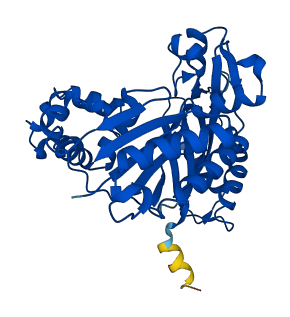
The autoinhibited protein was predicted that may have potential autoinhibitory elements via cis-regPred.
Autoinhibitory domains (AIDs)
Target domain |
|
Relief mechanism |
|
Assay |
cis-regPred |
Accessory elements
No accessory elements
Autoinhibited structure

Activated structure
32 structures for Q47155
| Entry ID | Method | Resolution | Chain | Position | Source |
|---|---|---|---|---|---|
| 1OK7 | X-ray | 165 A | C | 336-351 | PDB |
| 1UNN | X-ray | 190 A | C/D | 243-351 | PDB |
| 4IR1 | X-ray | 238 A | A/F | 2-351 | PDB |
| 4IR9 | X-ray | 233 A | A/F | 2-351 | PDB |
| 4IRC | X-ray | 267 A | A/F | 2-341 | PDB |
| 4IRD | X-ray | 248 A | A/F | 2-341 | PDB |
| 4IRK | X-ray | 232 A | A/B | 2-341 | PDB |
| 4Q43 | X-ray | 245 A | A/F | 2-351 | PDB |
| 4Q44 | X-ray | 271 A | A/F | 2-341 | PDB |
| 4Q45 | X-ray | 218 A | A/F | 2-341 | PDB |
| 4R8U | X-ray | 230 A | PDB | ||
| 5C5J | X-ray | 210 A | A/F | 2-351 | PDB |
| 5YUR | X-ray | 204 A | A/F | 2-351 | PDB |
| 5YUS | X-ray | 194 A | A/F | 2-351 | PDB |
| 5YUT | X-ray | 215 A | A/F | 2-351 | PDB |
| 5YUU | X-ray | 189 A | A/F | 2-351 | PDB |
| 5YUV | X-ray | 206 A | A/F | 2-351 | PDB |
| 5YUW | X-ray | 212 A | A/F | 2-351 | PDB |
| 5YUX | X-ray | 204 A | A/F | 2-351 | PDB |
| 5YUY | X-ray | 174 A | A/F | 2-351 | PDB |
| 5YUZ | X-ray | 183 A | A/F | 2-351 | PDB |
| 5YV0 | X-ray | 209 A | A/F | 2-351 | PDB |
| 5YV1 | X-ray | 209 A | A/F | 2-351 | PDB |
| 5YV2 | X-ray | 190 A | A/F | 2-351 | PDB |
| 5YV3 | X-ray | 203 A | A/F | 2-351 | PDB |
| 5YYD | X-ray | 205 A | A/F | 2-351 | PDB |
| 5YYE | X-ray | 233 A | A/F | 2-351 | PDB |
| 5ZLV | X-ray | 235 A | A/F | 2-351 | PDB |
| 6IG1 | X-ray | 197 A | A/F | 2-351 | PDB |
| 6JUP | X-ray | 244 A | A/F | 2-341 | PDB |
| 6JUQ | X-ray | 274 A | A/F | 2-341 | PDB |
| AF-Q47155-F1 | Predicted | AlphaFoldDB |
13 variants for Q47155
| Variant ID(s) | Position | Change | Description | Diseaes Association | Provenance |
|---|---|---|---|---|---|
| 36 | E>ARG | strain: ECOR 45B1 [UniProt] | No | ||
| 124 | Q>K | strain: ECOR 35D [UniProt] | No | ||
| 132 | N>S | strain: ECOR 34B1 and ECOR 37UG [UniProt] | No | ||
| 135 | Q>H | strain: ECOR 70B1 [UniProt] | No | ||
| 170 | P>S | strain: ECOR 37UG [UniProt] | No | ||
| 171 | A>T | strain: ECOR 45B1, ECOR 46D, ECOR 49D and ECOR 50D [UniProt] | No | ||
| 176 | L>F | strain: ECOR 37UG [UniProt] | No | ||
| 201 | G>S | strain: ECOR 59B2 [UniProt] | No | ||
| 210 | M>I | strain: ECOR 37UG, ECOR 45B1, ECOR 51B2, ECOR 52B2, ECOR 58B1 and ECOR 70B1 [UniProt] | No | ||
| 210 | M>T | strain: ECOR 35D, ECOR 46D, ECOR 49D, ECOR 50D, ECOR 57B2, ECOR 59B2, ECOR 60B2 and ECOR 62B2 [UniProt] | No | ||
| 225 | R>C | strain: ECOR 59B2 and ECOR 60B2 [UniProt] | No | ||
| 310 | A>S | strain: ECOR 57B2, ECOR 59B2, ECOR 60B2 and ECOR 62B2 [UniProt] | No | ||
| 321 | D>N | strain: ECOR 35D [UniProt] | No |
No associated diseases with Q47155
Functions
| Description | ||
|---|---|---|
| EC Number | 2.7.7.7 | Nucleotidyltransferases |
| Subcellular Localization |
|
|
| PANTHER Family | ||
| PANTHER Subfamily | ||
| PANTHER Protein Class | ||
| PANTHER Pathway Category | No pathway information available | |
1 GO annotations of cellular component
| Name | Definition |
|---|---|
| cytoplasm | The contents of a cell excluding the plasma membrane and nucleus, but including other subcellular structures. |
3 GO annotations of molecular function
| Name | Definition |
|---|---|
| damaged DNA binding | Binding to damaged DNA. |
| DNA-directed DNA polymerase activity | Catalysis of the reaction: deoxynucleoside triphosphate + DNA(n) = diphosphate + DNA(n+1); the synthesis of DNA from deoxyribonucleotide triphosphates in the presence of a DNA template and a 3'hydroxyl group. |
| magnesium ion binding | Binding to a magnesium (Mg) ion. |
6 GO annotations of biological process
| Name | Definition |
|---|---|
| cellular response to DNA damage stimulus | Any process that results in a change in state or activity of a cell (in terms of movement, secretion, enzyme production, gene expression, etc.) as a result of a stimulus indicating damage to its DNA from environmental insults or errors during metabolism. |
| DNA synthesis involved in DNA repair | Synthesis of DNA that proceeds from the broken 3' single-strand DNA end and uses the homologous intact duplex as the template. |
| DNA-templated DNA replication | A DNA replication process that uses parental DNA as a template for the DNA-dependent DNA polymerases that synthesize the new strands. |
| error-free translesion synthesis | The conversion of DNA-damage induced single-stranded gaps into large molecular weight DNA after replication by using a specialized DNA polymerase or replication complex to insert a defined nucleotide across the lesion. This process does not remove the replication-blocking lesions but does not causes an increase in the endogenous mutation level. For S. cerevisiae, RAD30 encodes DNA polymerase eta, which incorporates two adenines. When incorporated across a thymine-thymine dimer, it does not increase the endogenous mutation level. |
| error-prone translesion synthesis | The conversion of DNA-damage induced single-stranded gaps into large molecular weight DNA after replication by using a specialized DNA polymerase or replication complex to insert a defined nucleotide across the lesion. This process does not remove the replication-blocking lesions and causes an increase in the endogenous mutation level. For example, in E. coli, a low fidelity DNA polymerase, pol V, copies lesions that block replication fork progress. This produces mutations specifically targeted to DNA template damage sites, but it can also produce mutations at undamaged sites. |
| SOS response | An error-prone process for repairing damaged microbial DNA. |
1 homologous proteins in AiPD
| UniProt AC | Gene Name | Protein Name | Species | Evidence Code |
|---|---|---|---|---|
| Q9UBT6 | POLK | DNA polymerase kappa | Homo sapiens (Human) | PR |
| 10 | 20 | 30 | 40 | 50 | 60 |
| MRKIIHVDMD | CFFAAVEMRD | NPALRDIPIA | IGGSRERRGV | ISTANYPARK | FGVRSAMPTG |
| 70 | 80 | 90 | 100 | 110 | 120 |
| MALKLCPHLT | LLPGRFDAYK | EASNHIREIF | SRYTSRIEPL | SLDEAYLDVT | DSVHCHGSAT |
| 130 | 140 | 150 | 160 | 170 | 180 |
| LIAQEIRQTI | FNELQLTASA | GVAPVKFLAK | IASDMNKPNG | QFVITPAEVP | AFLQTLPLAK |
| 190 | 200 | 210 | 220 | 230 | 240 |
| IPGVGKVSAA | KLEAMGLRTC | GDVQKCDLVM | LLKRFGKFGR | ILWERSQGID | ERDVNSERLR |
| 250 | 260 | 270 | 280 | 290 | 300 |
| KSVGVERTMA | EDIHHWSECE | AIIERLYPEL | ERRLAKVKPD | LLIARQGVKL | KFDDFQQTTQ |
| 310 | 320 | 330 | 340 | 350 | |
| EHVWPRLNKA | DLIATARKTW | DERRGGRGVR | LVGLHVTLLD | PQMERQLVLG | L |