Q46D71
Gene name |
sepS |
Protein name |
O-phosphoserine--tRNA(Cys) ligase |
Names |
O-phosphoserine--tRNA ligase, Non-canonical O-phosphoseryl-tRNA(Cys) synthetase, O-phosphoseryl-tRNA(Cys) synthetase, SepRS |
Species |
Methanosarcina barkeri (strain Fusaro / DSM 804) |
KEGG Pathway |
mba:Mbar_A1204 |
EC number |
6.1.1.27: Ligases forming aminoacyl-tRNA and related compounds |
Protein Class |
|
Descriptions
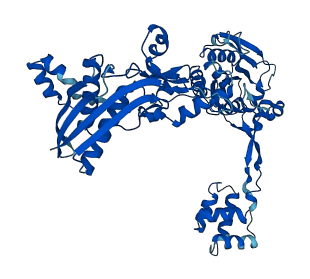
The autoinhibited protein was predicted that may have potential autoinhibitory elements via cis-regPred.
Autoinhibitory domains (AIDs)
Target domain |
|
Relief mechanism |
|
Assay |
cis-regPred |
Accessory elements
No accessory elements
Autoinhibited structure

Activated structure
1 structures for Q46D71
| Entry ID | Method | Resolution | Chain | Position | Source |
|---|---|---|---|---|---|
| AF-Q46D71-F1 | Predicted | AlphaFoldDB |
No variants for Q46D71
| Variant ID(s) | Position | Change | Description | Diseaes Association | Provenance |
|---|---|---|---|---|---|
| No variants for Q46D71 | |||||
No associated diseases with Q46D71
Functions
| Description | ||
|---|---|---|
| EC Number | 6.1.1.27 | Ligases forming aminoacyl-tRNA and related compounds |
| Subcellular Localization |
|
|
| PANTHER Family | ||
| PANTHER Subfamily | ||
| PANTHER Protein Class | ||
| PANTHER Pathway Category | No pathway information available | |
No GO annotations of cellular component
| Name | Definition |
|---|---|
| No GO annotations for cellular component |
3 GO annotations of molecular function
| Name | Definition |
|---|---|
| ATP binding | Binding to ATP, adenosine 5'-triphosphate, a universally important coenzyme and enzyme regulator. |
| phosphoserine-tRNA(Cys) ligase activity | Catalysis of the reaction: tRNA(Cys) + O-phospho-L-serine + ATP = AMP + diphosphate + phosphoseryl-tRNA(Cys). |
| tRNA binding | Binding to a transfer RNA. |
2 GO annotations of biological process
| Name | Definition |
|---|---|
| translation | The cellular metabolic process in which a protein is formed, using the sequence of a mature mRNA or circRNA molecule to specify the sequence of amino acids in a polypeptide chain. Translation is mediated by the ribosome, and begins with the formation of a ternary complex between aminoacylated initiator methionine tRNA, GTP, and initiation factor 2, which subsequently associates with the small subunit of the ribosome and an mRNA or circRNA. Translation ends with the release of a polypeptide chain from the ribosome. |
| tRNA aminoacylation | The chemical reactions and pathways by which the various amino acids become bonded to their corresponding tRNAs. The most common route for synthesis of aminoacyl tRNA is by the formation of an ester bond between the 3'-hydroxyl group of the most 3' adenosine of the tRNA and the alpha carboxylic acid group of an amino acid, usually catalyzed by the cognate aminoacyl-tRNA ligase. A given aminoacyl-tRNA ligase aminoacylates all species of an isoaccepting group of tRNA molecules. |
No homologous proteins in AiPD
| UniProt AC | Gene Name | Protein Name | Species | Evidence Code |
|---|---|---|---|---|
| No homologous proteins | ||||
| 10 | 20 | 30 | 40 | 50 | 60 |
| MKFDPEKIKR | DAKENFDLTW | NEGKKLVRTP | TLNERYPRTI | LKYGKAHPVY | DTIQKLREAY |
| 70 | 80 | 90 | 100 | 110 | 120 |
| LRMGFEEMMN | PLIVDDKEVH | KQFGSEALAV | LDRCFYLAGL | PRPNVGISDE | RTAEVKEILG |
| 130 | 140 | 150 | 160 | 170 | 180 |
| DIGNDGVEKI | RQVLHSYKKG | KIEGDDLVPE | ISTVLGVSDA | LVADMIDKVF | PEFKELVPQA |
| 190 | 200 | 210 | 220 | 230 | 240 |
| STKTLRSHMT | SGWFISLGAL | LERQEPPFHF | FSVDRCFRRE | QQEDASRLMT | YYSASCVIMD |
| 250 | 260 | 270 | 280 | 290 | 300 |
| EGVTVDHGKA | VSEGLLSQFG | FEKFLFRPDE | KRSKYYIPDT | QTEVFAFHPK | LVGSNSKYSD |
| 310 | 320 | 330 | 340 | 350 | 360 |
| GWIEIATFGI | YSPTALAQYD | IPCPVMNLGL | GVERLAMILH | DAPDIRSLTY | PQIPQYTEWE |
| 370 | 380 | 390 | 400 | 410 | 420 |
| MSDGELAKQV | FVDKVPETSE | GLAIAASIVS | QCELHGEEPS | PCEFPSWEGE | ICGRKVKVSV |
| 430 | 440 | 450 | 460 | 470 | 480 |
| IEPEENTKLC | GPAAFNEVVA | YQGDIMGIPN | TKKWQKAFEN | HSARAGIRFI | EAFAAQAARE |
| 490 | 500 | 510 | 520 | 530 | |
| IEEAALSGAT | EHIVRIRIAK | VPSEVNLRIG | SIAQRYVTGK | KKKIDMRGPV | FTSVKAEFV |