Q468I6
Gene name |
top6A |
Protein name |
Type 2 DNA topoisomerase 6 subunit A |
Names |
Type II DNA topoisomerase VI subunit A |
Species |
Methanosarcina barkeri (strain Fusaro / DSM 804) |
KEGG Pathway |
mba:Mbar_A2806 |
EC number |
5.6.2.2: Enzymes altering nucleic acid conformation |
Protein Class |
|
Descriptions
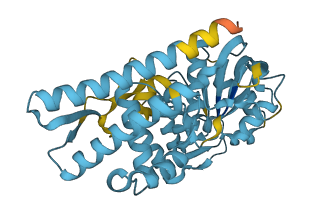
The autoinhibited protein was predicted that may have potential autoinhibitory elements via cis-regPred.
Autoinhibitory domains (AIDs)
Target domain |
|
Relief mechanism |
|
Assay |
cis-regPred |
Accessory elements
No accessory elements
Autoinhibited structure

Activated structure
1 structures for Q468I6
| Entry ID | Method | Resolution | Chain | Position | Source |
|---|---|---|---|---|---|
| AF-Q468I6-F1 | Predicted | AlphaFoldDB |
No variants for Q468I6
| Variant ID(s) | Position | Change | Description | Diseaes Association | Provenance |
|---|---|---|---|---|---|
| No variants for Q468I6 | |||||
No associated diseases with Q468I6
Functions
| Description | ||
|---|---|---|
| EC Number | 5.6.2.2 | Enzymes altering nucleic acid conformation |
| Subcellular Localization |
|
|
| PANTHER Family | ||
| PANTHER Subfamily | ||
| PANTHER Protein Class | ||
| PANTHER Pathway Category | No pathway information available | |
1 GO annotations of cellular component
| Name | Definition |
|---|---|
| chromosome | A structure composed of a very long molecule of DNA and associated proteins (e.g. histones) that carries hereditary information. |
4 GO annotations of molecular function
| Name | Definition |
|---|---|
| ATP binding | Binding to ATP, adenosine 5'-triphosphate, a universally important coenzyme and enzyme regulator. |
| DNA binding | Any molecular function by which a gene product interacts selectively and non-covalently with DNA (deoxyribonucleic acid). |
| DNA topoisomerase type II (double strand cut, ATP-hydrolyzing) activity | Catalysis of a DNA topological transformation by transiently cleaving a pair of complementary DNA strands to form a gate through which a second double-stranded DNA segment is passed, after which the severed strands in the first DNA segment are rejoined, driven by ATP hydrolysis. The enzyme changes the linking number in multiples of 2. |
| magnesium ion binding | Binding to a magnesium (Mg) ion. |
2 GO annotations of biological process
| Name | Definition |
|---|---|
| DNA topological change | The process in which a transformation is induced in the topological structure of a double-stranded DNA helix, resulting in a change in linking number. |
| DNA unwinding involved in DNA replication | The process in which interchain hydrogen bonds between two strands of DNA are broken or 'melted', generating unpaired template strands for DNA replication. |
No homologous proteins in AiPD
| UniProt AC | Gene Name | Protein Name | Species | Evidence Code |
|---|---|---|---|---|
| No homologous proteins | ||||
| 10 | 20 | 30 | 40 | 50 | 60 |
| MARKISNKKT | QRDLLAREKL | FELAEKIYNQ | FENEVVPSIS | LPSRTKSNLE | YSNESDVWVY |
| 70 | 80 | 90 | 100 | 110 | 120 |
| GGRESERSAK | TVKGAFQLLK | TTYATEFLIN | EHLAQSRGST | LRELYYISEG | WEAAKFKEQA |
| 130 | 140 | 150 | 160 | 170 | 180 |
| ESDRLIEDLE | LLTNLQREYF | HMRPEEDGAT | MFGPIEITEQ | TNRGERNIHC | QKDVGEGGYQ |
| 190 | 200 | 210 | 220 | 230 | 240 |
| IPFNVENIEF | KAHDASMIIA | IETGGMYARL | MENGFDEAYN | AILVHLKGQP | ARSTRRIIKR |
| 250 | 260 | 270 | 280 | 290 | 300 |
| MNEELGIPVA | VFTDGDPWSY | RIYASVAYGA | IKSAHLSEFM | ATPAAKFLGL | QPSDIVEYEL |
| 310 | 320 | 330 | 340 | 350 | 360 |
| STDKLTEQDI | NALRSELSDP | RFESDYWKEQ | IQLQLDIGKK | AEQQAFAGKG | LNFVTEVYLP |
| NRLKEMGML |