Q40541
Gene name |
NPK1 |
Protein name |
Mitogen-activated protein kinase kinase kinase NPK1 |
Names |
Nicotiana protein kinase 1 |
Species |
Nicotiana tabacum (Common tobacco) |
KEGG Pathway |
nta:107796336 |
EC number |
2.7.11.25: Protein-serine/threonine kinases |
Protein Class |
|
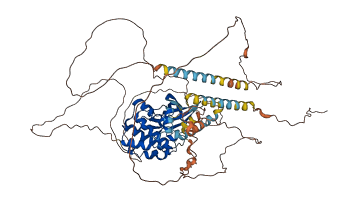
Descriptions
The autoinhibited protein was predicted that may have potential autoinhibitory elements via cis-regPred.
Autoinhibitory domains (AIDs)
Target domain |
|
Relief mechanism |
|
Assay |
cis-regPred |
Accessory elements
225-234 (Activation loop from InterPro)
Target domain |
80-342 (Protein kinase domain) |
Relief mechanism |
|
Assay |
|
245-250 (Activation loop from InterPro)
Target domain |
80-342 (Protein kinase domain) |
Relief mechanism |
|
Assay |
|
Autoinhibited structure

Activated structure
1 structures for Q40541
| Entry ID | Method | Resolution | Chain | Position | Source |
|---|---|---|---|---|---|
| AF-Q40541-F1 | Predicted | AlphaFoldDB |
No variants for Q40541
| Variant ID(s) | Position | Change | Description | Diseaes Association | Provenance |
|---|---|---|---|---|---|
| No variants for Q40541 | |||||
No associated diseases with Q40541
Functions
| Description | ||
|---|---|---|
| EC Number | 2.7.11.25 | Protein-serine/threonine kinases |
| Subcellular Localization |
|
|
| PANTHER Family | ||
| PANTHER Subfamily | ||
| PANTHER Protein Class | ||
| PANTHER Pathway Category | No pathway information available | |
3 GO annotations of cellular component
| Name | Definition |
|---|---|
| cytoskeleton | A cellular structure that forms the internal framework of eukaryotic and prokaryotic cells. The cytoskeleton includes intermediate filaments, microfilaments, microtubules, the microtrabecular lattice, and other structures characterized by a polymeric filamentous nature and long-range order within the cell. The various elements of the cytoskeleton not only serve in the maintenance of cellular shape but also have roles in other cellular functions, including cellular movement, cell division, endocytosis, and movement of organelles. |
| nucleus | A membrane-bounded organelle of eukaryotic cells in which chromosomes are housed and replicated. In most cells, the nucleus contains all of the cell's chromosomes except the organellar chromosomes, and is the site of RNA synthesis and processing. In some species, or in specialized cell types, RNA metabolism or DNA replication may be absent. |
| phragmoplast | Fibrous structure (light microscope view) that arises between the daughter nuclei at telophase and within which the initial partition (cell plate), dividing the mother cell in two (cytokinesis), is formed. Appears at first as a spindle connected to the two nuclei, but later spreads laterally in the form of a ring. Consists of microtubules. |
4 GO annotations of molecular function
| Name | Definition |
|---|---|
| ATP binding | Binding to ATP, adenosine 5'-triphosphate, a universally important coenzyme and enzyme regulator. |
| MAP kinase kinase kinase activity | Catalysis of the phosphorylation and activation of a MAP kinase kinase; each MAP kinase kinase can be phosphorylated by any of several MAP kinase kinase kinases. |
| protein kinase activity | Catalysis of the phosphorylation of an amino acid residue in a protein, usually according to the reaction: a protein + ATP = a phosphoprotein + ADP. |
| protein serine kinase activity | Catalysis of the reactions: ATP + protein serine = ADP + protein serine phosphate. |
4 GO annotations of biological process
| Name | Definition |
|---|---|
| cell plate assembly | The process of assembly, maturation, and growth of the cell plate to the cell periphery in cells that divide by cell plate formation; often involves deposition of cell wall material in and around the phragmoplast. |
| defense response | Reactions, triggered in response to the presence of a foreign body or the occurrence of an injury, which result in restriction of damage to the organism attacked or prevention/recovery from the infection caused by the attack. |
| protein phosphorylation | The process of introducing a phosphate group on to a protein. |
| signal transduction | The cellular process in which a signal is conveyed to trigger a change in the activity or state of a cell. Signal transduction begins with reception of a signal (e.g. a ligand binding to a receptor or receptor activation by a stimulus such as light), or for signal transduction in the absence of ligand, signal-withdrawal or the activity of a constitutively active receptor. Signal transduction ends with regulation of a downstream cellular process, e.g. regulation of transcription or regulation of a metabolic process. Signal transduction covers signaling from receptors located on the surface of the cell and signaling via molecules located within the cell. For signaling between cells, signal transduction is restricted to events at and within the receiving cell. |
No homologous proteins in AiPD
| UniProt AC | Gene Name | Protein Name | Species | Evidence Code |
|---|---|---|---|---|
| No homologous proteins | ||||
| 10 | 20 | 30 | 40 | 50 | 60 |
| MQDFIGSVRR | SLVFKQSGDF | DTGAAGVGSG | FGGFVEKLGS | SIRKSSIGIF | SKAHVPALPS |
| 70 | 80 | 90 | 100 | 110 | 120 |
| ISKAELPAKA | RKDDTPPIRW | RKGEMIGCGA | FGRVYMGMNV | DSGELLAIKE | VSIAMNGASR |
| 130 | 140 | 150 | 160 | 170 | 180 |
| ERAQAHVREL | EEEVNLLKNL | SHPNIVRYLG | TAREAGSLNI | LLEFVPGGSI | SSLLGKFGSF |
| 190 | 200 | 210 | 220 | 230 | 240 |
| PESVIRMYTK | QLLLGLEYLH | KNGIMHRDIK | GANILVDNKG | CIKLADFGAS | KKVVELATMT |
| 250 | 260 | 270 | 280 | 290 | 300 |
| GAKSMKGTPY | WMAPEVILQT | GHSFSADIWS | VGCTIIEMAT | GKPPWSQQYQ | EVAALFHIGT |
| 310 | 320 | 330 | 340 | 350 | 360 |
| TKSHPPIPEH | LSAESKDFLL | KCLQKEPHLR | HSASNLLQHP | FVTAEHQEAR | PFLRSSFMGN |
| 370 | 380 | 390 | 400 | 410 | 420 |
| PENMAAQRMD | VRTSIIPDMR | ASCNGLKDVC | GVSAVRCSTV | YPENSLGKES | LWKLGNSDDD |
| 430 | 440 | 450 | 460 | 470 | 480 |
| MCQMDNDDFM | FGASVKCSSD | LHSPANYKSF | NPMCEPDNDW | PCKFDESPEL | TKSQANLHYD |
| 490 | 500 | 510 | 520 | 530 | 540 |
| QATIKPTNNP | IMSYKEDLAF | TFPSGQSAAE | DDDELTESKI | RAFLDEKAMD | LKKLQTPLYE |
| 550 | 560 | 570 | 580 | 590 | 600 |
| GFYNSLNVSS | TPSPVGTGNK | ENVPSNINLP | PKSRSPKRML | SRRLSTAIEG | ACAPSPVTHS |
| 610 | 620 | 630 | 640 | 650 | 660 |
| KRISNIGGLN | GEAIQEAQLP | RHNEWKDLLG | SQREAVNSSF | SERQRRWKEE | LDEELQRKRE |
| 670 | 680 | ||||
| IMRQAVNLSP | PKDPILNRCR | SKSRFASPGR |