Q40466
Gene name |
|
Protein name |
Eukaryotic initiation factor 4A-13 |
Names |
eIF-4A-13, ATP-dependent RNA helicase eIF4A-13 |
Species |
Nicotiana tabacum (Common tobacco) |
KEGG Pathway |
|
EC number |
3.6.4.13: Acting on ATP; involved in cellular and subcellular movement |
Protein Class |
|
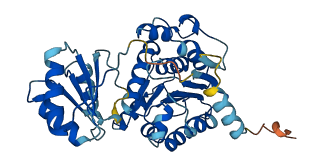
Descriptions
The autoinhibited protein was predicted that may have potential autoinhibitory elements via cis-regPred.
Autoinhibitory domains (AIDs)
Target domain |
|
Relief mechanism |
|
Assay |
cis-regPred |
Accessory elements
No accessory elements
Autoinhibited structure

Activated structure
1 structures for Q40466
| Entry ID | Method | Resolution | Chain | Position | Source |
|---|---|---|---|---|---|
| AF-Q40466-F1 | Predicted | AlphaFoldDB |
No variants for Q40466
| Variant ID(s) | Position | Change | Description | Diseaes Association | Provenance |
|---|---|---|---|---|---|
| No variants for Q40466 | |||||
No associated diseases with Q40466
4 regional properties for Q40466
| Type | Name | Position | InterPro Accession |
|---|---|---|---|
| domain | Signal recognition particle, SRP54 subunit, GTPase domain | 101 - 296 | IPR000897 |
| domain | AAA+ ATPase domain | 100 - 277 | IPR003593 |
| domain | Signal recognition particle, SRP54 subunit, M-domain | 326 - 431 | IPR004125 |
| domain | Signal recognition particle SRP54, helical bundle | 2 - 87 | IPR013822 |
Functions
| Description | ||
|---|---|---|
| EC Number | 3.6.4.13 | Acting on ATP; involved in cellular and subcellular movement |
| Subcellular Localization |
|
|
| PANTHER Family | ||
| PANTHER Subfamily | ||
| PANTHER Protein Class | ||
| PANTHER Pathway Category | No pathway information available | |
No GO annotations of cellular component
| Name | Definition |
|---|---|
| No GO annotations for cellular component |
5 GO annotations of molecular function
| Name | Definition |
|---|---|
| ATP binding | Binding to ATP, adenosine 5'-triphosphate, a universally important coenzyme and enzyme regulator. |
| ATP hydrolysis activity | Catalysis of the reaction: ATP + H2O = ADP + H+ phosphate. ATP hydrolysis is used in some reactions as an energy source, for example to catalyze a reaction or drive transport against a concentration gradient. |
| RNA binding | Binding to an RNA molecule or a portion thereof. |
| RNA helicase activity | Unwinding of an RNA helix, driven by ATP hydrolysis. |
| translation initiation factor activity | Functions in the initiation of ribosome-mediated translation of mRNA into a polypeptide. |
1 GO annotations of biological process
| Name | Definition |
|---|---|
| cytoplasmic translational initiation | The process preceding formation of the peptide bond between the first two amino acids of a protein in the cytoplasm. This includes the formation of a complex of the ribosome, mRNA or circRNA, and an initiation complex that contains the first aminoacyl-tRNA. |
No homologous proteins in AiPD
| UniProt AC | Gene Name | Protein Name | Species | Evidence Code |
|---|---|---|---|---|
| No homologous proteins | ||||
| 10 | 20 | 30 | 40 | 50 | 60 |
| MAGLAPEGSQ | FDARQYDAKM | TELLGTEQEE | FFTSYDEVYD | SFDAMGLQEN | LLRGIYAYGF |
| 70 | 80 | 90 | 100 | 110 | 120 |
| EKPSAIQQRG | IVPFCKGLDV | IQQAQSGTGK | TATFCSGVLQ | QLDYSLVECQ | ALVLAPTREL |
| 130 | 140 | 150 | 160 | 170 | 180 |
| AQQIEKVMRA | LGDYLGVKVH | ACVGGTSVRE | DQRILQSGVH | VVVGTPGRVF | DMLRRQSLRP |
| 190 | 200 | 210 | 220 | 230 | 240 |
| DHIKMFVLDE | ADEMLSRGFK | DQIYDIFQLL | PPKIQVGVFS | ATMPPEALEI | TRKFMNQPVR |
| 250 | 260 | 270 | 280 | 290 | 300 |
| ILVKRDDVTL | EGIKQFYVNV | DKEEWKLETL | CDLYETLAIT | QSVIFVNTRR | KVDWLTDKMR |
| 310 | 320 | 330 | 340 | 350 | |
| SRDHTVSATH | GDMDQNTRDI | IMREFRSGSS | RVLITTDLLA | RGIDVQQVSL | VINYD |