Q3ZZI5
Gene name |
aroA |
Protein name |
3-phosphoshikimate 1-carboxyvinyltransferase |
Names |
5-enolpyruvylshikimate-3-phosphate synthase, EPSP synthase, EPSPS |
Species |
Dehalococcoides mccartyi (strain CBDB1) |
KEGG Pathway |
deh:cbdbA427 |
EC number |
2.5.1.19: Transferring alkyl or aryl groups, other than methyl groups |
Protein Class |
|
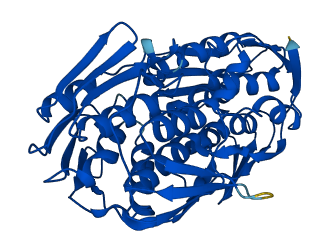
Descriptions
The autoinhibited protein was predicted that may have potential autoinhibitory elements via cis-regPred.
Autoinhibitory domains (AIDs)
Target domain |
|
Relief mechanism |
|
Assay |
cis-regPred |
Accessory elements
No accessory elements
Autoinhibited structure

Activated structure
1 structures for Q3ZZI5
| Entry ID | Method | Resolution | Chain | Position | Source |
|---|---|---|---|---|---|
| AF-Q3ZZI5-F1 | Predicted | AlphaFoldDB |
No variants for Q3ZZI5
| Variant ID(s) | Position | Change | Description | Diseaes Association | Provenance |
|---|---|---|---|---|---|
| No variants for Q3ZZI5 | |||||
No associated diseases with Q3ZZI5
Functions
| Description | ||
|---|---|---|
| EC Number | 2.5.1.19 | Transferring alkyl or aryl groups, other than methyl groups |
| Subcellular Localization |
|
|
| PANTHER Family | ||
| PANTHER Subfamily | ||
| PANTHER Protein Class | ||
| PANTHER Pathway Category | No pathway information available | |
1 GO annotations of cellular component
| Name | Definition |
|---|---|
| cytoplasm | The contents of a cell excluding the plasma membrane and nucleus, but including other subcellular structures. |
1 GO annotations of molecular function
| Name | Definition |
|---|---|
| 3-phosphoshikimate 1-carboxyvinyltransferase activity | Catalysis of the reaction: 3-phosphoshikimate + phosphoenolpyruvate = 5-O-(1-carboxyvinyl)-3-phosphoshikimate + phosphate. |
3 GO annotations of biological process
| Name | Definition |
|---|---|
| aromatic amino acid family biosynthetic process | The chemical reactions and pathways resulting in the formation of aromatic amino acid family, amino acids with aromatic ring (phenylalanine, tyrosine, tryptophan). |
| cellular amino acid biosynthetic process | The chemical reactions and pathways resulting in the formation of amino acids, organic acids containing one or more amino substituents. |
| chorismate biosynthetic process | The chemical reactions and pathways resulting in the formation of the unsymmetrical ether derived from phosphoenolpyruvate and 5-phosphoshikimic acid formed as an intermediate in the biosynthesis of aromatic amino acids and many other compounds. |
No homologous proteins in AiPD
| UniProt AC | Gene Name | Protein Name | Species | Evidence Code |
|---|---|---|---|---|
| No homologous proteins | ||||
| 10 | 20 | 30 | 40 | 50 | 60 |
| MKIHLDKSLP | GGNIAVPSSK | SYTIRGLIAA | AQANGQSHII | SPLIADDTLA | TRQVLSELGI |
| 70 | 80 | 90 | 100 | 110 | 120 |
| DISTDAGSES | WEITGNTFKA | PSGNLFCRES | AATLRFMSAV | CARLPFECHL | LAGHSLMRRP |
| 130 | 140 | 150 | 160 | 170 | 180 |
| MLPLIQALHQ | LGIEIETRGN | TTVINGQVIT | RSKVSLPGNI | SSQYVSALML | MAPACTHGLE |
| 190 | 200 | 210 | 220 | 230 | 240 |
| IHLATPPASL | PYLKMTKQTL | GSFGIKVHSS | IDWQEISIPP | QPYLPARYRV | EGDWSSASSF |
| 250 | 260 | 270 | 280 | 290 | 300 |
| LALGAIAAPV | FISNLDTDSF | QADRIMIKFL | AEMGAEIESG | QNWVKVNPKP | LSGINADLTH |
| 310 | 320 | 330 | 340 | 350 | 360 |
| SIDLLPALAV | AAACAKGQSI | LSGVRQARIK | ESNRIRAVSQ | GLSAMGINII | EEDDRLIIEG |
| 370 | 380 | 390 | 400 | 410 | |
| GQPKGAEIDS | FGDHRIAMAF | GILGSVVGET | HISDAECVTK | TYPDFWKNLE | SLGGKVTQDV |