Q3ZCL3
Gene name |
NMI |
Protein name |
N-myc-interactor |
Names |
Nmi, N-myc and STAT interactor |
Species |
Bos taurus (Bovine) |
KEGG Pathway |
bta:511280 |
EC number |
|
Protein Class |
|
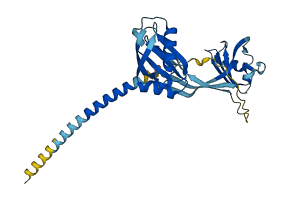
Descriptions
The autoinhibited protein was predicted that may have potential autoinhibitory elements via cis-regPred.
Autoinhibitory domains (AIDs)
Target domain |
|
Relief mechanism |
|
Assay |
cis-regPred |
Accessory elements
No accessory elements
Autoinhibited structure

Activated structure
1 structures for Q3ZCL3
| Entry ID | Method | Resolution | Chain | Position | Source |
|---|---|---|---|---|---|
| AF-Q3ZCL3-F1 | Predicted | AlphaFoldDB |
No variants for Q3ZCL3
| Variant ID(s) | Position | Change | Description | Diseaes Association | Provenance |
|---|---|---|---|---|---|
| No variants for Q3ZCL3 | |||||
No associated diseases with Q3ZCL3
3 regional properties for Q3ZCL3
| Type | Name | Position | InterPro Accession |
|---|---|---|---|
| domain | Nmi/IFP 35 domain | 106 - 193 | IPR009909-1 |
| domain | Nmi/IFP 35 domain | 204 - 293 | IPR009909-2 |
| domain | Nmi/IFP 35 domain, N-terminal | 30 - 105 | IPR009938 |
Functions
5 GO annotations of cellular component
| Name | Definition |
|---|---|
| cytoplasm | The contents of a cell excluding the plasma membrane and nucleus, but including other subcellular structures. |
| cytosol | The part of the cytoplasm that does not contain organelles but which does contain other particulate matter, such as protein complexes. |
| extracellular space | That part of a multicellular organism outside the cells proper, usually taken to be outside the plasma membranes, and occupied by fluid. |
| membrane | A lipid bilayer along with all the proteins and protein complexes embedded in it an attached to it. |
| nucleus | A membrane-bounded organelle of eukaryotic cells in which chromosomes are housed and replicated. In most cells, the nucleus contains all of the cell's chromosomes except the organellar chromosomes, and is the site of RNA synthesis and processing. In some species, or in specialized cell types, RNA metabolism or DNA replication may be absent. |
1 GO annotations of molecular function
| Name | Definition |
|---|---|
| transcription coregulator activity | A transcription regulator activity that modulates the transcription of specific gene sets via binding to a DNA-bound DNA-binding transcription factor, either on its own or as part of a complex. Coregulators often act by altering chromatin structure and modifications. For example, one class of transcription coregulators modifies chromatin structure through covalent modification of histones. A second class remodels the conformation of chromatin in an ATP-dependent fashion. A third class modulates interactions of DNA-bound DNA-binding transcription factors with other transcription coregulators. |
10 GO annotations of biological process
| Name | Definition |
|---|---|
| interferon-gamma-mediated signaling pathway | The series of molecular signals initiated by interferon-gamma binding to its receptor on the surface of a target cell, and ending with the regulation of a downstream cellular process, e.g. transcription. Interferon gamma is the only member of the type II interferon found so far. |
| macrophage activation involved in immune response | A change in morphology and behavior of a macrophage resulting from exposure to a cytokine, chemokine, cellular ligand, or soluble factor, leading to the initiation or perpetuation of an immune response. |
| negative regulation of cell population proliferation | Any process that stops, prevents or reduces the rate or extent of cell proliferation. |
| negative regulation of innate immune response | Any process that stops, prevents, or reduces the frequency, rate or extent of the innate immune response. |
| negative regulation of NIK/NF-kappaB signaling | Any process that stops, prevents or reduces the frequency, rate or extent of NIK/NF-kappaB signaling. |
| positive regulation of inflammatory response | Any process that activates or increases the frequency, rate or extent of the inflammatory response. |
| positive regulation of innate immune response | Any process that activates or increases the frequency, rate or extent of the innate immune response, the organism's first line of defense against infection. |
| positive regulation of NIK/NF-kappaB signaling | Any process that activates or increases the frequency, rate or extent of NIK/NF-kappaB signaling. |
| toll-like receptor 4 signaling pathway | The series of molecular signals initiated by a ligand binding to toll-like receptor 4. |
| transcription by RNA polymerase II | The synthesis of RNA from a DNA template by RNA polymerase II (RNAP II), originating at an RNA polymerase II promoter. Includes transcription of messenger RNA (mRNA) and certain small nuclear RNAs (snRNAs). |
1 homologous proteins in AiPD
| UniProt AC | Gene Name | Protein Name | Species | Evidence Code |
|---|---|---|---|---|
| O35309 | Nmi | N-myc-interactor | Mus musculus (Mouse) | PR |
| 10 | 20 | 30 | 40 | 50 | 60 |
| MSADEDNKEQ | VLKECEQAEE | IMKDKQNQKL | ISEITKENIQ | LKEEIKKLEA | ELQETTRTSQ |
| 70 | 80 | 90 | 100 | 110 | 120 |
| INEDIPETKI | KFTSVENPES | DSEFSDISYS | CQVSSKVPYE | LQKGQALITF | EKEEVAQNVI |
| 130 | 140 | 150 | 160 | 170 | 180 |
| RMEYHHVQVQ | NENVMLTANP | VSLNSGVKFQ | VHVGVSKMKI | NVTDIPDELP | ESQMRDKLEL |
| 190 | 200 | 210 | 220 | 230 | 240 |
| SFSKSRNGGG | EVEYVEYNKQ | TRSALITFVE | SGVADKILKM | KDYPLYINQN | CHRVTVYPYT |
| 250 | 260 | 270 | 280 | 290 | 300 |
| ETHLKKFQVF | SGVSKRTVLL | TGLKHLQTTD | EEVVEDFISI | HFQREKNGGG | EVEVVKCSLG |
| QPHTAYFEE |