Q3YYM5
Gene name |
grpE |
Protein name |
Protein GrpE |
Names |
HSP-70 cofactor |
Species |
Shigella sonnei (strain Ss046) |
KEGG Pathway |
ssn:SSON_2770 |
EC number |
|
Protein Class |
|
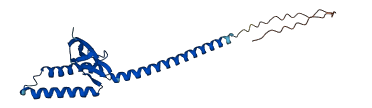
Descriptions
The autoinhibited protein was predicted that may have potential autoinhibitory elements via cis-regPred.
Autoinhibitory domains (AIDs)
Target domain |
|
Relief mechanism |
|
Assay |
cis-regPred |
Accessory elements
No accessory elements
Autoinhibited structure

Activated structure
1 structures for Q3YYM5
| Entry ID | Method | Resolution | Chain | Position | Source |
|---|---|---|---|---|---|
| AF-Q3YYM5-F1 | Predicted | AlphaFoldDB |
No variants for Q3YYM5
| Variant ID(s) | Position | Change | Description | Diseaes Association | Provenance |
|---|---|---|---|---|---|
| No variants for Q3YYM5 | |||||
2 associated diseases with Q3YYM5
[MIM: 113000]: Brachydactyly B1 (BDB1)
A form of brachydactyly. Brachydactyly defines a group of inherited malformations characterized by shortening of the digits due to abnormal development of the phalanges and/or the metacarpals. In brachydactyly type B1 the middle phalanges are short but in addition the terminal phalanges are rudimentary or absent. Both fingers and toes are affected. The thumbs and big toes are usually deformed. Symphalangism is also a feature. Note=The disease is caused by variants affecting the gene represented in this entry.
[MIM: 268310]: Robinow syndrome, autosomal recessive 1 (RRS1)
A recessive form of Robinow syndrome, a disease characterized by short-limb dwarfism, costovertebral segmentation defects and abnormalities of the head, face and external genitalia. The clinical signs are generally far more severe in recessive cases, particularly skeletal abnormalities. All patients with the recessive form suffer from vertebral segmentation abnormalities, resulting in scoliosis and chest deformities. Rib fusions are considered to be characteristic of the autosomal recessive form. Patients can also present brachydactyly, with extensive aplasia/hypoplasia of the phalanges and metacarpals/metatarsals, and brachy-syn-polydactyly of the hands and oligodactyly of the feet. {ECO:0000269|PubMed:10932186, ECO:0000269|PubMed:10932187}. Note=The disease is caused by variants affecting the gene represented in this entry.
Without disease ID
- A form of brachydactyly. Brachydactyly defines a group of inherited malformations characterized by shortening of the digits due to abnormal development of the phalanges and/or the metacarpals. In brachydactyly type B1 the middle phalanges are short but in addition the terminal phalanges are rudimentary or absent. Both fingers and toes are affected. The thumbs and big toes are usually deformed. Symphalangism is also a feature. Note=The disease is caused by variants affecting the gene represented in this entry.
- A recessive form of Robinow syndrome, a disease characterized by short-limb dwarfism, costovertebral segmentation defects and abnormalities of the head, face and external genitalia. The clinical signs are generally far more severe in recessive cases, particularly skeletal abnormalities. All patients with the recessive form suffer from vertebral segmentation abnormalities, resulting in scoliosis and chest deformities. Rib fusions are considered to be characteristic of the autosomal recessive form. Patients can also present brachydactyly, with extensive aplasia/hypoplasia of the phalanges and metacarpals/metatarsals, and brachy-syn-polydactyly of the hands and oligodactyly of the feet. {ECO:0000269|PubMed:10932186, ECO:0000269|PubMed:10932187}. Note=The disease is caused by variants affecting the gene represented in this entry.
1 GO annotations of cellular component
| Name | Definition |
|---|---|
| cytoplasm | The contents of a cell excluding the plasma membrane and nucleus, but including other subcellular structures. |
3 GO annotations of molecular function
| Name | Definition |
|---|---|
| adenyl-nucleotide exchange factor activity | Binds to and stimulates the hydrolysis and exchange of adenyl nucleotides by other proteins. |
| chaperone binding | Binding to a chaperone protein, a class of proteins that bind to nascent or unfolded polypeptides and ensure correct folding or transport. |
| protein homodimerization activity | Binding to an identical protein to form a homodimer. |
1 GO annotations of biological process
| Name | Definition |
|---|---|
| protein folding | The process of assisting in the covalent and noncovalent assembly of single chain polypeptides or multisubunit complexes into the correct tertiary structure. |
No homologous proteins in AiPD
| UniProt AC | Gene Name | Protein Name | Species | Evidence Code |
|---|---|---|---|---|
| No homologous proteins | ||||
| 10 | 20 | 30 | 40 | 50 | 60 |
| MSSKEQKTPE | GQAPEEIIMD | QHEEIEAVEP | EASAEQVDPR | DEKIANLEAQ | LAEAQTRERD |
| 70 | 80 | 90 | 100 | 110 | 120 |
| GILRVKAEME | NLRRRTELDI | EKAHKFALEK | FINELLPVID | SLDRALEVAD | KANPDMSAMV |
| 130 | 140 | 150 | 160 | 170 | 180 |
| EGIELTLKSM | LDVVRKFGVE | VIAETNVPLD | PNVHQAIAMV | ESDDVAPGNV | LGIMQKGYTL |
| 190 | |||||
| NGRTIRAAMV | TVAKAKA |