Q3UUQ7
Gene name |
Pgap1 |
Protein name |
GPI inositol-deacylase |
Names |
Post-GPI attachment to proteins factor 1 |
Species |
Mus musculus (Mouse) |
KEGG Pathway |
mmu:241062 |
EC number |
|
Protein Class |
|
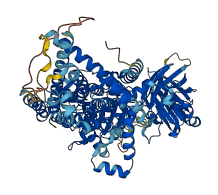
Descriptions
The autoinhibited protein was predicted that may have potential autoinhibitory elements via cis-regPred.
Autoinhibitory domains (AIDs)
Target domain |
|
Relief mechanism |
|
Assay |
cis-regPred |
Accessory elements
No accessory elements
Autoinhibited structure

Activated structure
1 structures for Q3UUQ7
| Entry ID | Method | Resolution | Chain | Position | Source |
|---|---|---|---|---|---|
| AF-Q3UUQ7-F1 | Predicted | AlphaFoldDB |
30 variants for Q3UUQ7
| Variant ID(s) | Position | Change | Description | Diseaes Association | Provenance |
|---|---|---|---|---|---|
| rs3388469552 | 264 | S>N | No | EVA | |
| rs3389992771 | 320 | V>A | No | EVA | |
| rs1131722276 | 325 | F>I | No | EVA | |
| rs1135120980 | 334 | E>G | No | EVA | |
| rs1132861259 | 335 | E>D | No | EVA | |
| rs1132540228 | 337 | P>A | No | EVA | |
| rs1133997458 | 338 | S>F | No | EVA | |
| rs3388470969 | 381 | Y>N | No | EVA | |
| rs3388470011 | 388 | S>C | No | EVA | |
| rs3388471364 | 431 | Q>R | No | EVA | |
| rs3388471295 | 477 | L>V | No | EVA | |
| rs3388470406 | 486 | T>I | No | EVA | |
| rs3388471054 | 487 | N>H | No | EVA | |
| rs3388471944 | 494 | E>A | No | EVA | |
| rs3412117813 | 526 | L>V | No | EVA | |
| rs3388469946 | 564 | L>M | No | EVA | |
| rs3388471296 | 588 | G>V | No | EVA | |
| rs3388469263 | 591 | V>S | No | EVA | |
| rs3388471934 | 612 | G>* | No | EVA | |
| rs3388469302 | 648 | F>Y | No | EVA | |
| rs260443830 | 703 | T>I | No | EVA | |
| rs3388470091 | 714 | A>T | No | EVA | |
| rs240916363 | 782 | K>R | No | EVA | |
| rs3390002332 | 791 | S>F | No | EVA | |
| rs3388469903 | 796 | D>V | No | EVA | |
| rs3388471096 | 812 | S>N | No | EVA | |
| rs3390001205 | 815 | M>C | No | EVA | |
| rs3388469560 | 819 | V>A | No | EVA | |
| rs1133665477 | 873 | S>P | No | EVA | |
| rs1133154019 | 886 | F>I | No | EVA |
No associated diseases with Q3UUQ7
No regional properties for Q3UUQ7
| Type | Name | Position | InterPro Accession |
|---|---|---|---|
| No domain, repeats, and functional sites for Q3UUQ7 | |||
3 GO annotations of cellular component
| Name | Definition |
|---|---|
| endoplasmic reticulum | The irregular network of unit membranes, visible only by electron microscopy, that occurs in the cytoplasm of many eukaryotic cells. The membranes form a complex meshwork of tubular channels, which are often expanded into slitlike cavities called cisternae. The ER takes two forms, rough (or granular), with ribosomes adhering to the outer surface, and smooth (with no ribosomes attached). |
| endoplasmic reticulum membrane | The lipid bilayer surrounding the endoplasmic reticulum. |
| integral component of membrane | The component of a membrane consisting of the gene products and protein complexes having at least some part of their peptide sequence embedded in the hydrophobic region of the membrane. |
1 GO annotations of molecular function
| Name | Definition |
|---|---|
| phosphatidylinositol deacylase activity | Catalysis of the reaction: 1-phosphatidyl-1D-myo-inositol + H(2)O = 1-acyl-sn-glycero-3-phospho-D-myo-inositol + a carboxylate + H(+). |
10 GO annotations of biological process
| Name | Definition |
|---|---|
| anterior/posterior axis specification | The establishment, maintenance and elaboration of the anterior/posterior axis. The anterior-posterior axis is defined by a line that runs from the head or mouth of an organism to the tail or opposite end of the organism. |
| embryonic pattern specification | The process that results in the patterns of cell differentiation that will arise in an embryo. |
| endoplasmic reticulum to Golgi vesicle-mediated transport | The directed movement of substances from the endoplasmic reticulum (ER) to the Golgi, mediated by COP II vesicles. Small COP II coated vesicles form from the ER and then fuse directly with the cis-Golgi. Larger structures are transported along microtubules to the cis-Golgi. |
| forebrain regionalization | The regionalization process resulting in the creation of areas within the forebrain that will direct the behavior of cell migration in differentiation as the forebrain develops. |
| GPI anchor biosynthetic process | The chemical reactions and pathways resulting in the formation of a glycosylphosphatidylinositol (GPI) anchor that attaches some membrane proteins to the lipid bilayer of the cell membrane. The phosphatidylinositol group is linked via the C-6 hydroxyl residue of inositol to a carbohydrate chain which is itself linked to the protein via an ethanolamine phosphate group, its amino group forming an amide linkage with the C-terminal carboxyl of the protein. Some GPI anchors have variants on this canonical linkage. |
| GPI anchor metabolic process | The chemical reactions and pathways involving glycosylphosphatidylinositol anchors, molecular mechanisms for attaching membrane proteins to the lipid bilayer of cell membranes. Structurally they consist of a molecule of phosphatidylinositol to which is linked, via the C-6 hydroxyl of the inositol, a carbohydrate chain. This chain is in turn linked to the protein through an ethanolamine phosphate group, the amino group of which is in amide linkage with the C-terminal carboxyl of the protein chain, the phosphate group being esterified to the C-6 hydroxyl of the terminal mannose of the core carbohydrate chain. |
| head development | The biological process whose specific outcome is the progression of a head from an initial condition to its mature state. The head is the anterior-most division of the body. |
| positive regulation of ER to Golgi vesicle-mediated transport | Any process that activates or increases the frequency, rate or extent of ER to Golgi vesicle-mediated transport. |
| protein transport | The directed movement of proteins into, out of or within a cell, or between cells, by means of some agent such as a transporter or pore. |
| sensory perception of sound | The series of events required for an organism to receive an auditory stimulus, convert it to a molecular signal, and recognize and characterize the signal. Sonic stimuli are detected in the form of vibrations and are processed to form a sound. |
| 10 | 20 | 30 | 40 | 50 | 60 |
| MFLHSVNLWN | LAFYVFMVFL | ATLGLWDVFF | GFEENKCSMS | YMFEYPEYQK | IELPKKLTKR |
| 70 | 80 | 90 | 100 | 110 | 120 |
| YPAYELYLYG | EGSYAEEHKI | LPLTGIPVLF | LPGNAGSYKQ | VRSIGSIALR | KAEDIDFKYH |
| 130 | 140 | 150 | 160 | 170 | 180 |
| FDFFSVNFNE | ELVALYGGSL | QKQTKFVHEC | IKAILKLYKG | QEFAPTSVAI | IGHSMGGLVA |
| 190 | 200 | 210 | 220 | 230 | 240 |
| RALLTLKNFK | QDLINLLVTQ | ATPHVAPVMP | LDRFITEFYM | NVNNYWILNA | RHINLTTLSV |
| 250 | 260 | 270 | 280 | 290 | 300 |
| AGGFRDYQVR | SGLTFLPKLS | HYTSALSVVS | SAVPKTWVST | DHLSIVWCKQ | LQLTTIRAFF |
| 310 | 320 | 330 | 340 | 350 | 360 |
| DLIDADTKQI | TQKPKKKLSV | LNHHFIRHPA | KQFEENPSII | SDLTGTSMWV | PVKVSRWSYV |
| 370 | 380 | 390 | 400 | 410 | 420 |
| AYNESDKIYF | AFPLANHRKI | YTHAYCQSTM | LDTNSWIFGC | INSTSMCRQG | VDLSWKAELL |
| 430 | 440 | 450 | 460 | 470 | 480 |
| PTIKSLTLRL | QDYPSLSHIV | VYVPSVHGSK | FVVDCEFFKK | EARSMQLPVT | HLFSFGLSSR |
| 490 | 500 | 510 | 520 | 530 | 540 |
| KVTLNTNGLY | YNIELLNFGQ | IYQAFKVNVV | SKCTGSKEEI | TSIYKLHIPW | SYEDSLTIAQ |
| 550 | 560 | 570 | 580 | 590 | 600 |
| VPSSTDISLK | LHVAQPENDS | HVALLKMYTS | SDCQYEVTIK | TSFPQILGQV | VRFHGGALPA |
| 610 | 620 | 630 | 640 | 650 | 660 |
| YVVSSILLAY | GGQLYSLLST | GYCLEYSTIL | DKEAKPYKVD | PFVIMIKFLL | GYKWFKELWD |
| 670 | 680 | 690 | 700 | 710 | 720 |
| AVLLPELDAI | VLTSQSMCFP | LVSLILFLFG | TCTAYWSGLL | SSTSVQLLSS | LWLALKRPAE |
| 730 | 740 | 750 | 760 | 770 | 780 |
| LPKDIKVMSP | DLPVLTVVFL | IVSWTTCGAL | AILLSYLYYV | FKVVHLQASL | TTFKNNQPVN |
| 790 | 800 | 810 | 820 | 830 | 840 |
| PKHSRRSEKK | SNHHKDSAVQ | SLRLCANDAE | DSLRMHSTVI | NLLTWVVLLS | MPSLIYWLKN |
| 850 | 860 | 870 | 880 | 890 | 900 |
| LRYYFKLSPD | PCKPLAFLLI | PAIAILGNTH | TVSVKSSKLL | KTVSQFPLPL | AVGVIAFGSS |
| 910 | 920 | ||||
| HLYRVPCFVI | IPLVFHALCN | FM |