Q3UJP5
Gene name |
Cfap418 |
Protein name |
Cilia- and flagella-associated protein 418 |
Names |
|
Species |
Mus musculus (Mouse) |
KEGG Pathway |
mmu:67157 |
EC number |
|
Protein Class |
|
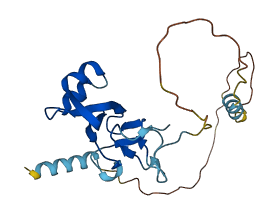
Descriptions
The autoinhibited protein was predicted that may have potential autoinhibitory elements via cis-regPred.
Autoinhibitory domains (AIDs)
Target domain |
|
Relief mechanism |
|
Assay |
cis-regPred |
Accessory elements
No accessory elements
Autoinhibited structure

Activated structure
1 structures for Q3UJP5
| Entry ID | Method | Resolution | Chain | Position | Source |
|---|---|---|---|---|---|
| AF-Q3UJP5-F1 | Predicted | AlphaFoldDB |
10 variants for Q3UJP5
| Variant ID(s) | Position | Change | Description | Diseaes Association | Provenance |
|---|---|---|---|---|---|
| rs234988921 | 33 | D>G | No | EVA | |
| rs252900390 | 47 | Q>R | No | EVA | |
| rs3388670172 | 62 | D>E | No | EVA | |
| rs3388676638 | 67 | L>R | No | EVA | |
| rs260386497 | 85 | F>S | No | EVA | |
| rs3388661930 | 123 | N>S | No | EVA | |
| rs3388672960 | 157 | F>L | No | EVA | |
| rs3388667730 | 180 | A>E | No | EVA | |
| rs3388671928 | 187 | W>L | No | EVA | |
| rs3388659166 | 207 | G>S | No | EVA |
No associated diseases with Q3UJP5
No regional properties for Q3UJP5
| Type | Name | Position | InterPro Accession |
|---|---|---|---|
| No domain, repeats, and functional sites for Q3UJP5 | |||
Functions
6 GO annotations of cellular component
| Name | Definition |
|---|---|
| cell junction | A cellular component that forms a specialized region of connection between two or more cells, or between a cell and the extracellular matrix, or between two membrane-bound components of a cell, such as flagella. |
| ciliary base | Area of the cilium (also called flagellum) where the basal body and the axoneme are anchored to the plasma membrane. The ciliary base encompasses the distal part of the basal body, transition fibers and transition zone and is structurally and functionally very distinct from the rest of the cilium. In this area proteins are sorted and filtered before entering the cilium, and many ciliary proteins localize specifically to this area. |
| cytoplasm | The contents of a cell excluding the plasma membrane and nucleus, but including other subcellular structures. |
| cytosol | The part of the cytoplasm that does not contain organelles but which does contain other particulate matter, such as protein complexes. |
| photoreceptor inner segment | The inner segment of a vertebrate photoreceptor containing mitochondria, ribosomes and membranes where opsin molecules are assembled and passed to be part of the outer segment discs. |
| plasma membrane | The membrane surrounding a cell that separates the cell from its external environment. It consists of a phospholipid bilayer and associated proteins. |
No GO annotations of molecular function
| Name | Definition |
|---|---|
| No GO annotations for molecular function |
1 GO annotations of biological process
| Name | Definition |
|---|---|
| photoreceptor cell morphogenesis | The process in which the structures of a photoreceptor cell are generated and organized. This process occurs while the initially relatively unspecialized cell is acquiring the specialized features of a photoreceptor cell, a sensory cell that reacts to the presence of light. An example of this is found in Drosophila melanogaster. |
No homologous proteins in AiPD
| UniProt AC | Gene Name | Protein Name | Species | Evidence Code |
|---|---|---|---|---|
| No homologous proteins | ||||
| 10 | 20 | 30 | 40 | 50 | 60 |
| MAKDLDELLD | EVETKFCRLD | PLRLDLGERP | KGDGGGGSHS | GDRNGAQEKE | TLRSTETFKK |
| 70 | 80 | 90 | 100 | 110 | 120 |
| EDDLDSLINE | IFEEPDFDRK | SFQKFKSKSS | SNTCVRAPMQ | GVSKSCSPVY | LSGSAIPCGI |
| 130 | 140 | 150 | 160 | 170 | 180 |
| GTNTSQRACD | RLRCVACDFR | IVSYNDYMWD | KSCDYLFFRN | NMPEFHKLKT | KLIEKKGARA |
| 190 | 200 | ||||
| YACQCSWRTV | EELTDLQTDH | QLRWVCGKH |