Q3TQF0
Gene name |
Fbxo31 (MNCb-2609) |
Protein name |
F-box only protein 31 |
Names |
|
Species |
Mus musculus (Mouse) |
KEGG Pathway |
mmu:76454 |
EC number |
|
Protein Class |
|
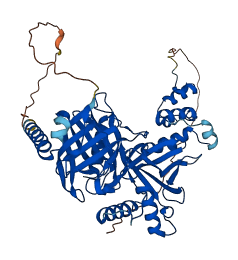
Descriptions
The autoinhibited protein was predicted that may have potential autoinhibitory elements via cis-regPred.
Autoinhibitory domains (AIDs)
Target domain |
|
Relief mechanism |
|
Assay |
cis-regPred |
Accessory elements
No accessory elements
Autoinhibited structure

Activated structure
1 structures for Q3TQF0
| Entry ID | Method | Resolution | Chain | Position | Source |
|---|---|---|---|---|---|
| AF-Q3TQF0-F1 | Predicted | AlphaFoldDB |
23 variants for Q3TQF0
| Variant ID(s) | Position | Change | Description | Diseaes Association | Provenance |
|---|---|---|---|---|---|
| rs1132604954 | 7 | L>F | No | EVA | |
| rs3389014930 | 122 | A>V | No | EVA | |
| rs3389014922 | 156 | I>V | No | EVA | |
| rs3399191516 | 167 | H>R | No | EVA | |
| rs3412852829 | 168 | V>M | No | EVA | |
| rs3399400244 | 170 | D>V | No | EVA | |
| rs3389017506 | 180 | I>N | No | EVA | |
| rs3388984845 | 245 | E>* | No | EVA | |
| rs3389021137 | 254 | E>G | No | EVA | |
| rs3389004209 | 256 | I>F | No | EVA | |
| rs3389014686 | 277 | L>V | No | EVA | |
| rs3388984881 | 287 | K>N | No | EVA | |
| rs3399775165 | 317 | I>S | No | EVA | |
| rs13466514 | 331 | E>D | No | EVA | |
| rs3388984832 | 337 | R>H | No | EVA | |
| rs3398773673 | 361 | E>Q | No | EVA | |
| rs3399677301 | 362 | Q>L | No | EVA | |
| rs258556645 | 373 | A>P | No | EVA | |
| rs266250957 | 377 | R>L | No | EVA | |
| rs247949649 | 384 | A>P | No | EVA | |
| rs3389023662 | 397 | G>D | No | EVA | |
| rs3389017555 | 464 | F>V | No | EVA | |
| rs3399695080 | 488 | A>V | No | EVA |
No associated diseases with Q3TQF0
1 regional properties for Q3TQF0
| Type | Name | Position | InterPro Accession |
|---|---|---|---|
| domain | F-box domain | 50 - 98 | IPR001810 |
3 GO annotations of cellular component
| Name | Definition |
|---|---|
| centrosome | A structure comprised of a core structure (in most organisms, a pair of centrioles) and peripheral material from which a microtubule-based structure, such as a spindle apparatus, is organized. Centrosomes occur close to the nucleus during interphase in many eukaryotic cells, though in animal cells it changes continually during the cell-division cycle. |
| neuronal cell body | The portion of a neuron that includes the nucleus, but excludes cell projections such as axons and dendrites. |
| SCF ubiquitin ligase complex | A ubiquitin ligase complex in which a cullin from the Cul1 subfamily and a RING domain protein form the catalytic core; substrate specificity is conferred by a Skp1 adaptor and an F-box protein. SCF complexes are involved in targeting proteins for degradation by the proteasome. The best characterized complexes are those from yeast and mammals (with core subunits named Cdc53/Cul1, Rbx1/Hrt1/Roc1). |
1 GO annotations of molecular function
| Name | Definition |
|---|---|
| cyclin binding | Binding to cyclins, proteins whose levels in a cell varies markedly during the cell cycle, rising steadily until mitosis, then falling abruptly to zero. As cyclins reach a threshold level, they are thought to drive cells into G2 phase and thus to mitosis. |
7 GO annotations of biological process
| Name | Definition |
|---|---|
| anaphase-promoting complex-dependent catabolic process | The chemical reactions and pathways resulting in the breakdown of a protein or peptide by hydrolysis of its peptide bonds, initiated by the covalent attachment of ubiquitin, with ubiquitin-protein ligation catalyzed by the anaphase-promoting complex, and mediated by the proteasome. |
| cellular response to DNA damage stimulus | Any process that results in a change in state or activity of a cell (in terms of movement, secretion, enzyme production, gene expression, etc.) as a result of a stimulus indicating damage to its DNA from environmental insults or errors during metabolism. |
| mitotic G1 DNA damage checkpoint signaling | A signal transduction process that contributes to a mitotic cell cycle G1/S transition DNA damage checkpoint. |
| positive regulation of dendrite morphogenesis | Any process that activates or increases the frequency, rate or extent of dendrite morphogenesis. |
| positive regulation of neuron migration | Any process that activates or increases the frequency, rate or extent of neuron migration. |
| protein ubiquitination | The process in which one or more ubiquitin groups are added to a protein. |
| SCF-dependent proteasomal ubiquitin-dependent protein catabolic process | The chemical reactions and pathways resulting in the breakdown of a protein or peptide by hydrolysis of its peptide bonds, initiated by the covalent attachment of ubiquitin, with ubiquitin-protein ligation catalyzed by an SCF (Skp1/Cul1/F-box protein) complex, and mediated by the proteasome. |
| 10 | 20 | 30 | 40 | 50 | 60 |
| MAVCARLCGV | GPARGCRRRQ | QRRGPAETAA | ADSEADTDPE | EERIEAGPAR | CSLLELPPEL |
| 70 | 80 | 90 | 100 | 110 | 120 |
| LVEIFASLPG | TDLPSLAQVC | SRFRRILHTD | TIWRRRCREE | YGVCENLRKL | EITGVSCRDV |
| 130 | 140 | 150 | 160 | 170 | 180 |
| YAKLLHRYRH | ILGLWQPDIG | PYGGLLNVVV | DGLFIIGWMY | LPPHDPHVGD | PMRFKPLFRI |
| 190 | 200 | 210 | 220 | 230 | 240 |
| HLMERKSATV | ECMYGHKGPH | NGHIQIVKRD | EFSTKCNQTD | HHRMSGGRQE | EFRTWLREEW |
| 250 | 260 | 270 | 280 | 290 | 300 |
| GRTLEDIFHE | HMQELILMKF | IYTSQYDNCL | TYRRIYLPPS | HPDDLIKPGL | FKGTYGSHGL |
| 310 | 320 | 330 | 340 | 350 | 360 |
| EIVMLSFHGS | RARGTKITGD | PNIPAGQQTV | EIDLQRRIQL | PDVENLRNFN | ELSRIVLEVR |
| 370 | 380 | 390 | 400 | 410 | 420 |
| EQVRQEQEAG | EGAAPPREPS | AKAADGPPAK | DGKEPGGGAE | AAEQSASSGQ | GQPFVLPVGV |
| 430 | 440 | 450 | 460 | 470 | 480 |
| SSRNEDYPRT | CRLCFYGTGL | IAGHGFTSPE | RTPGVFVLFD | EDRFGFLWLE | LKSFSLYSRV |
| 490 | 500 | ||||
| QATFQNAAAP | SPQAFDEMLR | NIQSLTS |