Q3SZY3
Gene name |
PTTG1 |
Protein name |
Securin |
Names |
Pituitary tumor-transforming gene 1 protein |
Species |
Bos taurus (Bovine) |
KEGG Pathway |
bta:508043 |
EC number |
|
Protein Class |
|
Descriptions
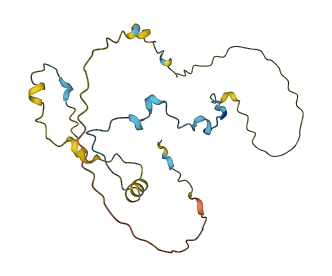
The autoinhibited protein was predicted that may have potential autoinhibitory elements via cis-regPred.
Autoinhibitory domains (AIDs)
Target domain |
|
Relief mechanism |
|
Assay |
cis-regPred |
Accessory elements
No accessory elements
Autoinhibited structure

Activated structure
1 structures for Q3SZY3
| Entry ID | Method | Resolution | Chain | Position | Source |
|---|---|---|---|---|---|
| AF-Q3SZY3-F1 | Predicted | AlphaFoldDB |
No variants for Q3SZY3
| Variant ID(s) | Position | Change | Description | Diseaes Association | Provenance |
|---|---|---|---|---|---|
| No variants for Q3SZY3 | |||||
No associated diseases with Q3SZY3
No regional properties for Q3SZY3
| Type | Name | Position | InterPro Accession |
|---|---|---|---|
| No domain, repeats, and functional sites for Q3SZY3 | |||
2 GO annotations of cellular component
| Name | Definition |
|---|---|
| cytoplasm | The contents of a cell excluding the plasma membrane and nucleus, but including other subcellular structures. |
| nucleus | A membrane-bounded organelle of eukaryotic cells in which chromosomes are housed and replicated. In most cells, the nucleus contains all of the cell's chromosomes except the organellar chromosomes, and is the site of RNA synthesis and processing. In some species, or in specialized cell types, RNA metabolism or DNA replication may be absent. |
1 GO annotations of molecular function
| Name | Definition |
|---|---|
| SH3 domain binding | Binding to a SH3 domain (Src homology 3) of a protein, small protein modules containing approximately 50 amino acid residues found in a great variety of intracellular or membrane-associated proteins. |
5 GO annotations of biological process
| Name | Definition |
|---|---|
| cell division | The process resulting in division and partitioning of components of a cell to form more cells; may or may not be accompanied by the physical separation of a cell into distinct, individually membrane-bounded daughter cells. |
| chromosome organization | A process that is carried out at the cellular level that results in the assembly, arrangement of constituent parts, or disassembly of chromosomes, structures composed of a very long molecule of DNA and associated proteins that carries hereditary information. This term covers covalent modifications at the molecular level as well as spatial relationships among the major components of a chromosome. |
| DNA repair | The process of restoring DNA after damage. Genomes are subject to damage by chemical and physical agents in the environment (e.g. UV and ionizing radiations, chemical mutagens, fungal and bacterial toxins, etc.) and by free radicals or alkylating agents endogenously generated in metabolism. DNA is also damaged because of errors during its replication. A variety of different DNA repair pathways have been reported that include direct reversal, base excision repair, nucleotide excision repair, photoreactivation, bypass, double-strand break repair pathway, and mismatch repair pathway. |
| homologous chromosome segregation | The cell cycle process in which replicated homologous chromosomes are organized and then physically separated and apportioned to two sets during the first division of the meiotic cell cycle. Each replicated chromosome, composed of two sister chromatids, aligns at the cell equator, paired with its homologous partner; this pairing off, referred to as synapsis, permits genetic recombination. One homolog (both sister chromatids) of each morphologic type goes into each of the resulting chromosome sets. |
| negative regulation of mitotic sister chromatid separation | Any process that stops, prevents or reduces the frequency, rate or extent of mitotic sister chromatid separation. |
No homologous proteins in AiPD
| UniProt AC | Gene Name | Protein Name | Species | Evidence Code |
|---|---|---|---|---|
| No homologous proteins | ||||
| 10 | 20 | 30 | 40 | 50 | 60 |
| MSTLIYVDKE | NGEPGIHVAP | KDGLKLGSVP | SVKALDGRSQ | VSTPHVGKMF | DAPPALPKTA |
| 70 | 80 | 90 | 100 | 110 | 120 |
| RKALGTVNRA | TEKSVKTNGP | LKQKQTTFST | KKITEKTVKA | KSSVPASDDT | YPEIEKFFPF |
| 130 | 140 | 150 | 160 | 170 | 180 |
| NPLDFENFDL | PEEHQIARLP | LSGVPLMILD | EERELEQLLH | VGPPSPLKMP | PLLWESNLLQ |
| 190 | 200 | ||||
| SPSSILSTLD | VELPPVCCDL | DI |