Q3SYS1
Gene name |
MRPL13 |
Protein name |
39S ribosomal protein L13, mitochondrial |
Names |
L13mt, MRP-L13 |
Species |
Bos taurus (Bovine) |
KEGG Pathway |
bta:617901 |
EC number |
|
Protein Class |
|
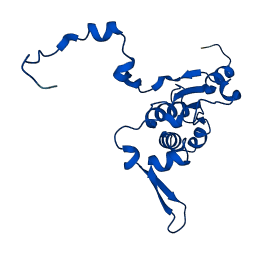
Descriptions
The autoinhibited protein was predicted that may have potential autoinhibitory elements via cis-regPred.
Autoinhibitory domains (AIDs)
Target domain |
|
Relief mechanism |
|
Assay |
cis-regPred |
Accessory elements
No accessory elements
Autoinhibited structure

Activated structure
2 structures for Q3SYS1
| Entry ID | Method | Resolution | Chain | Position | Source |
|---|---|---|---|---|---|
| 2FTC | EM | 1210 A | H | 1-148 | PDB |
| AF-Q3SYS1-F1 | Predicted | AlphaFoldDB |
21 variants for Q3SYS1
| Variant ID(s) | Position | Change | Description | Diseaes Association | Provenance |
|---|---|---|---|---|---|
| rs454117441 | 3 | S>G | No | EVA | |
| rs434057857 | 6 | R>W | No | EVA | |
| rs385774087 | 15 | A>S | No | EVA | |
| rs109155942 | 33 | A>T | No | EVA | |
| rs444626036 | 43 | H>N | No | EVA | |
| rs438453505 | 51 | S>R | No | EVA | |
| rs442433282 | 79 | S>* | No | EVA | |
| rs456050416 | 79 | S>A | No | EVA | |
| rs483297783 | 86 | G>R | No | EVA | |
| rs432501468 | 113 | P>Q | No | EVA | |
| rs436228627 | 130 | D>A | No | EVA | |
| rs451473156 | 139 | K>Q | No | EVA | |
| rs437759029 | 139 | K>T | No | EVA | |
| rs469175440 | 140 | N>I | No | EVA | |
| rs436068802 | 154 | R>C | No | EVA | |
| rs480331986 | 166 | F>L | No | EVA | |
| rs466571633 | 167 | P>A | No | EVA | |
| rs446435691 | 167 | P>Q | No | EVA | |
| rs456406489 | 175 | D>H | No | EVA | |
| rs436266901 | 176 | Y>* | No | EVA | |
| rs137001744 | 179 | L>E | No | EVA |
No associated diseases with Q3SYS1
1 regional properties for Q3SYS1
| Type | Name | Position | InterPro Accession |
|---|---|---|---|
| conserved_site | Ribosomal protein L13, conserved site | 108 - 130 | IPR023563 |
4 GO annotations of cellular component
| Name | Definition |
|---|---|
| mitochondrial inner membrane | The inner, i.e. lumen-facing, lipid bilayer of the mitochondrial envelope. It is highly folded to form cristae. |
| mitochondrial large ribosomal subunit | The larger of the two subunits of a mitochondrial ribosome. Two sites on the ribosomal large subunit are involved in translation: the aminoacyl site (A site) and peptidyl site (P site). |
| mitochondrial ribosome | A ribosome found in the mitochondrion of a eukaryotic cell; contains a characteristic set of proteins distinct from those of cytosolic ribosomes. |
| ribosome | An intracellular organelle, about 200 A in diameter, consisting of RNA and protein. It is the site of protein biosynthesis resulting from translation of messenger RNA (mRNA). It consists of two subunits, one large and one small, each containing only protein and RNA. Both the ribosome and its subunits are characterized by their sedimentation coefficients, expressed in Svedberg units (symbol: S). Hence, the prokaryotic ribosome (70S) comprises a large (50S) subunit and a small (30S) subunit, while the eukaryotic ribosome (80S) comprises a large (60S) subunit and a small (40S) subunit. Two sites on the ribosomal large subunit are involved in translation, namely the aminoacyl site (A site) and peptidyl site (P site). Ribosomes from prokaryotes, eukaryotes, mitochondria, and chloroplasts have characteristically distinct ribosomal proteins. |
2 GO annotations of molecular function
| Name | Definition |
|---|---|
| mRNA binding | Binding to messenger RNA (mRNA), an intermediate molecule between DNA and protein. mRNA includes UTR and coding sequences, but does not contain introns. |
| structural constituent of ribosome | The action of a molecule that contributes to the structural integrity of the ribosome. |
2 GO annotations of biological process
| Name | Definition |
|---|---|
| negative regulation of translation | Any process that stops, prevents, or reduces the frequency, rate or extent of the chemical reactions and pathways resulting in the formation of proteins by the translation of mRNA or circRNA. |
| translation | The cellular metabolic process in which a protein is formed, using the sequence of a mature mRNA or circRNA molecule to specify the sequence of amino acids in a polypeptide chain. Translation is mediated by the ribosome, and begins with the formation of a ternary complex between aminoacylated initiator methionine tRNA, GTP, and initiation factor 2, which subsequently associates with the small subunit of the ribosome and an mRNA or circRNA. Translation ends with the release of a polypeptide chain from the ribosome. |
1 homologous proteins in AiPD
| UniProt AC | Gene Name | Protein Name | Species | Evidence Code |
|---|---|---|---|---|
| Q9BYD1 | MRPL13 | 39S ribosomal protein L13, mitochondrial | Homo sapiens (Human) | PR |
| 10 | 20 | 30 | 40 | 50 | 60 |
| MASLSRAPQQ | WATFARVWYL | LDGKMQPPGK | LAALASVRLQ | GLHKPVYHQL | SDCGDHVVIM |
| 70 | 80 | 90 | 100 | 110 | 120 |
| NTRHIAFSGN | KWEQKVYSSH | TGYPGGFKQV | TAAQLHRKDP | VAIVKLAIYG | MLPKNLHRRT |
| 130 | 140 | 150 | 160 | 170 | |
| LMQRLHLFPD | EDIPEDILKN | LTEELPQPRK | VPRRLDEYTQ | EEIEAFPRVW | SPPEDYRL |