Q3IFG5
Gene name |
hscA |
Protein name |
Chaperone protein HscA homolog |
Names |
|
Species |
Pseudoalteromonas translucida (strain TAC 125) |
KEGG Pathway |
pha:PSHAa2667 |
EC number |
|
Protein Class |
|
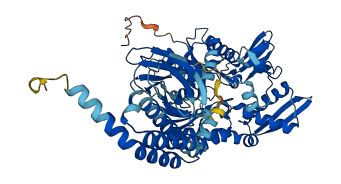
Descriptions
The autoinhibited protein was predicted that may have potential autoinhibitory elements via cis-regPred.
Autoinhibitory domains (AIDs)
Target domain |
|
Relief mechanism |
|
Assay |
cis-regPred |
Accessory elements
No accessory elements
Autoinhibited structure

Activated structure
1 structures for Q3IFG5
| Entry ID | Method | Resolution | Chain | Position | Source |
|---|---|---|---|---|---|
| AF-Q3IFG5-F1 | Predicted | AlphaFoldDB |
No variants for Q3IFG5
| Variant ID(s) | Position | Change | Description | Diseaes Association | Provenance |
|---|---|---|---|---|---|
| No variants for Q3IFG5 | |||||
No associated diseases with Q3IFG5
4 regional properties for Q3IFG5
| Type | Name | Position | InterPro Accession |
|---|---|---|---|
| conserved_site | Heat shock protein 70, conserved site | 24 - 31 | IPR018181-1 |
| conserved_site | Heat shock protein 70, conserved site | 205 - 218 | IPR018181-2 |
| conserved_site | Heat shock protein 70, conserved site | 335 - 349 | IPR018181-3 |
| domain | HscA chaperone, nucleotide-binding domain | 20 - 378 | IPR042039 |
No GO annotations of cellular component
| Name | Definition |
|---|---|
| No GO annotations for cellular component |
4 GO annotations of molecular function
| Name | Definition |
|---|---|
| ATP binding | Binding to ATP, adenosine 5'-triphosphate, a universally important coenzyme and enzyme regulator. |
| ATP hydrolysis activity | Catalysis of the reaction: ATP + H2O = ADP + H+ phosphate. ATP hydrolysis is used in some reactions as an energy source, for example to catalyze a reaction or drive transport against a concentration gradient. |
| ATP-dependent protein folding chaperone | Binding to a protein or a protein-containing complex to assist the protein folding process, driven by ATP hydrolysis. |
| unfolded protein binding | Binding to an unfolded protein. |
1 GO annotations of biological process
| Name | Definition |
|---|---|
| iron-sulfur cluster assembly | The incorporation of iron and exogenous sulfur into a metallo-sulfur cluster. |
No homologous proteins in AiPD
| UniProt AC | Gene Name | Protein Name | Species | Evidence Code |
|---|---|---|---|---|
| No homologous proteins | ||||
| 10 | 20 | 30 | 40 | 50 | 60 |
| MALLQIAEPG | QSAAPHEHKL | AIGIDLGTTN | SLVATVQSGE | ARTLTDDLGE | AMLPSVVRYQ |
| 70 | 80 | 90 | 100 | 110 | 120 |
| AGGITVGSEA | VKSATQDPVN | TLISVKRFLG | KTQAEIEQSY | GQLPYQFCQH | DGALAIETAA |
| 130 | 140 | 150 | 160 | 170 | 180 |
| GKISPVKASS | HILAALKARA | EQSFGNQEIL | GAVITVPAYF | DDAQRQSTKD | AAELAGINVL |
| 190 | 200 | 210 | 220 | 230 | 240 |
| RLLNEPTAAA | VAYGLDSGQE | GIIAVYDLGG | GTFDISILRL | HQGVFEVLAT | GGDSSLGGDD |
| 250 | 260 | 270 | 280 | 290 | 300 |
| FDSLIVDYLK | QQTGVTTLSP | AVLRLFINKA | KACKEALSQY | STVNVGLEFD | DEKHMVEVTR |
| 310 | 320 | 330 | 340 | 350 | 360 |
| EKLDELAIPL | VKKTLRSCRR | AVKDAGIENE | EVLQVIMVGG | STRMPLVRSQ | VSEFFNKEAL |
| 370 | 380 | 390 | 400 | 410 | 420 |
| TSIDPDRVVA | LGAALQADVL | IGNKPDSDML | LLDVLPLSLG | LETMGGLVEK | IIPRNTTIPV |
| 430 | 440 | 450 | 460 | 470 | 480 |
| ARAQEFTTFK | DGQTAMSLHV | LQGERELVDD | CRSLAKFSLK | GIPPMTAGAA | HIRVTFKVDA |
| 490 | 500 | 510 | 520 | 530 | 540 |
| DGLLSVSAME | KSTGVQADIQ | VKPSFGLSDD | QVSNMLKESM | SNAKGDMQAR | MLKEQQVEAL |
| 550 | 560 | 570 | 580 | 590 | 600 |
| RVIEALEASL | ASDSGLLDEA | QLAYLRAEIA | ELVKVRENAQ | QPNEIKTAIE | KMDNASSDFA |
| 610 | |||||
| ARRMDASIKK | VLTGQSVDNI |