Q3BQF5
Gene name |
ruvB |
Protein name |
Holliday junction ATP-dependent DNA helicase RuvB |
Names |
|
Species |
Xanthomonas campestris pv vesicatoria (strain 85-10) |
KEGG Pathway |
xcv:XCV3277 |
EC number |
3.6.4.12: Acting on ATP; involved in cellular and subcellular movement |
Protein Class |
|
Descriptions
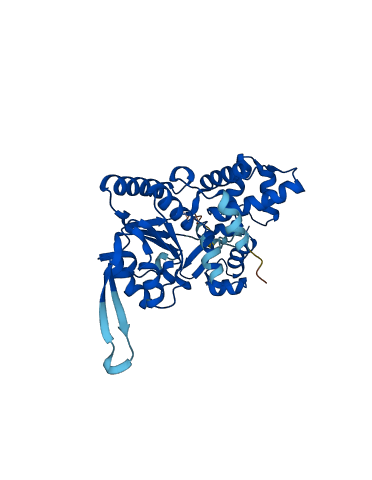
The autoinhibited protein was predicted that may have potential autoinhibitory elements via cis-regPred.
Autoinhibitory domains (AIDs)
Target domain |
|
Relief mechanism |
|
Assay |
cis-regPred |
Accessory elements
No accessory elements
Autoinhibited structure

Activated structure
1 structures for Q3BQF5
| Entry ID | Method | Resolution | Chain | Position | Source |
|---|---|---|---|---|---|
| AF-Q3BQF5-F1 | Predicted | AlphaFoldDB |
No variants for Q3BQF5
| Variant ID(s) | Position | Change | Description | Diseaes Association | Provenance |
|---|---|---|---|---|---|
| No variants for Q3BQF5 | |||||
No associated diseases with Q3BQF5
Functions
| Description | ||
|---|---|---|
| EC Number | 3.6.4.12 | Acting on ATP; involved in cellular and subcellular movement |
| Subcellular Localization |
|
|
| PANTHER Family | ||
| PANTHER Subfamily | ||
| PANTHER Protein Class | ||
| PANTHER Pathway Category | No pathway information available | |
No GO annotations of cellular component
| Name | Definition |
|---|---|
| No GO annotations for cellular component |
4 GO annotations of molecular function
| Name | Definition |
|---|---|
| ATP binding | Binding to ATP, adenosine 5'-triphosphate, a universally important coenzyme and enzyme regulator. |
| ATP hydrolysis activity | Catalysis of the reaction: ATP + H2O = ADP + H+ phosphate. ATP hydrolysis is used in some reactions as an energy source, for example to catalyze a reaction or drive transport against a concentration gradient. |
| DNA binding | Any molecular function by which a gene product interacts selectively and non-covalently with DNA (deoxyribonucleic acid). |
| four-way junction helicase activity | Unwinding a DNA helix of DNA containing four-way junctions, including Holliday junctions, driven by ATP hydrolysis. |
3 GO annotations of biological process
| Name | Definition |
|---|---|
| DNA recombination | Any process in which a new genotype is formed by reassortment of genes resulting in gene combinations different from those that were present in the parents. In eukaryotes genetic recombination can occur by chromosome assortment, intrachromosomal recombination, or nonreciprocal interchromosomal recombination. Interchromosomal recombination occurs by crossing over. In bacteria it may occur by genetic transformation, conjugation, transduction, or F-duction. |
| DNA repair | The process of restoring DNA after damage. Genomes are subject to damage by chemical and physical agents in the environment (e.g. UV and ionizing radiations, chemical mutagens, fungal and bacterial toxins, etc.) and by free radicals or alkylating agents endogenously generated in metabolism. DNA is also damaged because of errors during its replication. A variety of different DNA repair pathways have been reported that include direct reversal, base excision repair, nucleotide excision repair, photoreactivation, bypass, double-strand break repair pathway, and mismatch repair pathway. |
| SOS response | An error-prone process for repairing damaged microbial DNA. |
No homologous proteins in AiPD
| UniProt AC | Gene Name | Protein Name | Species | Evidence Code |
|---|---|---|---|---|
| No homologous proteins | ||||
| 10 | 20 | 30 | 40 | 50 | 60 |
| MTEQRIIASS | STREDDAADA | SIRPKRLADY | LGQQPVREQM | EIYIQAAKAR | GEAMDHVLIF |
| 70 | 80 | 90 | 100 | 110 | 120 |
| GPPGLGKTTL | SHVIANELGV | SLRVTSGPVI | EKAGDLAALL | TNLQPHDVLF | IDEIHRLSPV |
| 130 | 140 | 150 | 160 | 170 | 180 |
| VEEVLYPAME | DFQIDIMIGD | GPAARSIKID | LPPFTLIGAT | TRAGLLTAPL | RDRFGIVQRL |
| 190 | 200 | 210 | 220 | 230 | 240 |
| EFYSPQELTR | IVSRSAAILG | IDCTPEGAAE | IARRARGTPR | IANRLLRRVR | DYAQVKAAGH |
| 250 | 260 | 270 | 280 | 290 | 300 |
| IDLPVAQAAM | QMLKVDPEGF | DELDRRMLRT | IVEHFDGGPV | GVESLAASLS | EERGTLEDVI |
| 310 | 320 | 330 | 340 | ||
| EPYLIQQGFL | IRTARGRMVT | PKAYLHLGLK | VPRERAPGIG | EPGDLF |