Q39566
Gene name |
GSA |
Protein name |
Glutamate-1-semialdehyde 2,1-aminomutase, chloroplastic |
Names |
GSA, Glutamate-1-semialdehyde aminotransferase, GSA-AT |
Species |
Chlamydomonas reinhardtii (Chlamydomonas smithii) |
KEGG Pathway |
cre:CHLRE_03g158000v5 |
EC number |
5.4.3.8: Transferring amino groups |
Protein Class |
|
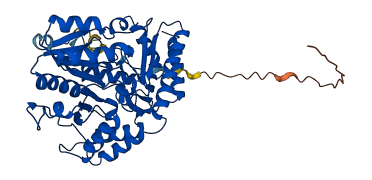
Descriptions
The autoinhibited protein was predicted that may have potential autoinhibitory elements via cis-regPred.
Autoinhibitory domains (AIDs)
Target domain |
|
Relief mechanism |
|
Assay |
cis-regPred |
Accessory elements
No accessory elements
Autoinhibited structure

Activated structure
1 structures for Q39566
| Entry ID | Method | Resolution | Chain | Position | Source |
|---|---|---|---|---|---|
| AF-Q39566-F1 | Predicted | AlphaFoldDB |
No variants for Q39566
| Variant ID(s) | Position | Change | Description | Diseaes Association | Provenance |
|---|---|---|---|---|---|
| No variants for Q39566 | |||||
No associated diseases with Q39566
No regional properties for Q39566
| Type | Name | Position | InterPro Accession |
|---|---|---|---|
| No domain, repeats, and functional sites for Q39566 | |||
Functions
| Description | ||
|---|---|---|
| EC Number | 5.4.3.8 | Transferring amino groups |
| Subcellular Localization |
|
|
| PANTHER Family | ||
| PANTHER Subfamily | ||
| PANTHER Protein Class | ||
| PANTHER Pathway Category | No pathway information available | |
1 GO annotations of cellular component
| Name | Definition |
|---|---|
| chloroplast | A chlorophyll-containing plastid with thylakoids organized into grana and frets, or stroma thylakoids, and embedded in a stroma. |
3 GO annotations of molecular function
| Name | Definition |
|---|---|
| glutamate-1-semialdehyde 2,1-aminomutase activity | Catalysis of the reaction: (S)-4-amino-5-oxopentanoate = 5-aminolevulinate. |
| pyridoxal phosphate binding | Binding to pyridoxal 5' phosphate, 3-hydroxy-5-(hydroxymethyl)-2-methyl4-pyridine carboxaldehyde 5' phosphate, the biologically active form of vitamin B6. |
| transaminase activity | Catalysis of the transfer of an amino group to an acceptor, usually a 2-oxo acid. |
2 GO annotations of biological process
| Name | Definition |
|---|---|
| chlorophyll biosynthetic process | The chemical reactions and pathways resulting in the formation of chlorophyll, any compound of magnesium complexed in a porphyrin (tetrapyrrole) ring and which functions as a photosynthetic pigment, from less complex precursors. |
| protoporphyrinogen IX biosynthetic process | The chemical reactions and pathways resulting in the formation of protoporphyrinogen IX. |
No homologous proteins in AiPD
| UniProt AC | Gene Name | Protein Name | Species | Evidence Code |
|---|---|---|---|---|
| No homologous proteins | ||||
| 10 | 20 | 30 | 40 | 50 | 60 |
| MQMQLNAKTV | QGAFKAQRPR | SVRGNVAVRA | VAAPPKLVTK | RSEEIFKEAQ | ELLPGGVNSP |
| 70 | 80 | 90 | 100 | 110 | 120 |
| VRAFRSVGGG | PIVFDRVKGA | YCWDVDGNKY | IDYVGSWGPA | ICGHGNDEVN | NALKAQIDKG |
| 130 | 140 | 150 | 160 | 170 | 180 |
| TSFGAPCELE | NVLAKMVIDR | VPSVEMVRFV | SSGTEACLSV | LRLMRAYTGR | EKVLKFTGCY |
| 190 | 200 | 210 | 220 | 230 | 240 |
| HGHADSFLVK | AGSGVITLGL | PDSPGVPKST | AAATLTATYN | NLDSVRELFA | ANKGEIAGVI |
| 250 | 260 | 270 | 280 | 290 | 300 |
| LEPVVGNSGF | IVPTKEFLQG | LREICTAEGA | VLCFDEVMTG | FRIAKGCAQE | HFGITPDLTT |
| 310 | 320 | 330 | 340 | 350 | 360 |
| MGKVIGGGMP | VGAYGGKKEI | MKMVAPAGPM | YQAGTLSGNP | MAMTAGIKTL | EILGRPGAYE |
| 370 | 380 | 390 | 400 | 410 | 420 |
| HLEKVTKRLI | DGIMAAAKEH | SHEITGGNIS | GMFGFFFCKG | PVTCFEDALA | ADTAKFARFH |
| 430 | 440 | 450 | 460 | ||
| RGMLEEGVYL | APSQFEAGFT | SLAHSEADVD | ATIAAARRVF | ARI |