Q388M1
Gene name |
GSK3 |
Protein name |
Glycogen synthase kinase 3 |
Names |
GSK-3 short |
Species |
Trypanosoma brucei brucei (strain 927/4 GUTat101) |
KEGG Pathway |
tbr:Tb10.61.3140 |
EC number |
2.7.11.26: Protein-serine/threonine kinases |
Protein Class |
|
Descriptions
The autoinhibited protein was predicted that may have potential autoinhibitory elements via cis-regPred.
Autoinhibitory domains (AIDs)
Target domain |
|
Relief mechanism |
|
Assay |
cis-regPred |
Accessory elements
170-192 (Activation loop from InterPro)
Target domain |
20-310 (Protein kinase domain) |
Relief mechanism |
|
Assay |
|
Autoinhibited structure

Activated structure
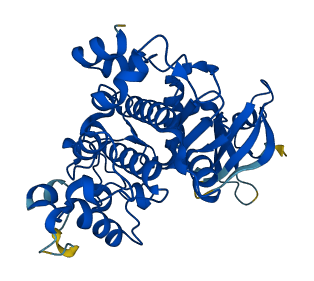
1 structures for Q388M1
| Entry ID | Method | Resolution | Chain | Position | Source |
|---|---|---|---|---|---|
| AF-Q388M1-F1 | Predicted | AlphaFoldDB |
No variants for Q388M1
| Variant ID(s) | Position | Change | Description | Diseaes Association | Provenance |
|---|---|---|---|---|---|
| No variants for Q388M1 | |||||
No associated diseases with Q388M1
1 regional properties for Q388M1
| Type | Name | Position | InterPro Accession |
|---|---|---|---|
| domain | GPCR, rhodopsin-like, 7TM | 38 - 286 | IPR017452 |
Functions
| Description | ||
|---|---|---|
| EC Number | 2.7.11.26 | Protein-serine/threonine kinases |
| Subcellular Localization |
|
|
| PANTHER Family | ||
| PANTHER Subfamily | ||
| PANTHER Protein Class | ||
| PANTHER Pathway Category | No pathway information available | |
9 GO annotations of cellular component
| Name | Definition |
|---|---|
| axoneme | The bundle of microtubules and associated proteins that forms the core of cilia (also called flagella) in eukaryotic cells and is responsible for their movements. |
| ciliary basal body | A membrane-tethered, short cylindrical array of microtubules and associated proteins found at the base of a eukaryotic cilium (also called flagellum) that is similar in structure to a centriole and derives from it. The cilium basal body is the site of assembly and remodelling of the cilium and serves as a nucleation site for axoneme growth. As well as anchoring the cilium, it is thought to provide a selective gateway regulating the entry of ciliary proteins and vesicles by intraflagellar transport. |
| ciliary plasm | All of the contents of a cilium, excluding the plasma membrane surrounding the cilium. |
| ciliary tip | Part of the cilium where the axoneme ends. The ciliary tip has been implicated in ciliary assembly and disassembly, as well as signal transduction. |
| cilium | A specialized eukaryotic organelle that consists of a filiform extrusion of the cell surface and of some cytoplasmic parts. Each cilium is largely bounded by an extrusion of the cytoplasmic (plasma) membrane, and contains a regular longitudinal array of microtubules, anchored to a basal body. |
| cytoplasm | The contents of a cell excluding the plasma membrane and nucleus, but including other subcellular structures. |
| kinetoplast | A sub-structure within the large single mitochondrion of kinetoplastid parasites and which is closely associated with the flagellar pocket and basal body of the flagellum. |
| nuclear lumen | The volume enclosed by the nuclear inner membrane. |
| nucleus | A membrane-bounded organelle of eukaryotic cells in which chromosomes are housed and replicated. In most cells, the nucleus contains all of the cell's chromosomes except the organellar chromosomes, and is the site of RNA synthesis and processing. In some species, or in specialized cell types, RNA metabolism or DNA replication may be absent. |
3 GO annotations of molecular function
| Name | Definition |
|---|---|
| ATP binding | Binding to ATP, adenosine 5'-triphosphate, a universally important coenzyme and enzyme regulator. |
| protein serine/threonine kinase activity | Catalysis of the reactions: ATP + protein serine = ADP + protein serine phosphate, and ATP + protein threonine = ADP + protein threonine phosphate. |
| tau-protein kinase activity | Catalysis of the reaction: ATP + tau-protein = ADP + O-phospho-tau-protein. |
4 GO annotations of biological process
| Name | Definition |
|---|---|
| mitotic cell cycle | Progression through the phases of the mitotic cell cycle, the most common eukaryotic cell cycle, which canonically comprises four successive phases called G1, S, G2, and M and includes replication of the genome and the subsequent segregation of chromosomes into daughter cells. In some variant cell cycles nuclear replication or nuclear division may not be followed by cell division, or G1 and G2 phases may be absent. |
| mitotic cytokinesis | A cell cycle process that results in the division of the cytoplasm of a cell after mitosis, resulting in the separation of the original cell into two daughter cells. |
| protein phosphorylation | The process of introducing a phosphate group on to a protein. |
| signal transduction | The cellular process in which a signal is conveyed to trigger a change in the activity or state of a cell. Signal transduction begins with reception of a signal (e.g. a ligand binding to a receptor or receptor activation by a stimulus such as light), or for signal transduction in the absence of ligand, signal-withdrawal or the activity of a constitutively active receptor. Signal transduction ends with regulation of a downstream cellular process, e.g. regulation of transcription or regulation of a metabolic process. Signal transduction covers signaling from receptors located on the surface of the cell and signaling via molecules located within the cell. For signaling between cells, signal transduction is restricted to events at and within the receiving cell. |
No homologous proteins in AiPD
| UniProt AC | Gene Name | Protein Name | Species | Evidence Code |
|---|---|---|---|---|
| No homologous proteins | ||||
| 10 | 20 | 30 | 40 | 50 | 60 |
| MSLNLTDAAD | DRSYKEMEKY | TVERVAGQGT | FGTVQLARDK | STGSLVAIKK | VIQDPRFKNR |
| 70 | 80 | 90 | 100 | 110 | 120 |
| ELQIMQHLAR | LRHPNIVMLK | NYFYTVGGEG | RRNDVYLNVV | MEFVPETLHR | TCRNYYRRMT |
| 130 | 140 | 150 | 160 | 170 | 180 |
| NPPLILVKVF | MFQLLRSIAC | LHIPVINICH | RDIKPHNVLV | DEQTGELKLC | DFGSAKRLAA |
| 190 | 200 | 210 | 220 | 230 | 240 |
| DEPNVAYICS | RYYRAPELIF | GNQFYTTAVD | IWSVGCIFAE | MLLGEPIFCG | ENTSGQLREI |
| 250 | 260 | 270 | 280 | 290 | 300 |
| VKILGKPTKE | ELHKLNGSST | EINANAKATP | WENVFKQPLP | AEVYDLCGKI | FKYVPDQRIT |
| 310 | 320 | 330 | 340 | 350 | |
| PLDALCHPFF | NELREPTTKL | PSGNPLPAHL | YQFTPDEVEA | MTEAQREYLL | KK |