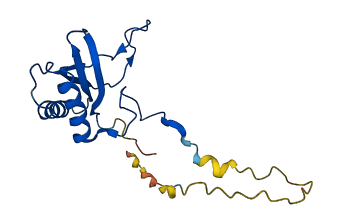
Descriptions
The autoinhibited protein was predicted that may have potential autoinhibitory elements via cis-regPred.
Autoinhibitory domains (AIDs)
Target domain |
|
Relief mechanism |
|
Assay |
cis-regPred |
Accessory elements
No accessory elements
Autoinhibited structure

Activated structure
1 structures for Q38793
| Entry ID | Method | Resolution | Chain | Position | Source |
|---|---|---|---|---|---|
| AF-Q38793-F1 | Predicted | AlphaFoldDB |
No variants for Q38793
| Variant ID(s) | Position | Change | Description | Diseaes Association | Provenance |
|---|---|---|---|---|---|
| No variants for Q38793 | |||||
No associated diseases with Q38793
1 GO annotations of cellular component
| Name | Definition |
|---|---|
| chloroplast | A chlorophyll-containing plastid with thylakoids organized into grana and frets, or stroma thylakoids, and embedded in a stroma. |
No GO annotations of molecular function
| Name | Definition |
|---|---|
| No GO annotations for molecular function |
2 GO annotations of biological process
| Name | Definition |
|---|---|
| photorespiration | A light-dependent catabolic process occurring concomitantly with photosynthesis in plants (especially C3 plants) whereby dioxygen (O2) is consumed and carbon dioxide (CO2) is evolved. The substrate is glycolate formed in large quantities in chloroplasts from 2-phosphoglycolate generated from ribulose 1,5-bisphosphate by the action of ribulose-bisphosphate carboxylase; the glycolate enters the peroxisomes where it is converted by glycolate oxidase to glyoxylate which undergoes transamination to glycine. This then passes into the mitochondria where it is decarboxylated forming one molecule of serine for every two molecules of glycine. This pathway also exists in photosynthetic bacteria. |
| reductive pentose-phosphate cycle | The fixation of carbon dioxide (CO2) as glucose in the chloroplasts of C3 plants; uses ATP and NADPH formed in the light reactions of photosynthesis; carbon dioxide reacts with ribulose 1,5-bisphosphate (catalyzed by the function of ribulose-bisphosphate carboxylase) to yield two molecules of 3-phosphoglycerate; these are then phosphorylated by ATP to 1,3-bisphosphateglyceraldehyde which, in turn, is then reduced by NADPH to glyceraldehyde 3-phosphate. The glyceraldehyde 3-phosphate is converted to fructose 5-phosphate and ribulose 5-phosphate by aldolase and other enzymes; the ribulose 5-phosphate is phosphorylated by ATP to ribulose 1,5-bisphosphate. |
No homologous proteins in AiPD
| UniProt AC | Gene Name | Protein Name | Species | Evidence Code |
|---|---|---|---|---|
| No homologous proteins | ||||
| 10 | 20 | 30 | 40 | 50 | 60 |
| MAPTVMASSA | TSVAPFQGLK | STAGLPVSRR | SNGASLGSVS | NGGRIRCMQV | WPIEGIKKFE |
| 70 | 80 | 90 | 100 | 110 | 120 |
| TLSYLPPLST | EGLLKQVDYL | IRSKWVPCLE | FRKVGFIFRE | HNVSPGYYDG | RYWTMWKLPM |
| 130 | 140 | 150 | 160 | 170 | |
| FGCPAPTQVI | PEVEEVRKEY | PDPYCRIIGF | DNMRQVQSVS | FIASKPPGCE | ESGKA |