Q32LT9
Gene name |
pm20d1.1 |
Protein name |
N-fatty-acyl-amino acid synthase/hydrolase PM20D1.1 |
Names |
Peptidase M20 domain-containing protein 1.1 |
Species |
Danio rerio (Zebrafish) (Brachydanio rerio) |
KEGG Pathway |
dre:553216 |
EC number |
3.5.1.14: In linear amides |
Protein Class |
|
Descriptions
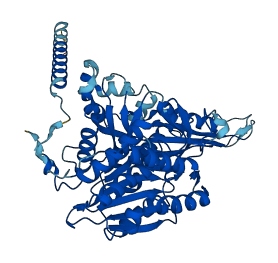
The autoinhibited protein was predicted that may have potential autoinhibitory elements via cis-regPred.
Autoinhibitory domains (AIDs)
Target domain |
|
Relief mechanism |
|
Assay |
cis-regPred |
Accessory elements
No accessory elements
Autoinhibited structure

Activated structure
1 structures for Q32LT9
| Entry ID | Method | Resolution | Chain | Position | Source |
|---|---|---|---|---|---|
| AF-Q32LT9-F1 | Predicted | AlphaFoldDB |
No variants for Q32LT9
| Variant ID(s) | Position | Change | Description | Diseaes Association | Provenance |
|---|---|---|---|---|---|
| No variants for Q32LT9 | |||||
No associated diseases with Q32LT9
Functions
| Description | ||
|---|---|---|
| EC Number | 3.5.1.14 | In linear amides |
| Subcellular Localization |
|
|
| PANTHER Family | ||
| PANTHER Subfamily | ||
| PANTHER Protein Class | ||
| PANTHER Pathway Category | No pathway information available | |
1 GO annotations of cellular component
| Name | Definition |
|---|---|
| extracellular space | That part of a multicellular organism outside the cells proper, usually taken to be outside the plasma membranes, and occupied by fluid. |
5 GO annotations of molecular function
| Name | Definition |
|---|---|
| aminoacylase activity | Catalysis of the reaction: an N-acyl-L-amino acid + H2O = a carboxylate + an L-amino acid. |
| hydrolase activity, acting on carbon-nitrogen (but not peptide) bonds, in linear amides | Catalysis of the hydrolysis of any non-peptide carbon-nitrogen bond in a linear amide. |
| lyase activity | Catalysis of the cleavage of C-C, C-O, C-N and other bonds by other means than by hydrolysis or oxidation, or conversely adding a group to a double bond. They differ from other enzymes in that two substrates are involved in one reaction direction, but only one in the other direction. When acting on the single substrate, a molecule is eliminated and this generates either a new double bond or a new ring. |
| metal ion binding | Binding to a metal ion. |
| peptidase activity | Catalysis of the hydrolysis of a peptide bond. A peptide bond is a covalent bond formed when the carbon atom from the carboxyl group of one amino acid shares electrons with the nitrogen atom from the amino group of a second amino acid. |
11 GO annotations of biological process
| Name | Definition |
|---|---|
| adaptive thermogenesis | The regulated production of heat in response to short term environmental changes, such as stress, diet or reduced temperature. |
| amide biosynthetic process | The chemical reactions and pathways resulting in the formation of an amide, any derivative of an oxoacid in which an acidic hydroxy group has been replaced by an amino or substituted amino group. |
| cellular amide catabolic process | The chemical reactions and pathways resulting in the breakdown of an amide, any derivative of an oxoacid in which an acidic hydroxy group has been replaced by an amino or substituted amino group. |
| cellular amino acid metabolic process | The chemical reactions and pathways involving amino acids, carboxylic acids containing one or more amino groups, as carried out by individual cells. |
| cellular lipid metabolic process | The chemical reactions and pathways involving lipids, as carried out by individual cells. |
| energy homeostasis | Any process involved in the balance between food intake (energy input) and energy expenditure. |
| fatty acid metabolic process | The chemical reactions and pathways involving fatty acids, aliphatic monocarboxylic acids liberated from naturally occurring fats and oils by hydrolysis. |
| nitrogen compound metabolic process | The chemical reactions and pathways involving organic or inorganic compounds that contain nitrogen. |
| proteolysis | The hydrolysis of proteins into smaller polypeptides and/or amino acids by cleavage of their peptide bonds. |
| regulation of oxidative phosphorylation uncoupler activity | Any process that modulates the frequency, rate or extent of oxidative phosphorylation uncoupler activity. |
| respiratory electron transport chain | A process in which a series of electron carriers operate together to transfer electrons from donors such as NADH and FADH2 to any of several different terminal electron acceptors to generate a transmembrane electrochemical gradient. |
No homologous proteins in AiPD
| UniProt AC | Gene Name | Protein Name | Species | Evidence Code |
|---|---|---|---|---|
| No homologous proteins | ||||
| 10 | 20 | 30 | 40 | 50 | 60 |
| MKTKFTKKTV | LKFFGILFAI | LLLSVLILFS | VVIGRTFTFK | VNRELGQWEN | TSTIYPYLSP |
| 70 | 80 | 90 | 100 | 110 | 120 |
| EQREKLLDNF | KVAVQIPTVS | FSESDQNITA | LQEFDLLLRR | VFPKVFSSSL | VRHEVVGNYS |
| 130 | 140 | 150 | 160 | 170 | 180 |
| HLFTVVGADA | GLEPYMLLAH | IDVVPANEAG | GWDAPPFSAQ | EIDGFIYGRG | TIDNKQSVMG |
| 190 | 200 | 210 | 220 | 230 | 240 |
| ILQALEYLLE | RGYTPRRTFY | IGLGHDEEIN | GEEGAVKIVN | LLKSRGVKLL | YVLDEGLTIM |
| 250 | 260 | 270 | 280 | 290 | 300 |
| DGVVDGLNEP | AALIGVSEKG | QTTVKLSVST | PPGHSSMPPR | ESSIGILASA | VARLEKNRMP |
| 310 | 320 | 330 | 340 | 350 | 360 |
| NLFGHGPERA | TFEHLAHKFG | WSYRMIMSNL | WLFSSLLSSV | LEGQPDTNAF | VRTTTAVTMF |
| 370 | 380 | 390 | 400 | 410 | 420 |
| NSGVKINVMP | AHAEAFVNFR | IHSSQTVQGV | LNRIESTVSD | KRVKVEFING | FDPLPIGSYE |
| 430 | 440 | 450 | 460 | 470 | 480 |
| DDTFGYQIIK | KSVQDIFPQV | TVTPGICVAN | TDSRHYTQLS | PDIYRFAPSW | YKPGDSARFH |
| 490 | 500 | 510 | |||
| GVNERISIQN | YEEIVLFYFQ | LMQNSDVRNL | PTLRS |