Q2W2Q1
Gene name |
msrP |
Protein name |
Protein-methionine-sulfoxide reductase catalytic subunit MsrP |
Names |
|
Species |
Magnetospirillum magneticum (strain AMB-1 / ATCC 700264) |
KEGG Pathway |
mag:amb3070 |
EC number |
|
Protein Class |
|
Descriptions
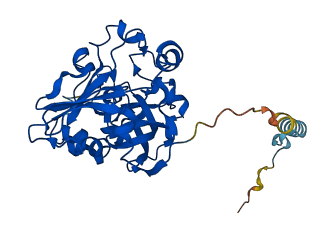
The autoinhibited protein was predicted that may have potential autoinhibitory elements via cis-regPred.
Autoinhibitory domains (AIDs)
Target domain |
|
Relief mechanism |
|
Assay |
cis-regPred |
Accessory elements
No accessory elements
Autoinhibited structure

Activated structure
1 structures for Q2W2Q1
| Entry ID | Method | Resolution | Chain | Position | Source |
|---|---|---|---|---|---|
| AF-Q2W2Q1-F1 | Predicted | AlphaFoldDB |
No variants for Q2W2Q1
| Variant ID(s) | Position | Change | Description | Diseaes Association | Provenance |
|---|---|---|---|---|---|
| No variants for Q2W2Q1 | |||||
No associated diseases with Q2W2Q1
1 GO annotations of cellular component
| Name | Definition |
|---|---|
| periplasmic space | The region between the inner (cytoplasmic) and outer membrane (Gram-negative Bacteria) or cytoplasmic membrane and cell wall (Fungi and Gram-positive Bacteria). |
3 GO annotations of molecular function
| Name | Definition |
|---|---|
| metal ion binding | Binding to a metal ion. |
| molybdopterin cofactor binding | Binding to a molybdopterin cofactor (Moco), essential for the catalytic activity of some enzymes, e.g. sulfite oxidase, xanthine dehydrogenase, and aldehyde oxidase. The cofactor consists of a mononuclear molybdenum (Mo-molybdopterin) or tungsten ion (W-molybdopterin) coordinated by one or two molybdopterin ligands. |
| oxidoreductase activity, acting on a sulfur group of donors, quinone or similar compound as acceptor | Catalysis of an oxidation-reduction (redox) reaction in which a sulfur-containing group acts as a hydrogen or electron donor and reduces quinone or a related compound. |
1 GO annotations of biological process
| Name | Definition |
|---|---|
| protein repair | The process of restoring a protein to its original state after damage by such things as oxidation or spontaneous decomposition of residues. |
No homologous proteins in AiPD
| UniProt AC | Gene Name | Protein Name | Species | Evidence Code |
|---|---|---|---|---|
| No homologous proteins | ||||
| 10 | 20 | 30 | 40 | 50 | 60 |
| MLIRSAADLR | ESEVTDKALW | LDRRRFLALG | AAGALALSGL | PAEAGLNTVK | GPFSTDEPPT |
| 70 | 80 | 90 | 100 | 110 | 120 |
| PRKDVTTYNN | FYELGVEKSD | PAQLAPSYFT | KTRPWSVTIA | GECAKPGTLG | YEDLIKPHRL |
| 130 | 140 | 150 | 160 | 170 | 180 |
| EDRIYRMRCV | EAWSMVIPWV | GIPLGEVLKR | FEPGSKAKFV | EFTTLQDPER | LPGQRRSVID |
| 190 | 200 | 210 | 220 | 230 | 240 |
| WPYVEGLRID | EAMHPLALLA | VGLYGEELLP | QNGAPIRLVV | PWKYGFKSIK | SIVAIRFAET |
| 250 | 260 | 270 | 280 | 290 | 300 |
| PSRTAWMKAA | PREYGFYANV | NPAVDHPRWS | QGAERRIGEF | LKRKTLPFNG | YADQVASLYS |
| GMDLAANF |