Q2TCH4
Gene name |
tgfb1i1 (ara55) |
Protein name |
Transforming growth factor beta-1-induced transcript 1 protein |
Names |
Androgen receptor activator of 55 kDa, Hydrogen peroxide-inducible clone 5 protein, Hic-5 |
Species |
Xenopus laevis (African clawed frog) |
KEGG Pathway |
xla:779337 |
EC number |
|
Protein Class |
|
Descriptions
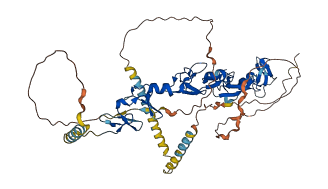
The autoinhibited protein was predicted that may have potential autoinhibitory elements via cis-regPred.
Autoinhibitory domains (AIDs)
Target domain |
|
Relief mechanism |
|
Assay |
cis-regPred |
Accessory elements
No accessory elements
Autoinhibited structure

Activated structure
1 structures for Q2TCH4
| Entry ID | Method | Resolution | Chain | Position | Source |
|---|---|---|---|---|---|
| AF-Q2TCH4-F1 | Predicted | AlphaFoldDB |
No variants for Q2TCH4
| Variant ID(s) | Position | Change | Description | Diseaes Association | Provenance |
|---|---|---|---|---|---|
| No variants for Q2TCH4 | |||||
No associated diseases with Q2TCH4
5 regional properties for Q2TCH4
| Type | Name | Position | InterPro Accession |
|---|---|---|---|
| domain | Zinc finger, LIM-type | 271 - 330 | IPR001781-1 |
| domain | Zinc finger, LIM-type | 331 - 388 | IPR001781-2 |
| domain | Zinc finger, LIM-type | 389 - 448 | IPR001781-3 |
| domain | Zinc finger, LIM-type | 449 - 506 | IPR001781-4 |
| domain | Paxillin/TGFB1I1, LIM domain 1 | 273 - 325 | IPR047075 |
Functions
4 GO annotations of cellular component
| Name | Definition |
|---|---|
| cytoplasm | The contents of a cell excluding the plasma membrane and nucleus, but including other subcellular structures. |
| cytoskeleton | A cellular structure that forms the internal framework of eukaryotic and prokaryotic cells. The cytoskeleton includes intermediate filaments, microfilaments, microtubules, the microtrabecular lattice, and other structures characterized by a polymeric filamentous nature and long-range order within the cell. The various elements of the cytoskeleton not only serve in the maintenance of cellular shape but also have roles in other cellular functions, including cellular movement, cell division, endocytosis, and movement of organelles. |
| focal adhesion | A cell-substrate junction that anchors the cell to the extracellular matrix and that forms a point of termination of actin filaments. In insects focal adhesion has also been referred to as hemi-adherens junction (HAJ). |
| nuclear matrix | The dense fibrillar network lying on the inner side of the nuclear membrane. |
2 GO annotations of molecular function
| Name | Definition |
|---|---|
| metal ion binding | Binding to a metal ion. |
| transcription coactivator activity | A transcription coregulator activity that activates or increases the transcription of specific gene sets via binding to a DNA-bound DNA-binding transcription factor, either on its own or as part of a complex. Coactivators often act by altering chromatin structure and modifications. For example, one class of transcription coactivators modifies chromatin structure through covalent modification of histones. A second class remodels the conformation of chromatin in an ATP-dependent fashion. A third class modulates interactions of DNA-bound DNA-binding transcription factors with other transcription coregulators. A fourth class of coactivator activity is the bridging of a DNA-binding transcription factor to the general (basal) transcription machinery. The Mediator complex, which bridges sequence-specific DNA binding transcription factors and RNA polymerase, is also a transcription coactivator. |
2 GO annotations of biological process
| Name | Definition |
|---|---|
| cell differentiation | The process in which relatively unspecialized cells, e.g. embryonic or regenerative cells, acquire specialized structural and/or functional features that characterize the cells, tissues, or organs of the mature organism or some other relatively stable phase of the organism's life history. Differentiation includes the processes involved in commitment of a cell to a specific fate and its subsequent development to the mature state. |
| Wnt signaling pathway | The series of molecular signals initiated by binding of a Wnt protein to a frizzled family receptor on the surface of the target cell and ending with a change in cell state. |
No homologous proteins in AiPD
| UniProt AC | Gene Name | Protein Name | Species | Evidence Code |
|---|---|---|---|---|
| No homologous proteins | ||||
| 10 | 20 | 30 | 40 | 50 | 60 |
| MEDLDALLAD | LQITTPPRCP | VLLTDSPEKP | QPTETRPPPP | PYDPKTAMSN | KTSDHETFPV |
| 70 | 80 | 90 | 100 | 110 | 120 |
| DKDHLYSTVQ | KYPLPSVSPA | LGGGLCELDR | LLNELNATQF | NITDEIMSQF | PTRDPSEQKA |
| 130 | 140 | 150 | 160 | 170 | 180 |
| EAQKEAEKRA | LSASSATLEL | DRLMASLSDF | HKQNTVSQEV | EAPGAYKGSE | EVSRPGDTED |
| 190 | 200 | 210 | 220 | 230 | 240 |
| LSSPRSTACV | PKDLEDAPTP | KSFKVVSAPG | HLEVKTNQVN | SDEVTASRVP | DSVSGSKVPE |
| 250 | 260 | 270 | 280 | 290 | 300 |
| ATSVPRSDLD | SMLVKLQSGL | KQQGIETYSK | GLCESCQRPI | AGQVVTALGH | TWHPEHFVCA |
| 310 | 320 | 330 | 340 | 350 | 360 |
| HCHTLIGTSN | FFEKDGRPYC | EKDYFMLYAP | RCALCELPIV | QNMVTALGCT | WHPEHFCCKV |
| 370 | 380 | 390 | 400 | 410 | 420 |
| CKKPIGEEGF | HEKDGEQYCS | DDYFRLFGAV | CAGCTEAVKE | SYISALGGLW | HPQCFVCHVC |
| 430 | 440 | 450 | 460 | 470 | 480 |
| HTPFINGSFF | EHEGLPLCET | HYHSRRGSLC | AGCEQPITGR | CVTAMGKKFH | PQHLNCTFCL |
| 490 | 500 | ||||
| RQLNKGTFRE | HDEKPYCQAC | YARLYG |