Q2SKW3
Gene name |
pcm |
Protein name |
Protein-L-isoaspartate O-methyltransferase |
Names |
L-isoaspartyl protein carboxyl methyltransferase, Protein L-isoaspartyl methyltransferase, Protein-beta-aspartate methyltransferase, PIMT |
Species |
Hahella chejuensis (strain KCTC 2396) |
KEGG Pathway |
hch:HCH_01874 |
EC number |
2.1.1.77: Methyltransferases |
Protein Class |
|
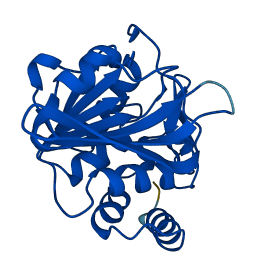
Descriptions
The autoinhibited protein was predicted that may have potential autoinhibitory elements via cis-regPred.
Autoinhibitory domains (AIDs)
Target domain |
|
Relief mechanism |
|
Assay |
cis-regPred |
Accessory elements
No accessory elements
Autoinhibited structure

Activated structure
1 structures for Q2SKW3
| Entry ID | Method | Resolution | Chain | Position | Source |
|---|---|---|---|---|---|
| AF-Q2SKW3-F1 | Predicted | AlphaFoldDB |
No variants for Q2SKW3
| Variant ID(s) | Position | Change | Description | Diseaes Association | Provenance |
|---|---|---|---|---|---|
| No variants for Q2SKW3 | |||||
No associated diseases with Q2SKW3
No regional properties for Q2SKW3
| Type | Name | Position | InterPro Accession |
|---|---|---|---|
| No domain, repeats, and functional sites for Q2SKW3 | |||
Functions
| Description | ||
|---|---|---|
| EC Number | 2.1.1.77 | Methyltransferases |
| Subcellular Localization |
|
|
| PANTHER Family | ||
| PANTHER Subfamily | ||
| PANTHER Protein Class | ||
| PANTHER Pathway Category | No pathway information available | |
1 GO annotations of cellular component
| Name | Definition |
|---|---|
| cytoplasm | The contents of a cell excluding the plasma membrane and nucleus, but including other subcellular structures. |
1 GO annotations of molecular function
| Name | Definition |
|---|---|
| protein-L-isoaspartate (D-aspartate) O-methyltransferase activity | Catalysis of the reaction: S-adenosyl-L-methionine + protein L-beta-aspartate = S-adenosyl-L-homocysteine + protein L-beta-aspartate methyl ester. |
1 GO annotations of biological process
| Name | Definition |
|---|---|
| protein repair | The process of restoring a protein to its original state after damage by such things as oxidation or spontaneous decomposition of residues. |
No homologous proteins in AiPD
| UniProt AC | Gene Name | Protein Name | Species | Evidence Code |
|---|---|---|---|---|
| No homologous proteins | ||||
| 10 | 20 | 30 | 40 | 50 | 60 |
| MTSRRTRLRL | IERLRKNGIQ | NEAVLEAMTE | IPRHIFVDEA | LAHRAYEDTA | LPIGHSQTIS |
| 70 | 80 | 90 | 100 | 110 | 120 |
| QPYIVARMTE | LLCSGWKPKR | VLEVGAGSGY | QTAILARLST | QVYTVERIAP | LLEKAKLRFK |
| 130 | 140 | 150 | 160 | 170 | 180 |
| ALKLNNVSAK | LSDGRWGWPE | QGPFDAIMVT | AAPEQTPSEL | LEQLADGGRL | VIPVGSGSEQ |
| 190 | 200 | 210 | |||
| MLKVYKRQGA | EIEESSLEQV | RFVPLLGGVV | R |