Q2PT31
Gene name |
MYOC |
Protein name |
Myocilin |
Names |
|
Species |
Canis lupus familiaris (Dog) (Canis familiaris) |
KEGG Pathway |
cfa:490344 |
EC number |
|
Protein Class |
|
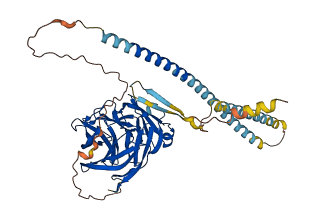
Descriptions
The autoinhibited protein was predicted that may have potential autoinhibitory elements via cis-regPred.
Autoinhibitory domains (AIDs)
Target domain |
|
Relief mechanism |
|
Assay |
cis-regPred |
Accessory elements
No accessory elements
Autoinhibited structure

Activated structure
1 structures for Q2PT31
| Entry ID | Method | Resolution | Chain | Position | Source |
|---|---|---|---|---|---|
| AF-Q2PT31-F1 | Predicted | AlphaFoldDB |
4 variants for Q2PT31
| Variant ID(s) | Position | Change | Description | Diseaes Association | Provenance |
|---|---|---|---|---|---|
| rs852526796 | 107 | R>* | No | EVA | |
| rs851717084 | 122 | S>R | No | EVA | |
| rs851906042 | 137 | R>Q | No | EVA | |
| rs851621828 | 339 | I>L | No | EVA |
No associated diseases with Q2PT31
1 regional properties for Q2PT31
| Type | Name | Position | InterPro Accession |
|---|---|---|---|
| conserved_site | Actin/actin-like conserved site | 119 - 131 | IPR020902 |
Functions
12 GO annotations of cellular component
| Name | Definition |
|---|---|
| cilium | A specialized eukaryotic organelle that consists of a filiform extrusion of the cell surface and of some cytoplasmic parts. Each cilium is largely bounded by an extrusion of the cytoplasmic (plasma) membrane, and contains a regular longitudinal array of microtubules, anchored to a basal body. |
| collagen-containing extracellular matrix | An extracellular matrix consisting mainly of proteins (especially collagen) and glycosaminoglycans (mostly as proteoglycans) that provides not only essential physical scaffolding for the cellular constituents but can also initiate crucial biochemical and biomechanical cues required for tissue morphogenesis, differentiation and homeostasis. The components are secreted by cells in the vicinity and form a sheet underlying or overlying cells such as endothelial and epithelial cells. |
| cytoplasmic vesicle | A vesicle found in the cytoplasm of a cell. |
| endoplasmic reticulum | The irregular network of unit membranes, visible only by electron microscopy, that occurs in the cytoplasm of many eukaryotic cells. The membranes form a complex meshwork of tubular channels, which are often expanded into slitlike cavities called cisternae. The ER takes two forms, rough (or granular), with ribosomes adhering to the outer surface, and smooth (with no ribosomes attached). |
| extracellular exosome | A vesicle that is released into the extracellular region by fusion of the limiting endosomal membrane of a multivesicular body with the plasma membrane. Extracellular exosomes, also simply called exosomes, have a diameter of about 40-100 nm. |
| extracellular space | That part of a multicellular organism outside the cells proper, usually taken to be outside the plasma membranes, and occupied by fluid. |
| Golgi apparatus | A membrane-bound cytoplasmic organelle of the endomembrane system that further processes the core oligosaccharides (e.g. N-glycans) added to proteins in the endoplasmic reticulum and packages them into membrane-bound vesicles. The Golgi apparatus operates at the intersection of the secretory, lysosomal, and endocytic pathways. |
| mitochondrial inner membrane | The inner, i.e. lumen-facing, lipid bilayer of the mitochondrial envelope. It is highly folded to form cristae. |
| mitochondrial intermembrane space | The region between the inner and outer lipid bilayers of the mitochondrial envelope. |
| mitochondrial outer membrane | The outer, i.e. cytoplasm-facing, lipid bilayer of the mitochondrial envelope. |
| node of Ranvier | An axon part that is a gap in the myelin where voltage-gated sodium channels cluster and saltatory conduction is executed. |
| rough endoplasmic reticulum | The rough (or granular) endoplasmic reticulum (ER) has ribosomes adhering to the outer surface; the ribosomes are the site of translation of the mRNA for those proteins which are either to be retained within the cisternae (ER-resident proteins), the proteins of the lysosomes, or the proteins destined for export from the cell. Glycoproteins undergo their initial glycosylation within the cisternae. |
5 GO annotations of molecular function
| Name | Definition |
|---|---|
| fibronectin binding | Binding to a fibronectin, a group of related adhesive glycoproteins of high molecular weight found on the surface of animal cells, connective tissue matrices, and in extracellular fluids. |
| frizzled binding | Binding to a frizzled (fz) receptor. |
| metal ion binding | Binding to a metal ion. |
| myosin light chain binding | Binding to a light chain of a myosin complex. |
| receptor tyrosine kinase binding | Binding to a receptor that possesses protein tyrosine kinase activity. |
20 GO annotations of biological process
| Name | Definition |
|---|---|
| bone development | The process whose specific outcome is the progression of bone over time, from its formation to the mature structure. Bone is the hard skeletal connective tissue consisting of both mineral and cellular components. |
| clustering of voltage-gated sodium channels | The process in which voltage-gated sodium channels become localized together in high densities. In animals, nodes of Ranvier differ dramatically from internodal axonal regions in very high densities of voltage-dependent sodium (Nav) channels responsible for the rapid, inward ionic currents that produce membrane depolarization. |
| ERBB2-ERBB3 signaling pathway | The series of molecular signals initiated by binding of a ligand to a ERBB3 receptor on the surface of a cell, followed by transmission of the signal by a heterodimeric complex of ERBB2 and ERBB3. ERBB2, which does not bind any known ligand, is activated through formation of a heterodimer with another ligand-activated ERBB family member such as ERBB3. ERBB3 also has impaired kinase activity and relies on ERBB2 for activation and signal transmission. |
| myelination in peripheral nervous system | The process in which neuronal axons and dendrites become coated with a segmented lipid-rich sheath (myelin) to enable faster and more energetically efficient conduction of electrical impulses. The sheath is formed by the cell membranes of Schwann cells in the peripheral nervous system. Adjacent myelin segments are separated by a non-myelinated stretch of axon called a node of Ranvier. |
| negative regulation of cell-matrix adhesion | Any process that stops, prevents, or reduces the rate or extent of cell adhesion to the extracellular matrix. |
| negative regulation of Rho protein signal transduction | Any process that stops, prevents, or reduces the frequency, rate or extent of Rho protein signal transduction. |
| negative regulation of stress fiber assembly | Any process that stops, prevents, or reduces the frequency, rate or extent of the assembly a stress fiber, a bundle of microfilaments and other proteins found in fibroblasts. |
| neuron projection development | The process whose specific outcome is the progression of a neuron projection over time, from its formation to the mature structure. A neuron projection is any process extending from a neural cell, such as axons or dendrites (collectively called neurites). |
| non-canonical Wnt signaling pathway via JNK cascade | The series of molecular signals initiated by binding of a Wnt protein to a frizzled family receptor on the surface of the target cell, where the signal is passed on via the JNK cascade. |
| osteoblast differentiation | The process whereby a relatively unspecialized cell acquires the specialized features of an osteoblast, a mesodermal or neural crest cell that gives rise to bone. |
| positive regulation of cell migration | Any process that activates or increases the frequency, rate or extent of cell migration. |
| positive regulation of focal adhesion assembly | Any process that activates or increases the frequency, rate or extent of focal adhesion assembly, the establishment and maturation of focal adhesions. |
| positive regulation of mitochondrial depolarization | Any process that activates, maintains or increases the frequency, rate or extent of the change in the membrane potential of the mitochondria from negative to positive. |
| positive regulation of phosphatidylinositol 3-kinase signaling | Any process that activates or increases the frequency, rate or extent of signal transduction mediated by the phosphatidylinositol 3-kinase cascade. |
| positive regulation of protein kinase B signaling | Any process that activates or increases the frequency, rate or extent of protein kinase B signaling, a series of reactions mediated by the intracellular serine/threonine kinase protein kinase B. |
| positive regulation of stress fiber assembly | Any process that activates or increases the frequency, rate or extent of the assembly of a stress fiber, a bundle of microfilaments and other proteins found in fibroblasts. |
| positive regulation of substrate adhesion-dependent cell spreading | Any process that activates or increases the frequency, rate or extent of substrate adhesion-dependent cell spreading. |
| regulation of MAPK cascade | Any process that modulates the frequency, rate or extent of signal transduction mediated by the MAP kinase (MAPK) cascade. |
| signal transduction | The cellular process in which a signal is conveyed to trigger a change in the activity or state of a cell. Signal transduction begins with reception of a signal (e.g. a ligand binding to a receptor or receptor activation by a stimulus such as light), or for signal transduction in the absence of ligand, signal-withdrawal or the activity of a constitutively active receptor. Signal transduction ends with regulation of a downstream cellular process, e.g. regulation of transcription or regulation of a metabolic process. Signal transduction covers signaling from receptors located on the surface of the cell and signaling via molecules located within the cell. For signaling between cells, signal transduction is restricted to events at and within the receiving cell. |
| skeletal muscle hypertrophy | The enlargement or overgrowth of all or part of an organ due to an increase in size (not length) of individual muscle fibers without cell division. In the case of skeletal muscle cells this happens due to the additional synthesis of sarcomeric proteins and assembly of myofibrils. |
| 10 | 20 | 30 | 40 | 50 | 60 |
| MPTAQLLLLA | CLLWGLEART | AQLRKANDRS | GRCQYIFSVA | SPNESSCPEQ | GQAMSAIQDL |
| 70 | 80 | 90 | 100 | 110 | 120 |
| QRDLESTKAR | LSSLEGLLHQ | LTLGQAAGPS | ESQEGLHREL | GTLRKEREQL | ETQARELEVA |
| 130 | 140 | 150 | 160 | 170 | 180 |
| YSNLLRDKSA | LEEEKRRLGE | ENEDLAQRLE | HSSQEVARLR | RGQCPQAHSS | SQDVPAGSRE |
| 190 | 200 | 210 | 220 | 230 | 240 |
| VSKWNVETVN | FQELKSELTE | VPASRILKES | PSGHPRNEEG | DSGCGELVWV | GEPLTLRTAE |
| 250 | 260 | 270 | 280 | 290 | 300 |
| TITGKYGVWM | RDPKPTYPHT | RETTWRIDTV | GTDIRQVFEY | ELASQFLQGY | PSKVHVLPRP |
| 310 | 320 | 330 | 340 | 350 | 360 |
| LESTGAVVYR | GSLYFQGAGS | GTVVRYELTA | ETVKAEREIP | GAGYHGQFPY | SWGGYTDIDL |
| 370 | 380 | 390 | 400 | 410 | 420 |
| AVDETGLWVI | YSTQEAKGAI | VLSKLNPETL | ELEQTWETNI | RKQSVANAFV | ICGHLYTISS |
| 430 | 440 | 450 | 460 | 470 | 480 |
| YSSPDATVNF | AYDTGTGRSR | VLSIPFKNRY | KYSSMIDYNP | LEKKLFAWDN | FNMVTYDIRL |
| SKM |