Q2P352
Gene name |
msrQ |
Protein name |
Protein-methionine-sulfoxide reductase heme-binding subunit MsrQ |
Names |
Flavocytochrome MsrQ |
Species |
Xanthomonas oryzae pv oryzae (strain MAFF 311018) |
KEGG Pathway |
xom:XOO2270 |
EC number |
|
Protein Class |
|
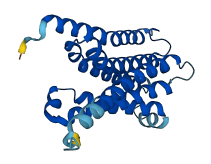
Descriptions
The autoinhibited protein was predicted that may have potential autoinhibitory elements via cis-regPred.
Autoinhibitory domains (AIDs)
Target domain |
|
Relief mechanism |
|
Assay |
cis-regPred |
Accessory elements
No accessory elements
Autoinhibited structure

Activated structure
1 structures for Q2P352
| Entry ID | Method | Resolution | Chain | Position | Source |
|---|---|---|---|---|---|
| AF-Q2P352-F1 | Predicted | AlphaFoldDB |
No variants for Q2P352
| Variant ID(s) | Position | Change | Description | Diseaes Association | Provenance |
|---|---|---|---|---|---|
| No variants for Q2P352 | |||||
No associated diseases with Q2P352
1 GO annotations of cellular component
| Name | Definition |
|---|---|
| integral component of plasma membrane | The component of the plasma membrane consisting of the gene products and protein complexes having at least some part of their peptide sequence embedded in the hydrophobic region of the membrane. |
4 GO annotations of molecular function
| Name | Definition |
|---|---|
| electron transfer activity | Any molecular entity that serves as an electron acceptor and electron donor in an electron transport chain. An electron transport chain is a process in which a series of electron carriers operate together to transfer electrons from donors to any of several different terminal electron acceptors to generate a transmembrane electrochemical gradient. |
| FMN binding | Binding to flavin mono nucleotide. Flavin mono nucleotide (FMN) is the coenzyme or the prosthetic group of various flavoprotein oxidoreductase enzymes. |
| heme binding | Binding to a heme, a compound composed of iron complexed in a porphyrin (tetrapyrrole) ring. |
| metal ion binding | Binding to a metal ion. |
1 GO annotations of biological process
| Name | Definition |
|---|---|
| protein repair | The process of restoring a protein to its original state after damage by such things as oxidation or spontaneous decomposition of residues. |
No homologous proteins in AiPD
| UniProt AC | Gene Name | Protein Name | Species | Evidence Code |
|---|---|---|---|---|
| No homologous proteins | ||||
| 10 | 20 | 30 | 40 | 50 | 60 |
| MAKTSTSVIV | AKTLVHAAAL | APIALLGWQF | WQVWQSGSDA | LGADPVAEIE | HRTGLWALRF |
| 70 | 80 | 90 | 100 | 110 | 120 |
| LLITLAITPL | RQLTGQAVLI | RFRRMLGLYA | FFYATVHLAA | YLTLDLRGFW | TQIFEEILKR |
| 130 | 140 | 150 | 160 | 170 | 180 |
| PYITVGFAAW | LLLMPLAITS | TQGWMRRLKR | NWGRVHMLIY | PIGLLAVLHF | WWLVKSDIRE |
| 190 | 200 | 210 | |||
| PALYAGILAV | LLGWRAWKKL | SARRTKARRS | APPQATPR |