Q2N9K0
Gene name |
smpB |
Protein name |
SsrA-binding protein |
Names |
Small protein B |
Species |
Erythrobacter litoralis (strain HTCC2594) |
KEGG Pathway |
eli:ELI_07745 |
EC number |
|
Protein Class |
|
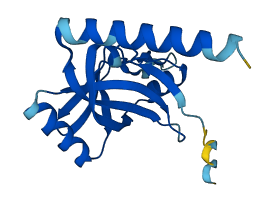
Descriptions
The autoinhibited protein was predicted that may have potential autoinhibitory elements via cis-regPred.
Autoinhibitory domains (AIDs)
Target domain |
|
Relief mechanism |
|
Assay |
cis-regPred |
Accessory elements
No accessory elements
Autoinhibited structure

Activated structure
1 structures for Q2N9K0
| Entry ID | Method | Resolution | Chain | Position | Source |
|---|---|---|---|---|---|
| AF-Q2N9K0-F1 | Predicted | AlphaFoldDB |
No variants for Q2N9K0
| Variant ID(s) | Position | Change | Description | Diseaes Association | Provenance |
|---|---|---|---|---|---|
| No variants for Q2N9K0 | |||||
No associated diseases with Q2N9K0
7 regional properties for Q2N9K0
| Type | Name | Position | InterPro Accession |
|---|---|---|---|
| domain | Signal transduction response regulator, receiver domain | 612 - 730 | IPR001789 |
| domain | GAF domain | 157 - 315 | IPR003018 |
| domain | Histidine kinase/HSP90-like ATPase | 453 - 585 | IPR003594 |
| domain | Signal transduction histidine kinase, dimerisation/phosphoacceptor domain | 340 - 406 | IPR003661 |
| domain | Signal transduction histidine kinase-related protein, C-terminal | 509 - 523 | IPR004358-1 |
| domain | Signal transduction histidine kinase-related protein, C-terminal | 544 - 562 | IPR004358-2 |
| domain | Histidine kinase domain | 348 - 585 | IPR005467 |
1 GO annotations of cellular component
| Name | Definition |
|---|---|
| cytoplasm | The contents of a cell excluding the plasma membrane and nucleus, but including other subcellular structures. |
1 GO annotations of molecular function
| Name | Definition |
|---|---|
| RNA binding | Binding to an RNA molecule or a portion thereof. |
1 GO annotations of biological process
| Name | Definition |
|---|---|
| trans-translation | A translational elongation process in which transfer of a translating ribosome from one mRNA to another RNA template takes place. Trans-translation occurs during tmRNA release of stalled ribosomes. |
No homologous proteins in AiPD
| UniProt AC | Gene Name | Protein Name | Species | Evidence Code |
|---|---|---|---|---|
| No homologous proteins | ||||
| 10 | 20 | 30 | 40 | 50 | 60 |
| MARPKPETFD | KQKTVAENRR | ARFDYAVEDK | FEAGIALQGT | EVKALRAGEA | SIAESYAEVR |
| 70 | 80 | 90 | 100 | 110 | 120 |
| DGEAWLINAN | IPEYSHGNRL | NHQPRRPRKL | LLHNREIERL | LGAVERKGMT | LVPLSIYFNS |
| 130 | 140 | 150 | |||
| RGRAKVELAL | AKGRQAQDKR | EYIKDRDWKR | DKARIMRDKG |