Q2KI41
Gene name |
CYTH2 (PSCD2) |
Protein name |
Cytohesin-2 |
Names |
PH, SEC7 and coiled-coil domain-containing protein 2 |
Species |
Bos taurus (Bovine) |
KEGG Pathway |
bta:768035 |
EC number |
|
Protein Class |
|
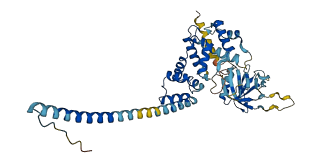
Descriptions
Autoinhibitory domains (AIDs)
Target domain |
58-246 (Sec7 domain) |
Relief mechanism |
Partner binding |
Assay |
|
Target domain |
58-246 (Sec7 domain) |
Relief mechanism |
Partner binding |
Assay |
|
Accessory elements
No accessory elements
References
- Yeon JH et al. (2016) "Systems-wide Identification of cis-Regulatory Elements in Proteins", Cell systems, 2, 89-100
- Malaby AW et al. (2013) "Structural basis for membrane recruitment and allosteric activation of cytohesin family Arf GTPase exchange factors", Proceedings of the National Academy of Sciences of the United States of America, 110, 14213-8
- DiNitto JP et al. (2007) "Structural basis and mechanism of autoregulation in 3-phosphoinositide-dependent Grp1 family Arf GTPase exchange factors", Molecular cell, 28, 569-83
Autoinhibited structure

Activated structure
1 structures for Q2KI41
| Entry ID | Method | Resolution | Chain | Position | Source |
|---|---|---|---|---|---|
| AF-Q2KI41-F1 | Predicted | AlphaFoldDB |
No variants for Q2KI41
| Variant ID(s) | Position | Change | Description | Diseaes Association | Provenance |
|---|---|---|---|---|---|
| No variants for Q2KI41 | |||||
4 associated diseases with Q2KI41
[MIM: 204000]: Leber congenital amaurosis 1 (LCA1)
A severe dystrophy of the retina, typically becoming evident in the first years of life. Visual function is usually poor and often accompanied by nystagmus, sluggish or near-absent pupillary responses, photophobia, high hyperopia and keratoconus. {ECO:0000269|PubMed:11035546, ECO:0000269|PubMed:12365911, ECO:0000269|PubMed:15123990, ECO:0000269|PubMed:17724218, ECO:0000269|PubMed:21602930, ECO:0000269|PubMed:27475985, ECO:0000269|PubMed:30319355, ECO:0000269|PubMed:8944027, ECO:0000269|PubMed:9888789}. Note=The disease is caused by variants affecting the gene represented in this entry.
[MIM: 601777]: Cone-rod dystrophy 6 (CORD6)
An inherited retinal dystrophy characterized by retinal pigment deposits visible on fundus examination, predominantly in the macular region, and initial loss of cone photoreceptors followed by rod degeneration. This leads to decreased visual acuity and sensitivity in the central visual field, followed by loss of peripheral vision. Severe loss of vision occurs earlier than in retinitis pigmentosa, due to cone photoreceptors degenerating at a higher rate than rod photoreceptors. {ECO:0000269|PubMed:12552567, ECO:0000269|PubMed:15111605, ECO:0000269|PubMed:18332321, ECO:0000269|PubMed:18487367, ECO:0000269|PubMed:20517349, ECO:0000269|PubMed:21552474, ECO:0000269|PubMed:22194653, ECO:0000269|PubMed:23734073, ECO:0000269|PubMed:24480840, ECO:0000269|PubMed:25515582, ECO:0000269|PubMed:27475985, ECO:0000269|PubMed:30319355, ECO:0000269|PubMed:9618177, ECO:0000269|PubMed:9683616}. Note=The disease is caused by variants affecting the gene represented in this entry.
[MIM: 215500]: Choroidal dystrophy, central areolar, 1 (CACD1)
A form of central areolar choroidal dystrophy, a retinal disease that affects the macula and results in a well-demarcated circumscribed area of atrophy of the pigment epithelium and choriocapillaris. CACD1 inheritance is autosomal recessive. {ECO:0000269|PubMed:22695961}. Note=The disease may be caused by variants affecting the gene represented in this entry.
[MIM: 618555]: Night blindness, congenital stationary, 1I (CSNB1I)
A form of congenital stationary night blindness, a non-progressive retinal disorder characterized by impaired night vision or in dim light, with good vision only on bright days. CSNB1I patients present with night blindness from infancy or early childhood. Visual acuity is preserved, but some patients have color vision and/or visual field defects. Progression to mild retinitis pigmentosa may occur. CSNB1I inheritance is autosomal recessive. {ECO:0000269|PubMed:29559409}. Note=The disease is caused by variants affecting the gene represented in this entry.
Without disease ID
- A severe dystrophy of the retina, typically becoming evident in the first years of life. Visual function is usually poor and often accompanied by nystagmus, sluggish or near-absent pupillary responses, photophobia, high hyperopia and keratoconus. {ECO:0000269|PubMed:11035546, ECO:0000269|PubMed:12365911, ECO:0000269|PubMed:15123990, ECO:0000269|PubMed:17724218, ECO:0000269|PubMed:21602930, ECO:0000269|PubMed:27475985, ECO:0000269|PubMed:30319355, ECO:0000269|PubMed:8944027, ECO:0000269|PubMed:9888789}. Note=The disease is caused by variants affecting the gene represented in this entry.
- An inherited retinal dystrophy characterized by retinal pigment deposits visible on fundus examination, predominantly in the macular region, and initial loss of cone photoreceptors followed by rod degeneration. This leads to decreased visual acuity and sensitivity in the central visual field, followed by loss of peripheral vision. Severe loss of vision occurs earlier than in retinitis pigmentosa, due to cone photoreceptors degenerating at a higher rate than rod photoreceptors. {ECO:0000269|PubMed:12552567, ECO:0000269|PubMed:15111605, ECO:0000269|PubMed:18332321, ECO:0000269|PubMed:18487367, ECO:0000269|PubMed:20517349, ECO:0000269|PubMed:21552474, ECO:0000269|PubMed:22194653, ECO:0000269|PubMed:23734073, ECO:0000269|PubMed:24480840, ECO:0000269|PubMed:25515582, ECO:0000269|PubMed:27475985, ECO:0000269|PubMed:30319355, ECO:0000269|PubMed:9618177, ECO:0000269|PubMed:9683616}. Note=The disease is caused by variants affecting the gene represented in this entry.
- A form of central areolar choroidal dystrophy, a retinal disease that affects the macula and results in a well-demarcated circumscribed area of atrophy of the pigment epithelium and choriocapillaris. CACD1 inheritance is autosomal recessive. {ECO:0000269|PubMed:22695961}. Note=The disease may be caused by variants affecting the gene represented in this entry.
- A form of congenital stationary night blindness, a non-progressive retinal disorder characterized by impaired night vision or in dim light, with good vision only on bright days. CSNB1I patients present with night blindness from infancy or early childhood. Visual acuity is preserved, but some patients have color vision and/or visual field defects. Progression to mild retinitis pigmentosa may occur. CSNB1I inheritance is autosomal recessive. {ECO:0000269|PubMed:29559409}. Note=The disease is caused by variants affecting the gene represented in this entry.
3 regional properties for Q2KI41
| Type | Name | Position | InterPro Accession |
|---|---|---|---|
| domain | Cyclin, N-terminal | 36 - 143 | IPR006671 |
| domain | Cyclin-like domain | 41 - 139 | IPR013763-1 |
| domain | Cyclin-like domain | 152 - 231 | IPR013763-2 |
Functions
3 GO annotations of cellular component
| Name | Definition |
|---|---|
| cytoplasm | The contents of a cell excluding the plasma membrane and nucleus, but including other subcellular structures. |
| growth cone | The migrating motile tip of a growing neuron projection, where actin accumulates, and the actin cytoskeleton is the most dynamic. |
| plasma membrane | The membrane surrounding a cell that separates the cell from its external environment. It consists of a phospholipid bilayer and associated proteins. |
3 GO annotations of molecular function
| Name | Definition |
|---|---|
| guanyl-nucleotide exchange factor activity | Stimulates the exchange of GDP to GTP on a signaling GTPase, changing its conformation to its active form. Guanine nucleotide exchange factors (GEFs) act by stimulating the release of guanosine diphosphate (GDP) to allow binding of guanosine triphosphate (GTP), which is more abundant in the cell under normal cellular physiological conditions. |
| inositol 1,4,5 trisphosphate binding | Binding to inositol 1,4,5 trisphosphate. |
| lipid binding | Binding to a lipid. |
1 GO annotations of biological process
| Name | Definition |
|---|---|
| regulation of ARF protein signal transduction | Any process that modulates the frequency, rate or extent of ARF protein signal transduction. |
12 homologous proteins in AiPD
| UniProt AC | Gene Name | Protein Name | Species | Evidence Code |
|---|---|---|---|---|
| O46382 | ARFGEF1 | Brefeldin A-inhibited guanine nucleotide-exchange protein 1 | Bos taurus (Bovine) | PR |
| Q9UIA0 | CYTH4 | Cytohesin-4 | Homo sapiens (Human) | SS |
| O43739 | CYTH3 | Cytohesin-3 | Homo sapiens (Human) | EV |
| Q15438 | CYTH1 | Cytohesin-1 | Homo sapiens (Human) | SS |
| Q99418 | CYTH2 | Cytohesin-2 | Homo sapiens (Human) | SS |
| Q9QX11 | Cyth1 | Cytohesin-1 | Mus musculus (Mouse) | SS |
| Q80YW0 | Cyth4 | Cytohesin-4 | Mus musculus (Mouse) | SS |
| O08967 | Cyth3 | Cytohesin-3 | Mus musculus (Mouse) | EV |
| P63034 | Cyth2 | Cytohesin-2 | Mus musculus (Mouse) | SS |
| P97696 | Cyth3 | Cytohesin-3 | Rattus norvegicus (Rat) | SS |
| P97694 | Cyth1 | Cytohesin-1 | Rattus norvegicus (Rat) | SS |
| P63035 | Cyth2 | Cytohesin-2 | Rattus norvegicus (Rat) | SS |
| 10 | 20 | 30 | 40 | 50 | 60 |
| MEDGVYEPPD | LTPEERMELE | NIRRRKQELL | VEIQRLREEL | SEAMSEVEGL | EANEGSKTLQ |
| 70 | 80 | 90 | 100 | 110 | 120 |
| RNRKMAMGRK | KFNMDPKKGI | QFLVENELLQ | NTPEEIARFL | YKGEGLNKTA | IGDYLGEREE |
| 130 | 140 | 150 | 160 | 170 | 180 |
| LNLAVLHAFV | DLHEFTDLNL | VQALRQFLWS | FRLPGEAQKI | DRMMEAFAQR | YCLCNPGVFQ |
| 190 | 200 | 210 | 220 | 230 | 240 |
| STDTCYVLSF | AVIMLNTSLH | NPNVRDKPGL | ERFVAMNRGI | NEGGDLPEEL | LRNLYDSIRN |
| 250 | 260 | 270 | 280 | 290 | 300 |
| EPFKIPEDDG | NDLTHTFFNP | DREGWLLKLG | AQAPSPPSLP | GGRVKTWKRR | WFILTDNCLY |
| 310 | 320 | 330 | 340 | 350 | 360 |
| YFEYTTDKEP | RGIIPLENLS | IREVDDPRKP | NCFELYIPNN | KGQLIKACKT | EADGRVVEGN |
| 370 | 380 | 390 | 400 | ||
| HMVYRISAPT | QEEKDEWIKS | IQAAVSVDPF | YEMLAARKKR | ISVKKKQEQP |