Q2JKD9
Gene name |
sasA |
Protein name |
Adaptive-response sensory-kinase SasA |
Names |
Synechococcus adaptive sensor protein A |
Species |
Synechococcus sp. (strain JA-2-3B'a(2-13)) (Cyanobacteria bacterium Yellowstone B-Prime) |
KEGG Pathway |
cyb:CYB_1895 |
EC number |
2.7.13.3: Protein-histidine kinases |
Protein Class |
|
Descriptions
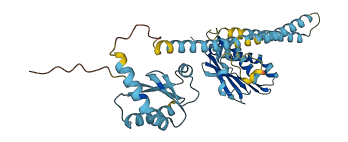
The autoinhibited protein was predicted that may have potential autoinhibitory elements via cis-regPred.
Autoinhibitory domains (AIDs)
Target domain |
|
Relief mechanism |
|
Assay |
cis-regPred |
Accessory elements
No accessory elements
Autoinhibited structure

Activated structure
1 structures for Q2JKD9
| Entry ID | Method | Resolution | Chain | Position | Source |
|---|---|---|---|---|---|
| AF-Q2JKD9-F1 | Predicted | AlphaFoldDB |
No variants for Q2JKD9
| Variant ID(s) | Position | Change | Description | Diseaes Association | Provenance |
|---|---|---|---|---|---|
| No variants for Q2JKD9 | |||||
No associated diseases with Q2JKD9
7 regional properties for Q2JKD9
| Type | Name | Position | InterPro Accession |
|---|---|---|---|
| domain | Histidine kinase/HSP90-like ATPase | 262 - 373 | IPR003594 |
| domain | Signal transduction histidine kinase, dimerisation/phosphoacceptor domain | 145 - 216 | IPR003661 |
| domain | Signal transduction histidine kinase-related protein, C-terminal | 300 - 314 | IPR004358-1 |
| domain | Signal transduction histidine kinase-related protein, C-terminal | 333 - 351 | IPR004358-2 |
| domain | Signal transduction histidine kinase-related protein, C-terminal | 357 - 370 | IPR004358-3 |
| domain | Histidine kinase domain | 154 - 373 | IPR005467 |
| domain | KaiB domain | 17 - 98 | IPR011649 |
Functions
| Description | ||
|---|---|---|
| EC Number | 2.7.13.3 | Protein-histidine kinases |
| Subcellular Localization |
|
|
| PANTHER Family | ||
| PANTHER Subfamily | ||
| PANTHER Protein Class | ||
| PANTHER Pathway Category | No pathway information available | |
No GO annotations of cellular component
| Name | Definition |
|---|---|
| No GO annotations for cellular component |
1 GO annotations of molecular function
| Name | Definition |
|---|---|
| phosphorelay sensor kinase activity | Catalysis of the phosphorylation of a histidine residue in response to detection of an extracellular signal such as a chemical ligand or change in environment, to initiate a change in cell state or activity. The two-component sensor is a histidine kinase that autophosphorylates a histidine residue in its active site. The phosphate is then transferred to an aspartate residue in a downstream response regulator, to trigger a response. |
1 GO annotations of biological process
| Name | Definition |
|---|---|
| circadian rhythm | Any biological process in an organism that recurs with a regularity of approximately 24 hours. |
No homologous proteins in AiPD
| UniProt AC | Gene Name | Protein Name | Species | Evidence Code |
|---|---|---|---|---|
| No homologous proteins | ||||
| 10 | 20 | 30 | 40 | 50 | 60 |
| MQTSPDLTSA | RSVIRLLLFA | KSRAVVAELE | EHLRQHIQGL | PGQYPAQLEV | VPLEEHPYLA |
| 70 | 80 | 90 | 100 | 110 | 120 |
| EHYKLVATPA | LVKAEPLPAQ | VLAGADLATQ | LEVWWPRWQG | QAALAAHQEG | AGRDPASPPT |
| 130 | 140 | 150 | 160 | 170 | 180 |
| TEALLQMSEE | VFLLRQERAQ | LREQLDFKDR | VLAMLVHDLR | SPLTATALAV | ETLQQGREGS |
| 190 | 200 | 210 | 220 | 230 | 240 |
| LDKALERQLF | DHARQQLRKM | DSMITDILES | ARGAASELRI | RAVETQLPGL | CQAVIEELWP |
| 250 | 260 | 270 | 280 | 290 | 300 |
| RIQGKRLQFQ | ADIPVDLPSV | HVDPDKIRQV | LFNLLDNAIK | YTPAGGSIRL | DVLHRTSQKV |
| 310 | 320 | 330 | 340 | 350 | 360 |
| QVTVSDTGPG | IPEADQESIF | SDSVRLSRDQ | QQEGYGIGLS | LCRRIVRAHY | GQIWVESSLG |
| 370 | |||||
| KGSSFHFTLP | VYRLCKR |