Q2IKX9
Gene name |
secD |
Protein name |
Protein translocase subunit SecD |
Names |
|
Species |
Anaeromyxobacter dehalogenans (strain 2CP-C) |
KEGG Pathway |
ade:Adeh_2540 |
EC number |
|
Protein Class |
|
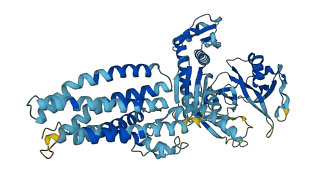
Descriptions
The autoinhibited protein was predicted that may have potential autoinhibitory elements via cis-regPred.
Autoinhibitory domains (AIDs)
Target domain |
|
Relief mechanism |
|
Assay |
cis-regPred |
Accessory elements
No accessory elements
Autoinhibited structure

Activated structure
1 structures for Q2IKX9
| Entry ID | Method | Resolution | Chain | Position | Source |
|---|---|---|---|---|---|
| AF-Q2IKX9-F1 | Predicted | AlphaFoldDB |
No variants for Q2IKX9
| Variant ID(s) | Position | Change | Description | Diseaes Association | Provenance |
|---|---|---|---|---|---|
| No variants for Q2IKX9 | |||||
No associated diseases with Q2IKX9
No regional properties for Q2IKX9
| Type | Name | Position | InterPro Accession |
|---|---|---|---|
| No domain, repeats, and functional sites for Q2IKX9 | |||
2 GO annotations of cellular component
| Name | Definition |
|---|---|
| integral component of membrane | The component of a membrane consisting of the gene products and protein complexes having at least some part of their peptide sequence embedded in the hydrophobic region of the membrane. |
| plasma membrane | The membrane surrounding a cell that separates the cell from its external environment. It consists of a phospholipid bilayer and associated proteins. |
1 GO annotations of molecular function
| Name | Definition |
|---|---|
| protein-transporting ATPase activity | Primary active carrier-mediated transport of a protein across a membrane, driven by the hydrolysis of the diphosphate bond of inorganic pyrophosphate, ATP, or another nucleoside triphosphate. The transport protein may or may not be transiently phosphorylated, but the substrate is not phosphorylated. |
3 GO annotations of biological process
| Name | Definition |
|---|---|
| intracellular protein transmembrane transport | The directed movement of proteins in a cell, from one side of a membrane to another by means of some agent such as a transporter or pore. |
| protein targeting | The process of targeting specific proteins to particular regions of the cell, typically membrane-bounded subcellular organelles. Usually requires an organelle specific protein sequence motif. |
| protein transport by the Sec complex | The process in which unfolded proteins are transported across the cytoplasmic membrane in Gram-positive and Gram-negative bacteria by the Sec complex, in a process involving proteolytic cleavage of an N-terminal signal peptide. |
No homologous proteins in AiPD
| UniProt AC | Gene Name | Protein Name | Species | Evidence Code |
|---|---|---|---|---|
| No homologous proteins | ||||
| 10 | 20 | 30 | 40 | 50 | 60 |
| MERSWYWRVA | LVVAVAILSI | YQLVPSWFYF | KLPPDQRNTE | AYDTSVPGWA | PDAKHHLNLG |
| 70 | 80 | 90 | 100 | 110 | 120 |
| LDLQGGILLS | MGVDVDRAVK | TKVARRADEI | GEFLKGKNVA | FTGTKVVGGG | AQVEVSAANP |
| 130 | 140 | 150 | 160 | 170 | 180 |
| GEVKDAVLGS | TGYSEEMYSP | GGAPDGAVRF | AFKDSVLRDF | REKAVKQAEK | VIRNRVDKWG |
| 190 | 200 | 210 | 220 | 230 | 240 |
| VTEPDIKTKA | NNQIQVQLPG | FKDPEKAKEL | LGRTAQLEFK | IADDENPVLD | QVRTQLPQCQ |
| 250 | 260 | 270 | 280 | 290 | 300 |
| GDRQGLSLPL | PESGCWTVEP | VELPSGGSRA | ATMVAANTRT | ELEKVITEKL | NPLLDPQKNV |
| 310 | 320 | 330 | 340 | 350 | 360 |
| VGIGEGQVGQ | GPIKTTYYRT | YLLRAKTELT | GDYIADAAVA | IDQSDTLQRG | RPVVSFKMSP |
| 370 | 380 | 390 | 400 | 410 | 420 |
| EGARLMDKLT | SENMRRRMAT | VLDDKVETAP | YIQGRISSNG | QITLGSGRNQ | QDMFDEANGI |
| 430 | 440 | 450 | 460 | 470 | 480 |
| ALVLKAGALP | APVTITEERT | VGATLGPELV | RKGTLAALVG | LALVVVFMVV | YYRGTGLVAD |
| 490 | 500 | 510 | 520 | 530 | 540 |
| VALALNGLLV | LAVMSMIGTT | LTLPGIAGFV | LTLGMAVDAN | VLINERIREE | MRAGRNVRQS |
| 550 | 560 | 570 | 580 | 590 | 600 |
| VQLGYDRVFW | TIVDSHVTTL | VAGVVLFQYG | SGPIRGFAVT | LIIGLVASMF | TSIVVTRVIM |
| 610 | |||||
| EYFTRHDTAR | LSV |