Q29RS5
Gene name |
RARRES2 |
Protein name |
Retinoic acid receptor responder protein 2 |
Names |
Chemerin |
Species |
Bos taurus (Bovine) |
KEGG Pathway |
bta:508990 |
EC number |
|
Protein Class |
|
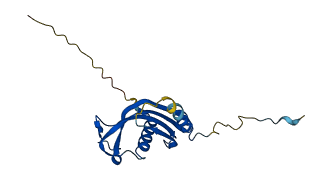
Descriptions
The autoinhibited protein was predicted that may have potential autoinhibitory elements via cis-regPred.
Autoinhibitory domains (AIDs)
Target domain |
|
Relief mechanism |
|
Assay |
cis-regPred |
Accessory elements
No accessory elements
Autoinhibited structure

Activated structure
1 structures for Q29RS5
| Entry ID | Method | Resolution | Chain | Position | Source |
|---|---|---|---|---|---|
| AF-Q29RS5-F1 | Predicted | AlphaFoldDB |
51 variants for Q29RS5
| Variant ID(s) | Position | Change | Description | Diseaes Association | Provenance |
|---|---|---|---|---|---|
| rs472099857 | 2 | W>G | No | EVA | |
| rs444405039 | 10 | L>R | No | EVA | |
| rs434048443 | 12 | L>R | No | EVA | |
| rs455775190 | 12 | L>V | No | EVA | |
| rs467070990 | 14 | T>P | No | EVA | |
| rs432996720 | 16 | G>A | No | EVA | |
| rs450707388 | 19 | R>G | No | EVA | |
| rs480359448 | 20 | A>G | No | EVA | |
| rs480359448 | 20 | A>V | No | EVA | |
| rs876282426 | 27 | H>P | No | EVA | |
| rs467987186 | 32 | V>G | No | EVA | |
| rs479527572 | 37 | F>L | No | EVA | |
| rs457789997 | 44 | L>P | No | EVA | |
| rs438941166 | 47 | F>L | No | EVA | |
| rs478458461 | 50 | T>P | No | EVA | |
| rs463193728 | 54 | N>K | No | EVA | |
| rs480815211 | 64 | Q>P | No | EVA | |
| rs462408143 | 66 | V>L | No | EVA | |
| rs447089343 | 67 | R>G | No | EVA | |
| rs458053488 | 72 | L>R | No | EVA | |
| rs439579998 | 77 | C>R | No | EVA | |
| rs468969857 | 94 | R>* | No | EVA | |
| rs473277674 | 104 | L>P | No | EVA | |
| rs458081202 | 105 | D>N | No | EVA | |
| rs439321793 | 105 | D>V | No | EVA | |
| rs469888042 | 126 | E>G | No | EVA | |
| rs436870863 | 126 | E>K | No | EVA | |
| rs435788180 | 127 | L>P | No | EVA | |
| rs435788180 | 127 | L>R | No | EVA | |
| rs457438627 | 127 | L>V | No | EVA | |
| rs468809023 | 128 | D>A | No | EVA | |
| rs447126187 | 128 | D>E | No | EVA | |
| rs468809023 | 128 | D>G | No | EVA | |
| rs479949828 | 129 | D>A | No | EVA | |
| rs384157091 | 132 | D>E | No | EVA | |
| rs446022064 | 132 | D>G | No | EVA | |
| rs441755227 | 133 | A>D | No | EVA | |
| rs463872567 | 133 | A>P | No | EVA | |
| rs481254599 | 134 | Q>R | No | EVA | |
| rs459528839 | 135 | C>S | No | EVA | |
| rs441119894 | 135 | C>W | No | EVA | |
| rs470914684 | 136 | S>N | No | EVA | |
| rs452089786 | 136 | S>R | No | EVA | |
| rs443263336 | 137 | R>M | No | EVA | |
| rs476258713 | 138 | V>G | No | EVA | |
| rs133604819 | 144 | D>A | No | EVA | |
| rs381055249 | 147 | S>G | No | EVA | |
| rs475233276 | 149 | Y>F | No | EVA | |
| rs453475583 | 154 | F>L | No | EVA | |
| rs435019693 | 157 | I>F | No | EVA | |
| rs445961081 | 163 | P>G | No | EVA |
No associated diseases with Q29RS5
No regional properties for Q29RS5
| Type | Name | Position | InterPro Accession |
|---|---|---|---|
| No domain, repeats, and functional sites for Q29RS5 | |||
4 GO annotations of cellular component
| Name | Definition |
|---|---|
| collagen-containing extracellular matrix | An extracellular matrix consisting mainly of proteins (especially collagen) and glycosaminoglycans (mostly as proteoglycans) that provides not only essential physical scaffolding for the cellular constituents but can also initiate crucial biochemical and biomechanical cues required for tissue morphogenesis, differentiation and homeostasis. The components are secreted by cells in the vicinity and form a sheet underlying or overlying cells such as endothelial and epithelial cells. |
| extracellular matrix | A structure lying external to one or more cells, which provides structural support, biochemical or biomechanical cues for cells or tissues. |
| extracellular region | The space external to the outermost structure of a cell. For cells without external protective or external encapsulating structures this refers to space outside of the plasma membrane. This term covers the host cell environment outside an intracellular parasite. |
| extracellular space | That part of a multicellular organism outside the cells proper, usually taken to be outside the plasma membranes, and occupied by fluid. |
1 GO annotations of molecular function
| Name | Definition |
|---|---|
| signaling receptor binding | Binding to one or more specific sites on a receptor molecule, a macromolecule that undergoes combination with a hormone, neurotransmitter, drug or intracellular messenger to initiate a change in cell function. |
17 GO annotations of biological process
| Name | Definition |
|---|---|
| antifungal humoral response | An immune response against a fungus mediated through a body fluid. An example of this process is the antifungal humoral response in Drosophila melanogaster. |
| antifungal innate immune response | An defense response against a fungus mediated through an innate immune response. An innate immune response is mediated by germline encoded components that directly recognize components of potential pathogens. |
| cell differentiation | The process in which relatively unspecialized cells, e.g. embryonic or regenerative cells, acquire specialized structural and/or functional features that characterize the cells, tissues, or organs of the mature organism or some other relatively stable phase of the organism's life history. Differentiation includes the processes involved in commitment of a cell to a specific fate and its subsequent development to the mature state. |
| chemotaxis | The directed movement of a motile cell or organism, or the directed growth of a cell guided by a specific chemical concentration gradient. Movement may be towards a higher concentration (positive chemotaxis) or towards a lower concentration (negative chemotaxis). |
| defense response to Gram-negative bacterium | Reactions triggered in response to the presence of a Gram-negative bacterium that act to protect the cell or organism. |
| defense response to Gram-positive bacterium | Reactions triggered in response to the presence of a Gram-positive bacterium that act to protect the cell or organism. |
| embryonic digestive tract development | The process whose specific outcome is the progression of the gut over time, from its formation to the mature structure during embryonic development. The gut is the region of the digestive tract extending from the beginning of the intestines to the anus. |
| inflammatory response | The immediate defensive reaction (by vertebrate tissue) to infection or injury caused by chemical or physical agents. The process is characterized by local vasodilation, extravasation of plasma into intercellular spaces and accumulation of white blood cells and macrophages. |
| innate immune response | Innate immune responses are defense responses mediated by germline encoded components that directly recognize components of potential pathogens. |
| insulin receptor signaling pathway | The series of molecular signals generated as a consequence of the insulin receptor binding to insulin. |
| positive regulation of chemotaxis | Any process that activates or increases the frequency, rate or extent of the directed movement of a motile cell or organism in response to a specific chemical concentration gradient. |
| positive regulation of fat cell differentiation | Any process that activates or increases the frequency, rate or extent of adipocyte differentiation. |
| positive regulation of macrophage chemotaxis | Any process that increases the rate, frequency or extent of macrophage chemotaxis. Macrophage chemotaxis is the movement of a macrophage in response to an external stimulus. |
| positive regulation of protein phosphorylation | Any process that activates or increases the frequency, rate or extent of addition of phosphate groups to amino acids within a protein. |
| regulation of insulin receptor signaling pathway | Any process that modulates the frequency, rate or extent of insulin receptor signaling. |
| regulation of lipid catabolic process | Any process that modulates the frequency, rate, or extent of the chemical reactions and pathways resulting in the breakdown of lipids. |
| retinoid metabolic process | The chemical reactions and pathways involving retinoids, any member of a class of isoprenoids that contain or are derived from four prenyl groups linked head-to-tail. Retinoids include retinol and retinal and structurally similar natural derivatives or synthetic compounds, but need not have vitamin A activity. |
1 homologous proteins in AiPD
| UniProt AC | Gene Name | Protein Name | Species | Evidence Code |
|---|---|---|---|---|
| Q9DD06 | Rarres2 | Retinoic acid receptor responder protein 2 | Mus musculus (Mouse) | PR |
| 10 | 20 | 30 | 40 | 50 | 60 |
| MWQLLLPLAL | GLGTMGLGRA | ELTTAQHRGL | QVALEEFHKH | PPVLWAFQVT | SVDNAADTLF |
| 70 | 80 | 90 | 100 | 110 | 120 |
| PAGQFVRLEF | KLQQTSCRKK | DWRKEDCKVK | PNGRKRKCLA | CIKLDSKDQV | LGRMVHCPIQ |
| 130 | 140 | 150 | 160 | ||
| TQVQRELDDA | QDAQCSRVER | AGEDPHSYYL | PGQFAFIKAL | SP |