Q29JI9
Gene name |
Mcm6 (GA17904) |
Protein name |
DNA replication licensing factor Mcm6 |
Names |
|
Species |
Drosophila pseudoobscura pseudoobscura (Fruit fly) |
KEGG Pathway |
dpo:Dpse_GA17904 |
EC number |
3.6.4.12: Acting on ATP; involved in cellular and subcellular movement |
Protein Class |
|
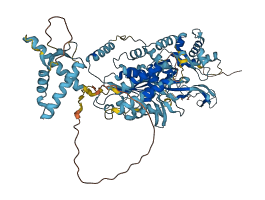
Descriptions
The autoinhibited protein was predicted that may have potential autoinhibitory elements via cis-regPred.
Autoinhibitory domains (AIDs)
Target domain |
|
Relief mechanism |
|
Assay |
cis-regPred |
Accessory elements
No accessory elements
Autoinhibited structure

Activated structure
1 structures for Q29JI9
| Entry ID | Method | Resolution | Chain | Position | Source |
|---|---|---|---|---|---|
| AF-Q29JI9-F1 | Predicted | AlphaFoldDB |
No variants for Q29JI9
| Variant ID(s) | Position | Change | Description | Diseaes Association | Provenance |
|---|---|---|---|---|---|
| No variants for Q29JI9 | |||||
No associated diseases with Q29JI9
6 regional properties for Q29JI9
| Type | Name | Position | InterPro Accession |
|---|---|---|---|
| domain | MCM domain | 326 - 548 | IPR001208 |
| conserved_site | Mini-chromosome maintenance, conserved site | 447 - 455 | IPR018525 |
| domain | MCM N-terminal domain | 22 - 95 | IPR027925 |
| domain | MCM OB domain | 116 - 245 | IPR033762 |
| domain | Mcm6, C-terminal winged-helix domain | 701 - 814 | IPR041024 |
| domain | MCM, AAA-lid domain | 564 - 648 | IPR041562 |
Functions
| Description | ||
|---|---|---|
| EC Number | 3.6.4.12 | Acting on ATP; involved in cellular and subcellular movement |
| Subcellular Localization |
|
|
| PANTHER Family | ||
| PANTHER Subfamily | ||
| PANTHER Protein Class | ||
| PANTHER Pathway Category | No pathway information available | |
3 GO annotations of cellular component
| Name | Definition |
|---|---|
| CMG complex | A protein complex that contains the GINS complex, Cdc45p, and the heterohexameric MCM complex, and that is involved in unwinding DNA during replication. |
| MCM complex | A hexameric protein complex required for the initiation and regulation of DNA replication. |
| nucleus | A membrane-bounded organelle of eukaryotic cells in which chromosomes are housed and replicated. In most cells, the nucleus contains all of the cell's chromosomes except the organellar chromosomes, and is the site of RNA synthesis and processing. In some species, or in specialized cell types, RNA metabolism or DNA replication may be absent. |
5 GO annotations of molecular function
| Name | Definition |
|---|---|
| 3'-5' DNA helicase activity | Unwinding a DNA helix in the direction 5' to 3', driven by ATP hydrolysis. |
| ATP binding | Binding to ATP, adenosine 5'-triphosphate, a universally important coenzyme and enzyme regulator. |
| ATP hydrolysis activity | Catalysis of the reaction: ATP + H2O = ADP + H+ phosphate. ATP hydrolysis is used in some reactions as an energy source, for example to catalyze a reaction or drive transport against a concentration gradient. |
| DNA binding | Any molecular function by which a gene product interacts selectively and non-covalently with DNA (deoxyribonucleic acid). |
| metal ion binding | Binding to a metal ion. |
5 GO annotations of biological process
| Name | Definition |
|---|---|
| cell cycle | The progression of biochemical and morphological phases and events that occur in a cell during successive cell replication or nuclear replication events. Canonically, the cell cycle comprises the replication and segregation of genetic material followed by the division of the cell, but in endocycles or syncytial cells nuclear replication or nuclear division may not be followed by cell division. |
| cell division | The process resulting in division and partitioning of components of a cell to form more cells; may or may not be accompanied by the physical separation of a cell into distinct, individually membrane-bounded daughter cells. |
| DNA replication | The cellular metabolic process in which a cell duplicates one or more molecules of DNA. DNA replication begins when specific sequences, known as origins of replication, are recognized and bound by initiation proteins, and ends when the original DNA molecule has been completely duplicated and the copies topologically separated. The unit of replication usually corresponds to the genome of the cell, an organelle, or a virus. The template for replication can either be an existing DNA molecule or RNA. |
| DNA replication initiation | The process in which DNA-dependent DNA replication is started; this begins with the ATP dependent loading of an initiator complex onto the DNA, this is followed by DNA melting and helicase activity. In bacteria, the gene products that enable the helicase activity are loaded after the initial melting and in archaea and eukaryotes, the gene products that enable the helicase activity are inactive when they are loaded and subsequently activate. |
| eggshell chorion gene amplification | Amplification by up to 60-fold of the loci containing the chorion gene clusters. Amplification is necessary for the rapid synthesis of chorion proteins by the follicle cells, and occurs by repeated firing of one or more origins located within each gene cluster. |
No homologous proteins in AiPD
| UniProt AC | Gene Name | Protein Name | Species | Evidence Code |
|---|---|---|---|---|
| No homologous proteins | ||||
| 10 | 20 | 30 | 40 | 50 | 60 |
| MDVADAQIGQ | LRVKDDVGIR | TQKLFQDFLE | EFKENGEIKY | TRPAANLESP | DRCTLEVSFE |
| 70 | 80 | 90 | 100 | 110 | 120 |
| DVEKYDQNLA | TAIIEEYYHV | YPFLCQSVSN | YVKDRIGLKT | NKDCYVAFTE | VPTRHKVRDL |
| 130 | 140 | 150 | 160 | 170 | 180 |
| TTSKIGTLIR | ISGQVVRTHP | VHPELVSGTF | MCLDCQTEIR | NVEQQFKFTN | PTICRNPVCS |
| 190 | 200 | 210 | 220 | 230 | 240 |
| NRRRFMLDVE | KSLFLDFQKI | RIQETQAELP | RGCIPRAVEI | ILRSELVETV | QAGDRYDFTG |
| 250 | 260 | 270 | 280 | 290 | 300 |
| TLIVVPDVSV | LAMPGTRAES | GSRHKPGEGM | EGVTGLKALG | MRELNYRMAF | LACSVQATTA |
| 310 | 320 | 330 | 340 | 350 | 360 |
| RFGGTDLPMS | EVTAEDMKKQ | MTDAEWHKIY | EMSKDRNLYQ | NLITCLFPSI | YGNDEVKRGI |
| 370 | 380 | 390 | 400 | 410 | 420 |
| LLQLFGGVAK | TTIEKTSLRG | DVNVCIVGDP | STAKSQFLKQ | VSDFSPRAIY | TSGKASSAAG |
| 430 | 440 | 450 | 460 | 470 | 480 |
| LTAAVVRDEE | SFDFVIEAGA | LMLADNGICC | IDEFDKMDLR | DQVAIHEAME | QQTISIARAG |
| 490 | 500 | 510 | 520 | 530 | 540 |
| VRATLNARTS | ILAAANPING | RYDRSKSLQQ | NIQLSAPIMS | RFDLFFILVD | ECNEVVDYAI |
| 550 | 560 | 570 | 580 | 590 | 600 |
| ARKIVDLHSN | IEESVERAYS | REEVLRYVTF | ARQFKPIIGQ | EAGKMLVENY | GHLRQRDTGT |
| 610 | 620 | 630 | 640 | 650 | 660 |
| AGRSTWRITV | RQLESMIRLS | EAMAKLECSN | RVLERHVKEA | FRLLNKSIIR | VEQPDIHLDD |
| 670 | 680 | 690 | 700 | 710 | 720 |
| DDDLDVDDGI | QDDIDMENNG | SAANTETDTL | DTSGASTVQK | KKFTLSFEDY | KNLSTMLVLH |
| 730 | 740 | 750 | 760 | 770 | 780 |
| MRGEEARCEV | EGSDSGMKRS | DVVTWYLEQV | ADQIESEDEL | ISRKNLIEKL | IDRLIYHDQV |
| 790 | 800 | 810 | |||
| IIPLKTSNLS | RIKGPAEEQV | DNDPLLVVHP | NYVVD |