Q297N8
Gene name |
p |
Protein name |
BLOC-2 complex member HPS5 homolog |
Names |
Hermansky-Pudlak syndrome 5 protein homolog, Protein pink |
Species |
Drosophila pseudoobscura pseudoobscura (Fruit fly) |
KEGG Pathway |
dpo:Dpse_GA22022 |
EC number |
|
Protein Class |
|
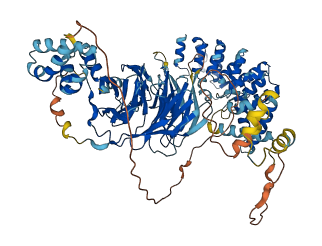
Descriptions
The autoinhibited protein was predicted that may have potential autoinhibitory elements via cis-regPred.
Autoinhibitory domains (AIDs)
Target domain |
|
Relief mechanism |
|
Assay |
cis-regPred |
Accessory elements
No accessory elements
Autoinhibited structure

Activated structure
1 structures for Q297N8
| Entry ID | Method | Resolution | Chain | Position | Source |
|---|---|---|---|---|---|
| AF-Q297N8-F1 | Predicted | AlphaFoldDB |
No variants for Q297N8
| Variant ID(s) | Position | Change | Description | Diseaes Association | Provenance |
|---|---|---|---|---|---|
| No variants for Q297N8 | |||||
No associated diseases with Q297N8
No regional properties for Q297N8
| Type | Name | Position | InterPro Accession |
|---|---|---|---|
| No domain, repeats, and functional sites for Q297N8 | |||
1 GO annotations of cellular component
| Name | Definition |
|---|---|
| cytoplasm | The contents of a cell excluding the plasma membrane and nucleus, but including other subcellular structures. |
1 GO annotations of molecular function
| Name | Definition |
|---|---|
| pigment binding | Binding to a pigment, a general or particular coloring matter in living organisms, e.g. melanin. |
7 GO annotations of biological process
| Name | Definition |
|---|---|
| compound eye pigmentation | Establishment of a pattern of pigment in the compound eye. |
| eye pigment biosynthetic process | The chemical reactions and pathways resulting in the formation of eye pigments, any general or particular coloring matter in living organisms, found or utilized in the eye. |
| negative regulation of post-transcriptional gene silencing by RNA | Any process that stops, prevents or reduces the frequency, rate or extent of post-transcriptional gene silencing by RNA. |
| ommochrome biosynthetic process | The chemical reactions and pathways resulting in the formation of ommochromes, any of a large group of natural polycyclic pigments commonly found in the Arthropoda, particularly in the ommatidia of the compound eye. |
| protein targeting to lysosome | The process of directing proteins towards the lysosome using signals contained within the protein. |
| response to stimulus | Any process that results in a change in state or activity of a cell or an organism (in terms of movement, secretion, enzyme production, gene expression, etc.) as a result of a stimulus. The process begins with detection of the stimulus and ends with a change in state or activity or the cell or organism. |
| visual perception | The series of events required for an organism to receive a visual stimulus, convert it to a molecular signal, and recognize and characterize the signal. Visual stimuli are detected in the form of photons and are processed to form an image. |
No homologous proteins in AiPD
| UniProt AC | Gene Name | Protein Name | Species | Evidence Code |
|---|---|---|---|---|
| No homologous proteins | ||||
| 10 | 20 | 30 | 40 | 50 | 60 |
| MADEYCLTNF | IDFSLSLSLP | LKHNRIKYTC | FDISDSYIIF | GASSGSLYLF | NRNGKFLHLI |
| 70 | 80 | 90 | 100 | 110 | 120 |
| PNKHGAITNL | SISANNKYVA | FSTQRSLICV | YVVNLSAQAT | PQVIVTHLDQ | SVQVSCIHWT |
| 130 | 140 | 150 | 160 | 170 | 180 |
| QDEKQFYYGD | SRGQVNLVLL | SSFIGHSLLL | NMTVHPLLYL | DSPIVQIDDF | ESLLLVSNCT |
| 190 | 200 | 210 | 220 | 230 | 240 |
| KCILCNTEYE | EYKQIGNRPR | DGAYGACFFI | SPHESVQPSR | IYCARPGTRI | WEVDFEGEVI |
| 250 | 260 | 270 | 280 | 290 | 300 |
| QTHQFKTALA | TAPAKIQKTT | NVDNNADELD | SNDELLDYQP | QQLQFSRVQR | LSHDFLLAYT |
| 310 | 320 | 330 | 340 | 350 | 360 |
| ELGLYIFDVR | NSSVVLWCNQ | FERILDCRVS | GMEIFVFTQT | GSLYSVQLQT | LHGYSITLMH |
| 370 | 380 | 390 | 400 | 410 | 420 |
| QSKLLQCANL | LRQHVKYFAD | KARENYELKL | LNQLKQLLIE | RQEYELLNDI | SVIFDAIAQC |
| 430 | 440 | 450 | 460 | 470 | 480 |
| TGTALDTQSS | GGSSAATERS | GSMRAIGVST | TKGPPKGVYV | LENAFCDNLK | QQPKSGHFKD |
| 490 | 500 | 510 | 520 | 530 | 540 |
| ALLTVTGKFG | KNIIKYKFNI | FAEEQQQLVR | ELIPASERSL | PFKDIKARYE | SGDVGEEEIV |
| 550 | 560 | 570 | 580 | 590 | 600 |
| SRCKRPTPQA | PHISPEEKTI | YNLYLICKSA | KFSRTHCVER | YRAVFDEYAA | SELIALMGKL |
| 610 | 620 | 630 | 640 | 650 | 660 |
| AQLMVEHGDG | QEQAERNCYE | MYFNYLNPEL | IWEVDDSTRD | YIASGFVLLN | APQCMEIVRC |
| 670 | 680 | 690 | 700 | 710 | 720 |
| DHCAFPLRFD | NACQYHELGA | VLLRYFWSRN | EQLKCFDVVQ | AVPALLDVLA | KFYLAEQNLD |
| 730 | 740 | 750 | 760 | 770 | 780 |
| KVIPIVLNYG | QPELLLDVGR | QLNVSAWARC | FEQFAELQRG | RLICVNCECV | SSVEQDQLTR |
| 790 | 800 | 810 | 820 | ||
| HFFYTWNCFL | NIALDHLTAS | DTLSLIFKWS | SYIPNDAIDR | EFYSRCLIKG |