Q28992
Gene name |
VIPR1 |
Protein name |
Vasoactive intestinal polypeptide receptor 1 |
Names |
VIP-R-1, Pituitary adenylate cyclase-activating polypeptide type II receptor, PACAP type II receptor, PACAP-R-2, PACAP-R2 |
Species |
Sus scrofa (Pig) |
KEGG Pathway |
ssc:100155402 |
EC number |
|
Protein Class |
|
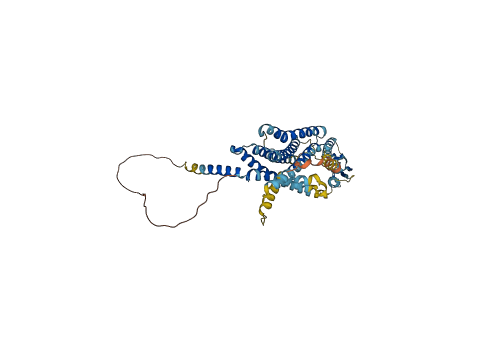
Descriptions
The autoinhibited protein was predicted that may have potential autoinhibitory elements via cis-regPred.
Autoinhibitory domains (AIDs)
Target domain |
|
Relief mechanism |
|
Assay |
cis-regPred |
Accessory elements
No accessory elements
Autoinhibited structure

Activated structure
1 structures for Q28992
| Entry ID | Method | Resolution | Chain | Position | Source |
|---|---|---|---|---|---|
| AF-Q28992-F1 | Predicted | AlphaFoldDB |
No variants for Q28992
| Variant ID(s) | Position | Change | Description | Diseaes Association | Provenance |
|---|---|---|---|---|---|
| No variants for Q28992 | |||||
No associated diseases with Q28992
4 regional properties for Q28992
| Type | Name | Position | InterPro Accession |
|---|---|---|---|
| domain | GPCR, family 2, extracellular hormone receptor domain | 50 - 132 | IPR001879 |
| domain | GPCR, family 2-like, transmembrane domain | 143 - 393 | IPR017981 |
| conserved_site | GPCR, family 2, secretin-like, conserved site | 64 - 88 | IPR017983-1 |
| conserved_site | GPCR, family 2, secretin-like, conserved site | 381 - 396 | IPR017983-2 |
2 GO annotations of cellular component
| Name | Definition |
|---|---|
| integral component of membrane | The component of a membrane consisting of the gene products and protein complexes having at least some part of their peptide sequence embedded in the hydrophobic region of the membrane. |
| plasma membrane | The membrane surrounding a cell that separates the cell from its external environment. It consists of a phospholipid bilayer and associated proteins. |
1 GO annotations of molecular function
| Name | Definition |
|---|---|
| vasoactive intestinal polypeptide receptor activity | Combining with vasoactive intestinal polypeptide to initiate a change in cell activity. |
1 GO annotations of biological process
| Name | Definition |
|---|---|
| cell surface receptor signaling pathway | The series of molecular signals initiated by activation of a receptor on the surface of a cell. The pathway begins with binding of an extracellular ligand to a cell surface receptor, or for receptors that signal in the absence of a ligand, by ligand-withdrawal or the activity of a constitutively active receptor. The pathway ends with regulation of a downstream cellular process, e.g. transcription. |
1 homologous proteins in AiPD
| UniProt AC | Gene Name | Protein Name | Species | Evidence Code |
|---|---|---|---|---|
| P32241 | VIPR1 | Vasoactive intestinal polypeptide receptor 1 | Homo sapiens (Human) | PR |
| 10 | 20 | 30 | 40 | 50 | 60 |
| MRPLSPPPAG | WFCVLAGVLA | CVLGPVGSWA | VGLQQEECDY | LQMIKVQHKQ | CLEEAQLENE |
| 70 | 80 | 90 | 100 | 110 | 120 |
| TSGCSKMWDN | LTCWPATPRG | QVVVLACPLI | FKLFSPTQGL | NVSRNCTDEG | WTPLEPGPYP |
| 130 | 140 | 150 | 160 | 170 | 180 |
| IACGMDDKAS | GLDEQQTVFY | NSVKTGYTIG | YSLSLAALLV | ATAILSLFRK | LHCTRNYIHM |
| 190 | 200 | 210 | 220 | 230 | 240 |
| HLFISFILRA | TAVFIKDLAL | FDSEESDHCS | KGSVGCKAAV | VLFQYCVMAN | FFWLLVEGLY |
| 250 | 260 | 270 | 280 | 290 | 300 |
| LHTLLAVSFF | SERKYFWGYI | FVGWGVPSTF | IMVWTVVRIH | FEDYGCWDTI | HSSLWWIIKA |
| 310 | 320 | 330 | 340 | 350 | 360 |
| PILASILVNF | ILFIRIIGIL | VQKLRPPDVG | KSDNSPYSRL | AKSTLLLIPL | FGVHYIMFAF |
| 370 | 380 | 390 | 400 | 410 | 420 |
| FPDNFKAEVK | MVFELIVGSF | QGCVVAILYC | FLNGEVQAEL | RRKWRRWHQQ | GVLGWDSKYQ |
| 430 | 440 | 450 | |||
| HPSGGSNGDT | CSTQVSMLTR | VSPSARRSSS | FQAEVSLV |