Descriptions
The autoinhibited protein was predicted that may have potential autoinhibitory elements via cis-regPred.
Autoinhibitory domains (AIDs)
Target domain |
|
Relief mechanism |
|
Assay |
cis-regPred |
Accessory elements
No accessory elements
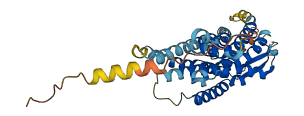
Autoinhibited structure

Activated structure
1 structures for Q28642
| Entry ID | Method | Resolution | Chain | Position | Source |
|---|---|---|---|---|---|
| AF-Q28642-F1 | Predicted | AlphaFoldDB |
No variants for Q28642
| Variant ID(s) | Position | Change | Description | Diseaes Association | Provenance |
|---|---|---|---|---|---|
| No variants for Q28642 | |||||
No associated diseases with Q28642
No regional properties for Q28642
| Type | Name | Position | InterPro Accession |
|---|---|---|---|
| No domain, repeats, and functional sites for Q28642 | |||
2 GO annotations of cellular component
| Name | Definition |
|---|---|
| integral component of membrane | The component of a membrane consisting of the gene products and protein complexes having at least some part of their peptide sequence embedded in the hydrophobic region of the membrane. |
| plasma membrane | The membrane surrounding a cell that separates the cell from its external environment. It consists of a phospholipid bilayer and associated proteins. |
1 GO annotations of molecular function
| Name | Definition |
|---|---|
| bradykinin receptor activity | Combining with bradykinin to initiate a change in cell activity. |
2 GO annotations of biological process
| Name | Definition |
|---|---|
| smooth muscle contraction | A process in which force is generated within smooth muscle tissue, resulting in a change in muscle geometry. Force generation involves a chemo-mechanical energy conversion step that is carried out by the actin/myosin complex activity, which generates force through ATP hydrolysis. Smooth muscle differs from striated muscle in the much higher actin/myosin ratio, the absence of conspicuous sarcomeres and the ability to contract to a much smaller fraction of its resting length. |
| vasoconstriction | A decrease in the diameter of blood vessels, especially arteries, due to constriction of smooth muscle cells that line the vessels, and usually causing an increase in blood pressure. |
No homologous proteins in AiPD
| UniProt AC | Gene Name | Protein Name | Species | Evidence Code |
|---|---|---|---|---|
| No homologous proteins | ||||
| 10 | 20 | 30 | 40 | 50 | 60 |
| MLNITSQVLA | PALNGSVSQS | SGCPNTEWSG | WLNVIQAPFL | WVLFVLATLE | NLFVLSVFCL |
| 70 | 80 | 90 | 100 | 110 | 120 |
| HKSSCTVAEV | YLGNLAAADL | ILACGLPFWA | VTIANHFDWL | FGEALCRVVN | TMIYMNLYSS |
| 130 | 140 | 150 | 160 | 170 | 180 |
| ICFLMLVSID | RYLALVKTMS | IGRMRRVRWA | KLYSLVIWGC | TLLLSSPMLV | FRTMKDYRDE |
| 190 | 200 | 210 | 220 | 230 | 240 |
| GYNVTACIID | YPSRSWEVFT | NVLLNLVGFL | LPLSVITFCT | VQILQVLRNN | EMQKFKEIQT |
| 250 | 260 | 270 | 280 | 290 | 300 |
| ERRATVLVLA | VLLLFVVCWL | PFQVSTFLDT | LLKLGVLSSC | WDEHVIDVIT | QVGSFMGYSN |
| 310 | 320 | 330 | 340 | 350 | 360 |
| SCLNPLVYVI | VGKRFRKKSR | EVYRAACPKA | GCVLEPVQAE | SSMGTLRTSI | SVERQIHKLP |
| EWTRSSQ |