Q28612
Gene name |
Ugt1a4 |
Protein name |
UDP-glucuronosyltransferase 1A4 |
Names |
UGT1A4, UDP-glucuronosyltransferase 1-4, UDPGT 1-4, UGT1*4, UGT1-04, UGT1.4 |
Species |
Oryctolagus cuniculus (Rabbit) |
KEGG Pathway |
ocu:100038310 |
EC number |
2.4.1.17: Hexosyltransferases |
Protein Class |
|
Descriptions
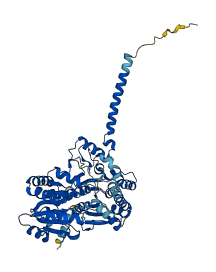
The autoinhibited protein was predicted that may have potential autoinhibitory elements via cis-regPred.
Autoinhibitory domains (AIDs)
Target domain |
|
Relief mechanism |
|
Assay |
cis-regPred |
Accessory elements
No accessory elements
Autoinhibited structure

Activated structure
1 structures for Q28612
| Entry ID | Method | Resolution | Chain | Position | Source |
|---|---|---|---|---|---|
| AF-Q28612-F1 | Predicted | AlphaFoldDB |
No variants for Q28612
| Variant ID(s) | Position | Change | Description | Diseaes Association | Provenance |
|---|---|---|---|---|---|
| No variants for Q28612 | |||||
No associated diseases with Q28612
1 regional properties for Q28612
| Type | Name | Position | InterPro Accession |
|---|---|---|---|
| conserved_site | UDP-glycosyltransferase family, conserved site | 354 - 397 | IPR035595 |
Functions
| Description | ||
|---|---|---|
| EC Number | 2.4.1.17 | Hexosyltransferases |
| Subcellular Localization |
|
|
| PANTHER Family | ||
| PANTHER Subfamily | ||
| PANTHER Protein Class | ||
| PANTHER Pathway Category | No pathway information available | |
2 GO annotations of cellular component
| Name | Definition |
|---|---|
| endoplasmic reticulum membrane | The lipid bilayer surrounding the endoplasmic reticulum. |
| integral component of membrane | The component of a membrane consisting of the gene products and protein complexes having at least some part of their peptide sequence embedded in the hydrophobic region of the membrane. |
2 GO annotations of molecular function
| Name | Definition |
|---|---|
| glucuronosyltransferase activity | Catalysis of the reaction: UDP-glucuronate + acceptor = UDP + acceptor beta-D-glucuronoside. |
| protein homodimerization activity | Binding to an identical protein to form a homodimer. |
2 GO annotations of biological process
| Name | Definition |
|---|---|
| cellular glucuronidation | The modification of an organic chemical by the conjugation of glucuronic acid. The substances resulting from glucuronidation are known as glucuronosides (or glucuronides) and are often much more water-soluble than the non-glucuronic acid-containing precursor. |
| vitamin D3 metabolic process | The chemical reactions and pathways involving vitamin D3, (3S,5Z,7E)-9,10-secocholesta-5,7,10(19)-trien-3-ol. |
No homologous proteins in AiPD
| UniProt AC | Gene Name | Protein Name | Species | Evidence Code |
|---|---|---|---|---|
| No homologous proteins | ||||
| 10 | 20 | 30 | 40 | 50 | 60 |
| MVLGVWITLW | RLVRLLLLLC | VLPWAEGGKV | LVVPMDGSPW | LSLREVVRDV | HARGHQVLVL |
| 70 | 80 | 90 | 100 | 110 | 120 |
| GPEVTMHIKG | EDFFTLQTYA | TPYSKEEFDQ | LMQRNYQMIF | KPQHSLKTLL | ETMENLKKFS |
| 130 | 140 | 150 | 160 | 170 | 180 |
| MLCSRSCWEL | LHNKPLIKHL | NESSFDVVLT | DPLDLCGALL | AKYLSVPSVF | LLRFILCDLD |
| 190 | 200 | 210 | 220 | 230 | 240 |
| FEGTQCPNPS | SYIPRMLTMN | SDHMSFLQRV | KNMLYPLMMK | YTCHISYDPY | ASLASELFQR |
| 250 | 260 | 270 | 280 | 290 | 300 |
| EVSLVDILSH | ASVWLFREDF | VLDYPRPIMP | NMVFIGGINC | ANRKPLSQEF | EAYVNASGEH |
| 310 | 320 | 330 | 340 | 350 | 360 |
| GIVVFSLGSM | VSEIPEKKAM | EIADALGKIP | QTVLWRYTGS | RPSNLAKNTY | LVKWLPQNVL |
| 370 | 380 | 390 | 400 | 410 | 420 |
| LGHPKTRAFI | THSGSHGIYE | GICNGVPMVM | LPLFGDQMDN | AKRIETRGAG | VTLNVLEMTS |
| 430 | 440 | 450 | 460 | 470 | 480 |
| DDLANALKTV | INDKSYKENI | MRLSSLHKDR | PVEPLDLAVF | WVEFVMRHKG | AAPRPAAHDL |
| 490 | 500 | 510 | 520 | 530 | |
| TWYQYHSLDV | IGFLLAIVLT | VAFVTFKCCA | FAWGKCFGKK | GRVKKAHKSK | VH |