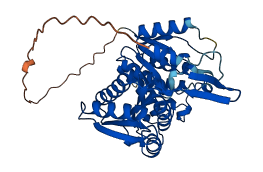
Descriptions
The autoinhibited protein was predicted that may have potential autoinhibitory elements via cis-regPred.
Autoinhibitory domains (AIDs)
Target domain |
|
Relief mechanism |
|
Assay |
cis-regPred |
Accessory elements
No accessory elements
Autoinhibited structure

Activated structure
1 structures for Q28479
| Entry ID | Method | Resolution | Chain | Position | Source |
|---|---|---|---|---|---|
| AF-Q28479-F1 | Predicted | AlphaFoldDB |
No variants for Q28479
| Variant ID(s) | Position | Change | Description | Diseaes Association | Provenance |
|---|---|---|---|---|---|
| No variants for Q28479 | |||||
No associated diseases with Q28479
1 GO annotations of cellular component
| Name | Definition |
|---|---|
| mitochondrial isocitrate dehydrogenase complex (NAD+) | Mitochondrial complex that possesses isocitrate dehydrogenase (NAD+) activity. |
3 GO annotations of molecular function
| Name | Definition |
|---|---|
| magnesium ion binding | Binding to a magnesium (Mg) ion. |
| NAD binding | Binding to nicotinamide adenine dinucleotide, a coenzyme involved in many redox and biosynthetic reactions; binding may be to either the oxidized form, NAD+, or the reduced form, NADH. |
| oxidoreductase activity, acting on the CH-OH group of donors, NAD or NADP as acceptor | Catalysis of an oxidation-reduction (redox) reaction in which a CH-OH group acts as a hydrogen or electron donor and reduces NAD+ or NADP. |
1 GO annotations of biological process
| Name | Definition |
|---|---|
| tricarboxylic acid cycle | A nearly universal metabolic pathway in which the acetyl group of acetyl coenzyme A is effectively oxidized to two CO2 and four pairs of electrons are transferred to coenzymes. The acetyl group combines with oxaloacetate to form citrate, which undergoes successive transformations to isocitrate, 2-oxoglutarate, succinyl-CoA, succinate, fumarate, malate, and oxaloacetate again, thus completing the cycle. In eukaryotes the tricarboxylic acid is confined to the mitochondria. See also glyoxylate cycle. |
No homologous proteins in AiPD
| UniProt AC | Gene Name | Protein Name | Species | Evidence Code |
|---|---|---|---|---|
| No homologous proteins | ||||
| 10 | 20 | 30 | 40 | 50 | 60 |
| MAALSGVRWL | TRALVSAGNP | GAWRGLSTSA | AAHAASRSQA | EDVRVEGSFP | VTMLPGDGVG |
| 70 | 80 | 90 | 100 | 110 | 120 |
| PELMHAVKEV | FKAAAVPVEF | QEHHLSEVQN | MASEEKLEQV | LSSMKENKVA | IIGKIHTPME |
| 130 | 140 | 150 | 160 | 170 | 180 |
| YKGELASYDM | RLRRKLDLFA | NVVHVKSLPG | YMTRHNNLDL | VIIREQTEGE | YSSLEHESAR |
| 190 | 200 | 210 | 220 | 230 | 240 |
| GVIECLKIVT | RAKSQRIAKF | AFDYATKKGR | SKVTAVHKAN | IMKLGDGLFL | QCCEEVAELY |
| 250 | 260 | 270 | 280 | 290 | 300 |
| PKIKFETMII | DNCCMQLVQN | PYQFDVLVMP | NLYGNIIDNL | AAGLVGGAGV | VPGESYSAEY |
| 310 | 320 | 330 | 340 | 350 | 360 |
| AVFETGARHP | FAQAVGRNIA | NPTAMLLSAS | NMLRHLNLEY | HSNMIADAVK | KVIKVGKVRT |
| 370 | 380 | ||||
| RDMGGYSTTT | DFIKSVIGHL | HPHGS |