Descriptions
The autoinhibited protein was predicted that may have potential autoinhibitory elements via cis-regPred.
Autoinhibitory domains (AIDs)
Target domain |
|
Relief mechanism |
|
Assay |
cis-regPred |
Accessory elements
No accessory elements
Autoinhibited structure

Activated structure
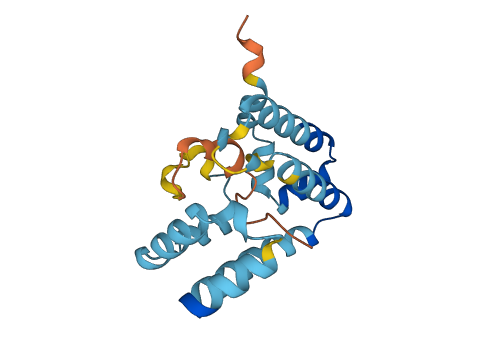
1 structures for Q25619
| Entry ID | Method | Resolution | Chain | Position | Source |
|---|---|---|---|---|---|
| AF-Q25619-F1 | Predicted | AlphaFoldDB |
No variants for Q25619
| Variant ID(s) | Position | Change | Description | Diseaes Association | Provenance |
|---|---|---|---|---|---|
| No variants for Q25619 | |||||
No associated diseases with Q25619
No regional properties for Q25619
| Type | Name | Position | InterPro Accession |
|---|---|---|---|
| No domain, repeats, and functional sites for Q25619 | |||
1 GO annotations of cellular component
| Name | Definition |
|---|---|
| extracellular region | The space external to the outermost structure of a cell. For cells without external protective or external encapsulating structures this refers to space outside of the plasma membrane. This term covers the host cell environment outside an intracellular parasite. |
3 GO annotations of molecular function
| Name | Definition |
|---|---|
| fatty acid binding | Binding to a fatty acid, an aliphatic monocarboxylic acids liberated from naturally occurring fats and oils by hydrolysis. |
| retinal binding | Binding to retinal, one of the forms of vitamin A. Retinal plays an important role in the visual process in most vertebrates, combining with opsins to form visual pigments in the retina. |
| retinol binding | Binding to retinol, vitamin A1, 2,6,6-trimethyl-1-(9'-hydroxy-3',7'-dimethylnona-1',3',5',7'-tetraenyl)cyclohex-1-ene, one of the three components that makes up vitamin A. Retinol is an intermediate in the vision cycle and it also plays a role in growth and differentiation. |
No GO annotations of biological process
| Name | Definition |
|---|---|
| No GO annotations for biological process |
No homologous proteins in AiPD
| UniProt AC | Gene Name | Protein Name | Species | Evidence Code |
|---|---|---|---|---|
| No homologous proteins | ||||
| 10 | 20 | 30 | 40 | 50 | 60 |
| MYHQLILMAL | IGVIMANVVP | FSMSNIPEEY | KEFIPEEVKN | FYKNLTQEDR | QILRELASKH |
| 70 | 80 | 90 | 100 | 110 | 120 |
| ATFTNEDAAL | EALKNKSDKL | YQKAVELRNF | VKAKIDSLKP | DAKAFVDEII | AKVRSLRPED |
| 130 | 140 | 150 | 160 | 170 | |
| GQKLDMEKLK | QAARDIIAKY | EALNEETKEE | LKATFPNTTK | IITNEKFKRI | ANSFLQKN |