Q25519
Gene name |
ppo |
Protein name |
Phenoloxidase subunit 2 |
Names |
proPO-p2 |
Species |
Manduca sexta (Tobacco hawkmoth) (Tobacco hornworm) |
KEGG Pathway |
|
EC number |
1.14.18.1: With another compound as one donor, and incorporation of one atom of oxygen |
Protein Class |
|
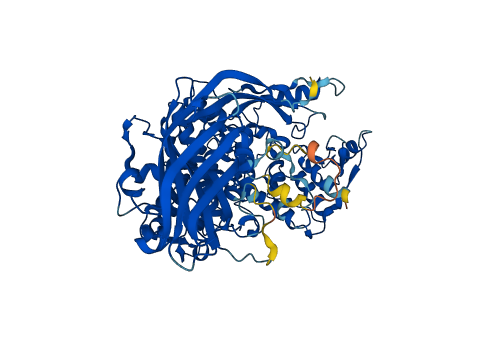
Descriptions
The autoinhibited protein was predicted that may have potential autoinhibitory elements via cis-regPred.
Autoinhibitory domains (AIDs)
Target domain |
|
Relief mechanism |
|
Assay |
cis-regPred |
Accessory elements
No accessory elements
Autoinhibited structure

Activated structure
2 structures for Q25519
| Entry ID | Method | Resolution | Chain | Position | Source |
|---|---|---|---|---|---|
| 3HHS | X-ray | 197 A | A | 2-695 | PDB |
| AF-Q25519-F1 | Predicted | AlphaFoldDB |
No variants for Q25519
| Variant ID(s) | Position | Change | Description | Diseaes Association | Provenance |
|---|---|---|---|---|---|
| No variants for Q25519 | |||||
No associated diseases with Q25519
Functions
| Description | ||
|---|---|---|
| EC Number | 1.14.18.1 | With another compound as one donor, and incorporation of one atom of oxygen |
| Subcellular Localization |
|
|
| PANTHER Family | ||
| PANTHER Subfamily | ||
| PANTHER Protein Class | ||
| PANTHER Pathway Category | No pathway information available | |
1 GO annotations of cellular component
| Name | Definition |
|---|---|
| extracellular region | The space external to the outermost structure of a cell. For cells without external protective or external encapsulating structures this refers to space outside of the plasma membrane. This term covers the host cell environment outside an intracellular parasite. |
3 GO annotations of molecular function
| Name | Definition |
|---|---|
| chloride ion binding | Binding to a chloride ion (Cl-). |
| copper ion binding | Binding to a copper (Cu) ion. |
| tyrosinase activity | Catalysis of the reaction: L-tyrosine + O2 = L-DOPAquinone + H2O. This reaction can use both monophenols (such as tyrosine) and catechols (o-diphenols) as substrates. |
3 GO annotations of biological process
| Name | Definition |
|---|---|
| defense response | Reactions, triggered in response to the presence of a foreign body or the occurrence of an injury, which result in restriction of damage to the organism attacked or prevention/recovery from the infection caused by the attack. |
| melanin biosynthetic process from tyrosine | The chemical reactions and pathways resulting in the formation of melanin from other compounds, including tyrosine. |
| positive regulation of melanization defense response | Any process that increases the rate or extent of the melanization defense response during injury or invasion. |
No homologous proteins in AiPD
| UniProt AC | Gene Name | Protein Name | Species | Evidence Code |
|---|---|---|---|---|
| No homologous proteins | ||||
| 10 | 20 | 30 | 40 | 50 | 60 |
| MADIFDSFEL | LYDRPGEPMI | NTKGEDKVLF | ELTEQFLTPE | YANNGLELNN | RFGDEEEVSR |
| 70 | 80 | 90 | 100 | 110 | 120 |
| KIILKNLDKI | PEFPKAKQLP | NDADFSLFLP | SHQEMANEVI | DVLMSVTENQ | LQELLSTCVY |
| 130 | 140 | 150 | 160 | 170 | 180 |
| ARINLNPQLF | NYCYTVAIMH | RRDTGKVRVQ | NYAEIFPAKF | LDSQVFTQAR | EAAAVIPKTI |
| 190 | 200 | 210 | 220 | 230 | 240 |
| PRTPIIIPRD | YTATDLEEEH | RLAYWREDLG | INLHHWHWHL | VYPFSASDEK | IVAKDRRGEL |
| 250 | 260 | 270 | 280 | 290 | 300 |
| FFYMHQQIIA | RYNCERLCNS | LKRVKKFSDW | REPIPEAYYP | KLDSLTSARG | WPPRQAGMRW |
| 310 | 320 | 330 | 340 | 350 | 360 |
| QDLKRPVDGL | NVTIDDMERY | RRNIEEAIAT | GNVILPDKST | KKLDIDMLGN | MMEASVLSPN |
| 370 | 380 | 390 | 400 | 410 | 420 |
| RDLYGSIHNN | MHSFSAYMHD | PEHRYLESFG | VIADEATTMR | DPFFYRVHAW | VDDIFQSFKE |
| 430 | 440 | 450 | 460 | 470 | 480 |
| APHNVRPYSR | SQLENPGVQV | TSVAVESAGG | QQNVLNTFWM | QSDVNLSKGL | DFSDRGPVYA |
| 490 | 500 | 510 | 520 | 530 | 540 |
| RFTHLNHRPF | RYVIKANNTA | SARRTTVRIF | IAPKTDERNL | PWALSDQRKM | FIEMDRFVVP |
| 550 | 560 | 570 | 580 | 590 | 600 |
| LSAGENTITR | QSTESSLTIP | FEQTFRDLSI | QGSDPRRSEL | AAFNYCGCGW | PQHMLVPKGT |
| 610 | 620 | 630 | 640 | 650 | 660 |
| VGGVAYQLFV | MLSNYELDKI | EQPDGRELSC | VEASMFCGLK | DKKYPDARPM | GYPFDRPSNS |
| 670 | 680 | 690 | |||
| ATNIEDFSAM | SNMGLQDIVI | KLSDVTEPNP | RNPPA |