Q24247
Gene name |
mew (CG1771) |
Protein name |
Integrin alpha-PS1 |
Names |
Position-specific antigen subunit alpha-1, Protein multiple edematous wings |
Species |
Drosophila melanogaster (Fruit fly) |
KEGG Pathway |
dme:Dmel_CG1771 |
EC number |
|
Protein Class |
|
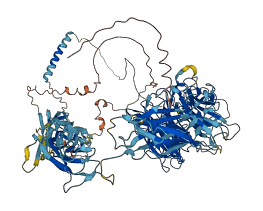
Descriptions
The autoinhibited protein was predicted that may have potential autoinhibitory elements via cis-regPred.
Autoinhibitory domains (AIDs)
Target domain |
|
Relief mechanism |
|
Assay |
cis-regPred |
Accessory elements
No accessory elements
Autoinhibited structure

Activated structure
1 structures for Q24247
| Entry ID | Method | Resolution | Chain | Position | Source |
|---|---|---|---|---|---|
| AF-Q24247-F1 | Predicted | AlphaFoldDB |
No variants for Q24247
| Variant ID(s) | Position | Change | Description | Diseaes Association | Provenance |
|---|---|---|---|---|---|
| No variants for Q24247 | |||||
No associated diseases with Q24247
9 regional properties for Q24247
| Type | Name | Position | InterPro Accession |
|---|---|---|---|
| repeat | FG-GAP repeat | 321 - 357 | IPR013517-1 |
| repeat | FG-GAP repeat | 380 - 413 | IPR013517-2 |
| repeat | Integrin alpha beta-propellor | 38 - 112 | IPR013519-1 |
| repeat | Integrin alpha beta-propellor | 121 - 186 | IPR013519-2 |
| repeat | Integrin alpha beta-propellor | 193 - 245 | IPR013519-3 |
| repeat | Integrin alpha beta-propellor | 263 - 429 | IPR013519-4 |
| repeat | Integrin alpha beta-propellor | 432 - 494 | IPR013519-5 |
| domain | Integrin alpha-2 | 479 - 1006 | IPR013649 |
| conserved_site | Integrin alpha chain, C-terminal cytoplasmic region, conserved site | 1107 - 1114 | IPR018184 |
Functions
7 GO annotations of cellular component
| Name | Definition |
|---|---|
| apical plasma membrane | The region of the plasma membrane located at the apical end of the cell. |
| basal plasma membrane | The region of the plasma membrane located at the basal end of the cell. Often used in reference to animal polarized epithelial membranes, where the basal membrane is the part attached to the extracellular matrix, or in plant cells, where the basal membrane is defined with respect to the zygotic axis. |
| external side of plasma membrane | The leaflet of the plasma membrane that faces away from the cytoplasm and any proteins embedded or anchored in it or attached to its surface. |
| focal adhesion | A cell-substrate junction that anchors the cell to the extracellular matrix and that forms a point of termination of actin filaments. In insects focal adhesion has also been referred to as hemi-adherens junction (HAJ). |
| integral component of plasma membrane | The component of the plasma membrane consisting of the gene products and protein complexes having at least some part of their peptide sequence embedded in the hydrophobic region of the membrane. |
| integrin complex | A protein complex that is composed of one alpha subunit and one beta subunit, both of which are members of the integrin superfamily of cell adhesion receptors; the complex spans the plasma membrane and binds to extracellular matrix ligands, cell-surface ligands, and soluble ligands. |
| lateral plasma membrane | The portion of the plasma membrane at the lateral side of the cell. In epithelial cells, lateral plasma membranes are on the sides of cells which lie at the interface of adjacent cells. |
4 GO annotations of molecular function
| Name | Definition |
|---|---|
| cell adhesion molecule binding | Binding to a cell adhesion molecule. |
| extracellular matrix binding | Binding to a component of the extracellular matrix. |
| integrin binding | Binding to an integrin. |
| protein heterodimerization activity | Binding to a nonidentical protein to form a heterodimer. |
22 GO annotations of biological process
| Name | Definition |
|---|---|
| actin filament organization | A process that is carried out at the cellular level which results in the assembly, arrangement of constituent parts, or disassembly of cytoskeletal structures comprising actin filaments. Includes processes that control the spatial distribution of actin filaments, such as organizing filaments into meshworks, bundles, or other structures, as by cross-linking. |
| apposition of dorsal and ventral imaginal disc-derived wing surfaces | The coming together of the dorsal and ventral surfaces of the imaginal disc-derived wing during the conversion of a folded single layered wing disc to a flat bilayered wing. |
| axon guidance | The chemotaxis process that directs the migration of an axon growth cone to a specific target site in response to a combination of attractive and repulsive cues. |
| axonal defasciculation | Separation of axons away from a bundle of axons known as a fascicle. |
| cell adhesion | The attachment of a cell, either to another cell or to an underlying substrate such as the extracellular matrix, via cell adhesion molecules. |
| cell adhesion mediated by integrin | The attachment of a cell, either to another cell or to an underlying substrate such as the extracellular matrix, via an integrin, a heterodimeric adhesion receptor formed by the non-covalent association of particular alpha and beta subunits. |
| cell differentiation | The process in which relatively unspecialized cells, e.g. embryonic or regenerative cells, acquire specialized structural and/or functional features that characterize the cells, tissues, or organs of the mature organism or some other relatively stable phase of the organism's life history. Differentiation includes the processes involved in commitment of a cell to a specific fate and its subsequent development to the mature state. |
| cell migration | The controlled self-propelled movement of a cell from one site to a destination guided by molecular cues. Cell migration is a central process in the development and maintenance of multicellular organisms. |
| cell-cell adhesion | The attachment of one cell to another cell via adhesion molecules. |
| cell-matrix adhesion | The binding of a cell to the extracellular matrix via adhesion molecules. |
| ectodermal digestive tract morphogenesis | The process in which the anatomical structures of the ectodermal digestive tract are generated and organized. The ectodermal digestive tract includes those portions of the digestive tract that are derived from ectoderm. |
| heterophilic cell-cell adhesion via plasma membrane cell adhesion molecules | The attachment of an adhesion molecule in one cell to a nonidentical adhesion molecule in an adjacent cell. |
| imaginal disc-derived wing morphogenesis | The process in which the anatomical structures of the imaginal disc-derived wing are generated and organized. The wing is an appendage modified for flying. |
| integrin-mediated signaling pathway | The series of molecular signals initiated by an extracellular ligand binding to an integrin on the surface of a target cell, and ending with the regulation of a downstream cellular process, e.g. transcription. |
| maintenance of epithelial integrity, open tracheal system | Ensuring that tracheal tubes in an open tracheal system maintain their epithelial structure during the cell shape changes and movements that occur during the branching process. |
| midgut development | The process whose specific outcome is the progression of the midgut over time, from its formation to the mature structure. The midgut is the middle part of the alimentary canal from the stomach, or entrance of the bile duct, to, or including, the large intestine. |
| muscle attachment | The developmental process in which a skeletal muscle attaches to its target (such as bone or body wall). |
| salivary gland boundary specification | Determination of where the salivary gland forms, the total number of salivary gland cells and how many cells are allocated to each of the specialised cell types within the salivary gland. |
| salivary gland development | The process whose specific outcome is the progression of the salivary gland over time, from its formation to the mature structure. Salivary glands include any of the saliva-secreting exocrine glands of the oral cavity. |
| salivary gland morphogenesis | The process in which the anatomical structures of the salivary gland are generated and organized. |
| sensory perception of smell | The series of events required for an organism to receive an olfactory stimulus, convert it to a molecular signal, and recognize and characterize the signal. Olfaction involves the detection of chemical composition of an organism's ambient medium by chemoreceptors. This is a neurological process. |
| substrate adhesion-dependent cell spreading | The morphogenetic process that results in flattening of a cell as a consequence of its adhesion to a substrate. |
| 10 | 20 | 30 | 40 | 50 | 60 |
| MLELPFTTIR | PNCRLRQNLG | ILIILQCVLT | CYNFNLEQRL | PIVKYGHPHS | HFGYSVATHT |
| 70 | 80 | 90 | 100 | 110 | 120 |
| IGEANGPNKT | NCVLVGAPLD | QNRQPNTTHS | GALWRCPMTQ | RFDDCEQVIT | DGRRNFDSEI |
| 130 | 140 | 150 | 160 | 170 | 180 |
| LSPPGNDEIK | EDQWMGVTVR | SNPLQANGSG | GKVIVCAHRY | MYIVRENRYG | QGLCYLLTND |
| 190 | 200 | 210 | 220 | 230 | 240 |
| LQFEEVHEPC | KGRPVQRQHE | DYGLCQAGTS | AALLDDDTMV | LGSPGPYTWR | GSIWVTQVGG |
| 250 | 260 | 270 | 280 | 290 | 300 |
| EYLQRDKTTY | YSDHSDLNSP | VDKYSYLGMS | VTGGRFFGHM | SYAAGAPRSE | GHGQVVIFDK |
| 310 | 320 | 330 | 340 | 350 | 360 |
| STDNPIPVHS | ILDGEQFGSS | FGYELATADI | NGDHRPDLIV | AAPLYFTKTE | GGAVYVYQNI |
| 370 | 380 | 390 | 400 | 410 | 420 |
| QDTLPMKYTL | KLTGPLESRF | GLALANIGDL | NKDNCEDLAV | GAPYEGNGVV | YIYLGSSQGL |
| 430 | 440 | 450 | 460 | 470 | 480 |
| NSKPAQKIQA | SELGGTIPNG | QPIRTFGISI | SGNTDLDDNS | YPDVVIGAFN | SSAAVILLAR |
| 490 | 500 | 510 | 520 | 530 | 540 |
| PIISIQTSVQ | RKELHNMDPN | TPGCLDDPAS | NLTCFTFRAC | CSIEPYDEKN | KELRLAYSVE |
| 550 | 560 | 570 | 580 | 590 | 600 |
| AETFDHLKKF | SRVFFFDREN | KRTNVLSRVV | RVHTNGRTEC | QAVTGYIKAN | TRDIQTPVRF |
| 610 | 620 | 630 | 640 | 650 | 660 |
| RLKYSLVEPP | LADSALVRLN | PILDQTQAHV | DFEGTFQKDC | GDDDLCESNL | IIRVEPNITE |
| 670 | 680 | 690 | 700 | 710 | 720 |
| SSGNEYTLIL | DETELEVRIN | VSNLADSAYE | AQLFIAHQAG | VSYVATKKPT | NATCNSYNTT |
| 730 | 740 | 750 | 760 | 770 | 780 |
| LVACSLGNPM | LRDTTTFVTI | RFQPKGLEPS | EKIMLFHIFA | NTTSKLVGPE | RPERDLRVNV |
| 790 | 800 | 810 | 820 | 830 | 840 |
| VRRAKLNFRG | WAIPEQSFYS | GSSVANSVAN | TAATDIEGHG | PMGMDDVGSQ | VHHMFTIFNE |
| 850 | 860 | 870 | 880 | 890 | 900 |
| GPSTAPKVQM | VIHWPYSLYS | DPQSGRPVQY | LLYLEQVPTV | EVSQGECHVA | KEYVNPLNLA |
| 910 | 920 | 930 | 940 | 950 | 960 |
| SGSRENPAYL | SAPAQMRMFP | SQSRHSFNKS | LIHSQRSYYS | SSHRDDHSDD | TQSNRNRVRR |
| 970 | 980 | 990 | 1000 | 1010 | 1020 |
| SFLERVTRLE | RLMYDPESSN | AANGKKQDIV | ELDCNKGATN | CVRIECDILN | MPALSEAQVV |
| 1030 | 1040 | 1050 | 1060 | 1070 | 1080 |
| VKARLWNSTL | VSEYPRVERV | RIFSTATAQI | PESYGVEVMD | HNNIEVETRA | YPELRNQQRD |
| 1090 | 1100 | 1110 | 1120 | 1130 | 1140 |
| TSIPWLIIIL | GIVGGLLLLA | LVTYVLWKVG | FFKRIRPTDP | TLSGNLEKMN | EEKPFLAPSK |
| NTHHVF |