Q23229
Gene name |
xol-1 |
Protein name |
XO lethal protein 1 |
Names |
|
Species |
Caenorhabditis elegans |
KEGG Pathway |
cel:CELE_C18A11.5 |
EC number |
|
Protein Class |
|
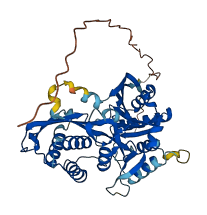
Descriptions
The autoinhibited protein was predicted that may have potential autoinhibitory elements via cis-regPred.
Autoinhibitory domains (AIDs)
Target domain |
|
Relief mechanism |
|
Assay |
cis-regPred |
Accessory elements
No accessory elements
Autoinhibited structure

Activated structure
2 structures for Q23229
| Entry ID | Method | Resolution | Chain | Position | Source |
|---|---|---|---|---|---|
| 1MG7 | X-ray | 155 A | A/B | 1-417 | PDB |
| AF-Q23229-F1 | Predicted | AlphaFoldDB |
No variants for Q23229
| Variant ID(s) | Position | Change | Description | Diseaes Association | Provenance |
|---|---|---|---|---|---|
| No variants for Q23229 | |||||
No associated diseases with Q23229
1 GO annotations of cellular component
| Name | Definition |
|---|---|
| nucleus | A membrane-bounded organelle of eukaryotic cells in which chromosomes are housed and replicated. In most cells, the nucleus contains all of the cell's chromosomes except the organellar chromosomes, and is the site of RNA synthesis and processing. In some species, or in specialized cell types, RNA metabolism or DNA replication may be absent. |
No GO annotations of molecular function
| Name | Definition |
|---|---|
| No GO annotations for molecular function |
4 GO annotations of biological process
| Name | Definition |
|---|---|
| cell differentiation | The process in which relatively unspecialized cells, e.g. embryonic or regenerative cells, acquire specialized structural and/or functional features that characterize the cells, tissues, or organs of the mature organism or some other relatively stable phase of the organism's life history. Differentiation includes the processes involved in commitment of a cell to a specific fate and its subsequent development to the mature state. |
| dosage compensation by hypoactivation of X chromosome | Compensating for the two-fold variation in X:autosome chromosome ratios between sexes by an inactivation of a proportion of genes on both of the X chromosomes of the XX sex, leading to a decrease, of half, of the levels of gene expression from these chromosomes. An example of this process is found in Caenorhabditis elegans. |
| intergenic mRNA trans splicing | The joining together of two independently transcribed RNAs from two different genes, each of which also produces mRNA(s) via cis-splicing. |
| male sex determination | The specification of male sex of an individual organism. |
No homologous proteins in AiPD
| UniProt AC | Gene Name | Protein Name | Species | Evidence Code |
|---|---|---|---|---|
| No homologous proteins | ||||
| 10 | 20 | 30 | 40 | 50 | 60 |
| MQVEANSERR | VKILGIDRSE | NSPVLTYMET | EDDPNFRNSK | LAAAPHTVHM | MDSGFLAINR |
| 70 | 80 | 90 | 100 | 110 | 120 |
| QCLVKGKAIL | AREPKSSNEH | MIDDLPKHAH | DQHTLSILRD | FIDQLKLHNV | YEINFYDPLD |
| 130 | 140 | 150 | 160 | 170 | 180 |
| SSGKLAVIPM | LIALWKCMLA | SETDICDQEV | LKSIMNSVIA | KFELQIPCKN | AVIDATLSGS |
| 190 | 200 | 210 | 220 | 230 | 240 |
| REEVHIIAED | GSLENSNGTT | EHFNKKHDLV | FVKTDLHPED | FTPQMFPSQA | KAKLLRDAFN |
| 250 | 260 | 270 | 280 | 290 | 300 |
| NEEDEDTFPD | ILVPAYMTAH | SKNRVRQEDY | TCLEVEFDSQ | VALEKLMNEH | EQVEGFEVQQ |
| 310 | 320 | 330 | 340 | 350 | 360 |
| GGILVALKKD | SFFDDELIEK | IAIAIATESR | QSVSSVSFDL | LKLGPGASLV | TLANSRRFEP |
| 370 | 380 | 390 | 400 | 410 | |
| ECRVVLQIEV | KPVSPGETSS | EGISDEHHYE | EYDEDDIMEE | EEAPSARQDD | TYDEDEE |