Q1RGE3
Gene name |
lptD |
Protein name |
LPS-assembly protein LptD |
Names |
|
Species |
Escherichia coli (strain UTI89 / UPEC) |
KEGG Pathway |
eci:UTI89_C0061 |
EC number |
|
Protein Class |
|
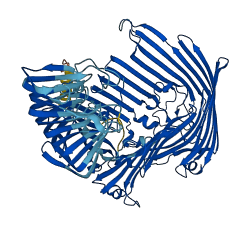
Descriptions
The autoinhibited protein was predicted that may have potential autoinhibitory elements via cis-regPred.
Autoinhibitory domains (AIDs)
Target domain |
|
Relief mechanism |
|
Assay |
cis-regPred |
Accessory elements
No accessory elements
Autoinhibited structure

Activated structure
1 structures for Q1RGE3
| Entry ID | Method | Resolution | Chain | Position | Source |
|---|---|---|---|---|---|
| AF-Q1RGE3-F1 | Predicted | AlphaFoldDB |
No variants for Q1RGE3
| Variant ID(s) | Position | Change | Description | Diseaes Association | Provenance |
|---|---|---|---|---|---|
| No variants for Q1RGE3 | |||||
No associated diseases with Q1RGE3
1 GO annotations of cellular component
| Name | Definition |
|---|---|
| cell outer membrane | A lipid bilayer that forms the outermost membrane of the cell envelope; enriched in polysaccharide and protein; the outer leaflet of the membrane contains specific lipopolysaccharide structures. |
No GO annotations of molecular function
| Name | Definition |
|---|---|
| No GO annotations for molecular function |
3 GO annotations of biological process
| Name | Definition |
|---|---|
| Gram-negative-bacterium-type cell outer membrane assembly | The assembly of an outer membrane of the type formed in Gram-negative bacteria. This membrane is enriched in polysaccharide and protein, and the outer leaflet of the membrane contains specific lipopolysaccharide structures. |
| lipopolysaccharide transport | The directed movement of lipopolysaccharides into, out of or within a cell, or between cells, by means of some agent such as a transporter or pore. A lipopolysaccharide is any of a group of related, structurally complex components of the outer membrane of Gram-negative bacteria. Lipopolysaccharides consist three covalently linked regions, lipid A, core oligosaccharide, and an O side chain. Lipid A is responsible for the toxicity of the lipopolysaccharide. |
| response to organic substance | Any process that results in a change in state or activity of a cell or an organism (in terms of movement, secretion, enzyme production, gene expression, etc.) as a result of an organic substance stimulus. |
No homologous proteins in AiPD
| UniProt AC | Gene Name | Protein Name | Species | Evidence Code |
|---|---|---|---|---|
| No homologous proteins | ||||
| 10 | 20 | 30 | 40 | 50 | 60 |
| MKKRIPTLLA | TMIATALYSQ | QGLAADLASQ | CMLGVPSYDR | PLVQGDTNDL | PVTINADHAK |
| 70 | 80 | 90 | 100 | 110 | 120 |
| GDYPDDAVFT | GSVDIMQGNS | RLQADEVQLH | QKEAPGQPEP | VRTVDALGNV | HYDDNQVILK |
| 130 | 140 | 150 | 160 | 170 | 180 |
| GPKGWANLNT | KDTNVWEGDY | QMVGRQGRGK | ADLMKQRGEN | RYTILDNGSF | TSCLPGSDTW |
| 190 | 200 | 210 | 220 | 230 | 240 |
| SVVGSEIIHD | REEQVAEIWN | ARFKVGPVPI | FYSPYLQLPV | GDKRRSGFLI | PNAKYTTTNY |
| 250 | 260 | 270 | 280 | 290 | 300 |
| FEFYLPYYWN | IAPNMDATIT | PHYMHRRGNI | MWENEFRYLS | QAGAGLMELD | YLPSDKVYKD |
| 310 | 320 | 330 | 340 | 350 | 360 |
| EHPNDDSSRR | WLFYWNHSGV | MDQVWRFNVD | YTKVSDPSYF | NDFDNKYGSS | TDGYATQKFS |
| 370 | 380 | 390 | 400 | 410 | 420 |
| VGYAVQNFNA | TVSTKQFQVF | SEQNTSSYSA | EPQLDVNYYQ | NDVGPFDTRI | YGQAVHFVNT |
| 430 | 440 | 450 | 460 | 470 | 480 |
| RDDMPEATRV | HLEPTINLPL | SNNWGSINTE | AKLLATHYQQ | TNLDWYNSRN | TTKLAESANR |
| 490 | 500 | 510 | 520 | 530 | 540 |
| VMPQFKVDGR | MVFERDMEML | APGYTQTLEP | RAQYLYVPYR | DQSKIYNYDS | SLLQSDYSGL |
| 550 | 560 | 570 | 580 | 590 | 600 |
| FRDRTYGGLD | RIASANQVTT | GVTSRIYDDA | AVERFNISVG | QIYYFTESRT | GDDNITWEND |
| 610 | 620 | 630 | 640 | 650 | 660 |
| DKTGSLVWAG | DTYWRISDRW | GLRGGIQYDT | RLDNVATSNS | SIEYRRDEDR | LVQLNYRYAS |
| 670 | 680 | 690 | 700 | 710 | 720 |
| PEYIQATLPK | YYSTAEQYKN | GISQVGAVAS | WPIADRWSIV | GAYYYDTNAN | KQADSMLGVQ |
| 730 | 740 | 750 | 760 | 770 | 780 |
| YSSCCYAIRV | GYERKLNGWD | NDKQHAVYDN | AIGFNIELRG | LSSNYGLGTQ | EMLRSNILPY |
| QNTL |