Q1LP26
Gene name |
bpt |
Protein name |
Aspartate/glutamate leucyltransferase |
Names |
|
Species |
Cupriavidus metallidurans (strain ATCC 43123 / DSM 2839 / NBRC 102507 / CH34) (Ralstonia metallidurans) |
KEGG Pathway |
rme:Rmet_1214 |
EC number |
2.3.2.29: Aminoacyltransferases |
Protein Class |
|
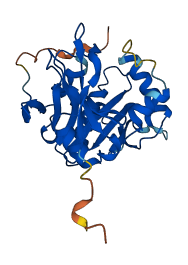
Descriptions
The autoinhibited protein was predicted that may have potential autoinhibitory elements via cis-regPred.
Autoinhibitory domains (AIDs)
Target domain |
|
Relief mechanism |
|
Assay |
cis-regPred |
Accessory elements
No accessory elements
Autoinhibited structure

Activated structure
1 structures for Q1LP26
| Entry ID | Method | Resolution | Chain | Position | Source |
|---|---|---|---|---|---|
| AF-Q1LP26-F1 | Predicted | AlphaFoldDB |
No variants for Q1LP26
| Variant ID(s) | Position | Change | Description | Diseaes Association | Provenance |
|---|---|---|---|---|---|
| No variants for Q1LP26 | |||||
No associated diseases with Q1LP26
Functions
| Description | ||
|---|---|---|
| EC Number | 2.3.2.29 | Aminoacyltransferases |
| Subcellular Localization |
|
|
| PANTHER Family | ||
| PANTHER Subfamily | ||
| PANTHER Protein Class | ||
| PANTHER Pathway Category | No pathway information available | |
1 GO annotations of cellular component
| Name | Definition |
|---|---|
| cytoplasm | The contents of a cell excluding the plasma membrane and nucleus, but including other subcellular structures. |
2 GO annotations of molecular function
| Name | Definition |
|---|---|
| arginyltransferase activity | Catalysis of the reaction: L-arginyl-tRNA + protein = tRNA + L-arginyl-protein. |
| leucyltransferase activity | Catalysis of the reaction: L-leucyl-tRNA + protein = tRNA + L-leucyl-protein. |
1 GO annotations of biological process
| Name | Definition |
|---|---|
| ubiquitin-dependent protein catabolic process via the N-end rule pathway | The chemical reactions and pathways resulting in the breakdown of a protein or peptide covalently tagged with ubiquitin, via the N-end rule pathway. In the N-end rule pathway, destabilizing N-terminal residues (N-degrons) in substrates are recognized by E3 ligases (N-recognins), whereupon the substrates are linked to ubiquitin and then delivered to the proteasome for degradation. |
No homologous proteins in AiPD
| UniProt AC | Gene Name | Protein Name | Species | Evidence Code |
|---|---|---|---|---|
| No homologous proteins | ||||
| 10 | 20 | 30 | 40 | 50 | 60 |
| MSKLKELPLS | ALQFYATAPY | ACSYLEGRMA | RSQVATPAHL | INADVYSRLV | RAGFRRSGIF |
| 70 | 80 | 90 | 100 | 110 | 120 |
| TYRPYCDECR | ACTPCRVLVD | QFRPDRSQRR | AWRDHQGLQA | LVAPLTYVEE | HYALYLLYQS |
| 130 | 140 | 150 | 160 | 170 | 180 |
| MRHAGGGMDQ | DSRDQYEQFL | LQSRVNSRLV | EFREPPGSPE | AGRLRMVSMI | DVLDDGLSSV |
| 190 | 200 | 210 | 220 | 230 | 240 |
| YTFYDPLIVG | ASYGTYNILW | QINQTRELGL | PHLYLGYWIA | DSRKMAYKAR | FQPLQVLTGN |
| 250 | 260 | ||||
| QWHTFKAPAE | ASGQPAPDPA | LE |