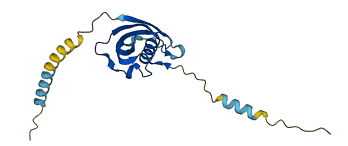
Descriptions
The autoinhibited protein was predicted that may have potential autoinhibitory elements via cis-regPred.
Autoinhibitory domains (AIDs)
Target domain |
|
Relief mechanism |
|
Assay |
cis-regPred |
Accessory elements
No accessory elements
Autoinhibited structure

Activated structure
1 structures for Q1KLX8
| Entry ID | Method | Resolution | Chain | Position | Source |
|---|---|---|---|---|---|
| AF-Q1KLX8-F1 | Predicted | AlphaFoldDB |
No variants for Q1KLX8
| Variant ID(s) | Position | Change | Description | Diseaes Association | Provenance |
|---|---|---|---|---|---|
| No variants for Q1KLX8 | |||||
No associated diseases with Q1KLX8
3 regional properties for Q1KLX8
| Type | Name | Position | InterPro Accession |
|---|---|---|---|
| conserved_site | Cathelicidin, conserved site | 35 - 48 | IPR018216-1 |
| conserved_site | Cathelicidin, conserved site | 79 - 101 | IPR018216-2 |
| domain | Cathelicidin, antimicrobial peptide, C-terminal | 136 - 162 | IPR022746 |
Functions
1 GO annotations of cellular component
| Name | Definition |
|---|---|
| extracellular region | The space external to the outermost structure of a cell. For cells without external protective or external encapsulating structures this refers to space outside of the plasma membrane. This term covers the host cell environment outside an intracellular parasite. |
No GO annotations of molecular function
| Name | Definition |
|---|---|
| No GO annotations for molecular function |
2 GO annotations of biological process
| Name | Definition |
|---|---|
| defense response to bacterium | Reactions triggered in response to the presence of a bacterium that act to protect the cell or organism. |
| neutrophil activation | The change in morphology and behavior of a neutrophil resulting from exposure to a cytokine, chemokine, cellular ligand, or soluble factor. |
No homologous proteins in AiPD
| UniProt AC | Gene Name | Protein Name | Species | Evidence Code |
|---|---|---|---|---|
| No homologous proteins | ||||
| 10 | 20 | 30 | 40 | 50 | 60 |
| MKTQRDGHSL | GGWSLMLLLL | GLLMPLAIVA | QVLSYKEAVL | RAIDGINQRS | SDANLYRLLD |
| 70 | 80 | 90 | 100 | 110 | 120 |
| LDPRPTMDGD | PDTPKPVSFT | VKETVCPRTT | QQSPEDCDFK | KDGLVKRCVG | TVTLNQARDS |
| 130 | 140 | 150 | 160 | ||
| FDISCDKDNR | RFASLGNFFR | KARKKIGEEF | KRIVQRIKDF | LQHLIPRTEA |