Q1KL86
Gene name |
EPHA2 |
Protein name |
Ephrin type-A receptor 2 |
Names |
|
Species |
Macaca fascicularis (Crab-eating macaque) (Cynomolgus monkey) |
KEGG Pathway |
|
EC number |
2.7.10.1: Protein-tyrosine kinases |
Protein Class |
|
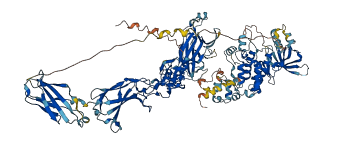
Descriptions
The autoinhibited protein was predicted that may have potential autoinhibitory elements via cis-regPred.
Autoinhibitory domains (AIDs)
Target domain |
|
Relief mechanism |
|
Assay |
cis-regPred |
Accessory elements
No accessory elements
Autoinhibited structure

Activated structure
1 structures for Q1KL86
| Entry ID | Method | Resolution | Chain | Position | Source |
|---|---|---|---|---|---|
| AF-Q1KL86-F1 | Predicted | AlphaFoldDB |
No variants for Q1KL86
| Variant ID(s) | Position | Change | Description | Diseaes Association | Provenance |
|---|---|---|---|---|---|
| No variants for Q1KL86 | |||||
No associated diseases with Q1KL86
13 regional properties for Q1KL86
| Type | Name | Position | InterPro Accession |
|---|---|---|---|
| domain | Protein kinase domain | 613 - 875 | IPR000719 |
| domain | Ephrin receptor ligand binding domain | 28 - 206 | IPR001090 |
| domain | Serine-threonine/tyrosine-protein kinase, catalytic domain | 614 - 871 | IPR001245 |
| conserved_site | Tyrosine-protein kinase, receptor class V, conserved site | 182 - 202 | IPR001426-1 |
| conserved_site | Tyrosine-protein kinase, receptor class V, conserved site | 247 - 267 | IPR001426-2 |
| domain | Sterile alpha motif domain | 901 - 968 | IPR001660 |
| domain | Fibronectin type III | 328 - 432 | IPR003961-1 |
| domain | Fibronectin type III | 436 - 529 | IPR003961-2 |
| active_site | Tyrosine-protein kinase, active site | 735 - 747 | IPR008266 |
| binding_site | Protein kinase, ATP binding site | 619 - 646 | IPR017441 |
| domain | Tyrosine-protein kinase, catalytic domain | 613 - 871 | IPR020635 |
| domain | Ephrin receptor, transmembrane domain | 538 - 610 | IPR027936 |
| domain | Ephrin type-A receptor 2, ligand binding domain | 28 - 201 | IPR034263 |
Functions
| Description | ||
|---|---|---|
| EC Number | 2.7.10.1 | Protein-tyrosine kinases |
| Subcellular Localization |
|
|
| PANTHER Family | ||
| PANTHER Subfamily | ||
| PANTHER Protein Class | ||
| PANTHER Pathway Category | No pathway information available | |
6 GO annotations of cellular component
| Name | Definition |
|---|---|
| focal adhesion | A cell-substrate junction that anchors the cell to the extracellular matrix and that forms a point of termination of actin filaments. In insects focal adhesion has also been referred to as hemi-adherens junction (HAJ). |
| integral component of plasma membrane | The component of the plasma membrane consisting of the gene products and protein complexes having at least some part of their peptide sequence embedded in the hydrophobic region of the membrane. |
| lamellipodium | A thin sheetlike process extended by the leading edge of a migrating cell or extending cell process; contains a dense meshwork of actin filaments. |
| lamellipodium membrane | The portion of the plasma membrane surrounding a lamellipodium. |
| leading edge membrane | The portion of the plasma membrane surrounding the leading edge of a motile cell. |
| ruffle membrane | The portion of the plasma membrane surrounding a ruffle. |
3 GO annotations of molecular function
| Name | Definition |
|---|---|
| ATP binding | Binding to ATP, adenosine 5'-triphosphate, a universally important coenzyme and enzyme regulator. |
| ephrin receptor activity | Combining with an ephrin receptor ligand to initiate a change in cell activity. |
| transmembrane receptor protein tyrosine kinase activity | Combining with a signal and transmitting the signal from one side of the membrane to the other to initiate a change in cell activity by catalysis of the reaction: ATP + a protein-L-tyrosine = ADP + a protein-L-tyrosine phosphate. |
22 GO annotations of biological process
| Name | Definition |
|---|---|
| activation of GTPase activity | Any process that initiates the activity of an inactive GTPase through the replacement of GDP by GTP. |
| angiogenesis | Blood vessel formation when new vessels emerge from the proliferation of pre-existing blood vessels. |
| apoptotic process | A programmed cell death process which begins when a cell receives an internal (e.g. DNA damage) or external signal (e.g. an extracellular death ligand), and proceeds through a series of biochemical events (signaling pathway phase) which trigger an execution phase. The execution phase is the last step of an apoptotic process, and is typically characterized by rounding-up of the cell, retraction of pseudopodes, reduction of cellular volume (pyknosis), chromatin condensation, nuclear fragmentation (karyorrhexis), plasma membrane blebbing and fragmentation of the cell into apoptotic bodies. When the execution phase is completed, the cell has died. |
| bone remodeling | The continuous turnover of bone matrix and mineral that involves first, an increase in resorption (osteoclastic activity) and later, reactive bone formation (osteoblastic activity). The process of bone remodeling takes place in the adult skeleton at discrete foci. The process ensures the mechanical integrity of the skeleton throughout life and plays an important role in calcium homeostasis. An imbalance in the regulation of bone resorption and bone formation results in many of the metabolic bone diseases, such as osteoporosis. |
| branching involved in mammary gland duct morphogenesis | The process in which the branching structure of the mammary gland duct is generated and organized. The mammary gland is a large compound sebaceous gland that in female mammals is modified to secrete milk. |
| cAMP metabolic process | The chemical reactions and pathways involving the nucleotide cAMP (cyclic AMP, adenosine 3',5'-cyclophosphate). |
| cell adhesion | The attachment of a cell, either to another cell or to an underlying substrate such as the extracellular matrix, via cell adhesion molecules. |
| cell chemotaxis | The directed movement of a motile cell guided by a specific chemical concentration gradient. Movement may be towards a higher concentration (positive chemotaxis) or towards a lower concentration (negative chemotaxis). |
| cell migration | The controlled self-propelled movement of a cell from one site to a destination guided by molecular cues. Cell migration is a central process in the development and maintenance of multicellular organisms. |
| cell motility | Any process involved in the controlled self-propelled movement of a cell that results in translocation of the cell from one place to another. |
| ephrin receptor signaling pathway | The series of molecular signals initiated by ephrin binding to its receptor, and ending with the regulation of a downstream cellular process, e.g. transcription. |
| lens fiber cell morphogenesis | The process in which the structures of a lens fiber cell are generated and organized. This process occurs while the initially relatively unspecialized cell is acquiring the specialized features of a lens fiber cell. A lens fiber cell is any of the elongated, tightly packed cells that make up the bulk of the mature lens in a camera-type eye. |
| mammary gland epithelial cell proliferation | The multiplication or reproduction of mammary gland epithelial cells, resulting in the expansion of a cell population. Mammary gland epithelial cells make up the covering of surfaces of the mammary gland. The mammary gland is a large compound sebaceous gland that in female mammals is modified to secrete milk. |
| negative regulation of protein kinase B signaling | Any process that stops, prevents, or reduces the frequency, rate or extent of protein kinase B signaling, a series of reactions mediated by the intracellular serine/threonine kinase protein kinase B. |
| osteoblast differentiation | The process whereby a relatively unspecialized cell acquires the specialized features of an osteoblast, a mesodermal or neural crest cell that gives rise to bone. |
| osteoclast differentiation | The process in which a relatively unspecialized monocyte acquires the specialized features of an osteoclast. An osteoclast is a specialized phagocytic cell associated with the absorption and removal of the mineralized matrix of bone tissue. |
| positive regulation of protein localization to plasma membrane | Any process that activates or increases the frequency, rate or extent of protein localization to plasma membrane. |
| protein kinase B signaling | A series of reactions, mediated by the intracellular serine/threonine kinase protein kinase B (also called AKT), which occurs as a result of a single trigger reaction or compound. |
| regulation of angiogenesis | Any process that modulates the frequency, rate or extent of angiogenesis. |
| regulation of cell adhesion mediated by integrin | Any process that modulates the frequency, rate, or extent of cell adhesion mediated by integrin. |
| regulation of lamellipodium assembly | Any process that modulates the rate, frequency or extent of the formation of a lamellipodium, a thin sheetlike extension of the surface of a migrating cell. |
| response to growth factor | Any process that results in a change in state or activity of a cell or an organism (in terms of movement, secretion, enzyme production, gene expression, etc.) as a result of a growth factor stimulus. |
No homologous proteins in AiPD
| UniProt AC | Gene Name | Protein Name | Species | Evidence Code |
|---|---|---|---|---|
| No homologous proteins | ||||
| 10 | 20 | 30 | 40 | 50 | 60 |
| MELWAARACF | VLLWGCALAP | ATAAQGKEVV | LLDFAAAGGE | LGWLTHPYGK | GWDLMQNIMN |
| 70 | 80 | 90 | 100 | 110 | 120 |
| DMPIYMYSVC | NVMSGDQDNW | LRTNWVYRGE | AERIFIELKF | TVRDCNSFPG | GASSCKETFN |
| 130 | 140 | 150 | 160 | 170 | 180 |
| LYYAESDLDY | GTNFQKRLFT | KIDTIAPDEI | TVSSDFEARH | VKLNVEERSV | GPLTRKGFYL |
| 190 | 200 | 210 | 220 | 230 | 240 |
| AFQDIGACVA | LLSVRVYYKK | CPELLQSLAR | FPETIAGSDA | PSLATVAGTC | VDHAVVPPGG |
| 250 | 260 | 270 | 280 | 290 | 300 |
| EEPRMHCAVD | GEWLVPIGQC | LCQAGYEKVE | DACQACSPGF | FKFEVSESPC | LECPEHTLPS |
| 310 | 320 | 330 | 340 | 350 | 360 |
| PEGATSCECE | EGFFRAPQDP | MSMPCTRPPS | APHYLTAVGM | GAKVELRWTP | PQDSGGREDI |
| 370 | 380 | 390 | 400 | 410 | 420 |
| VYSVTCEQCW | PESGECGPCE | SSVRYSEPPH | GLTRTSVTVS | DLEPHMNYTF | TVEARNGVSG |
| 430 | 440 | 450 | 460 | 470 | 480 |
| LVTSRSFRTA | SVSINQTEPP | KVRLEGRSTT | SLSVSWSIPP | PQQSRVWKYE | VTYRKKGDSN |
| 490 | 500 | 510 | 520 | 530 | 540 |
| SYNVRRTEGF | SVTLDDLAPD | TTYLVQVQAL | TQEGQGAGSK | VHEFQTLSPE | GSGSLAVIGG |
| 550 | 560 | 570 | 580 | 590 | 600 |
| VAVCVVLLLL | LAGAGFFIHR | RRKNLRARQS | PEDVYFSKSE | QLKPLKTYVD | PHTYEDPNQA |
| 610 | 620 | 630 | 640 | 650 | 660 |
| VLKFTTEIHP | SCVTRQKVIG | AGEFGEVYKG | TLKTSSGKKE | VPVAIKTLKA | GYTEKQRVDF |
| 670 | 680 | 690 | 700 | 710 | 720 |
| LGEAGIMGQF | SHHNIIRLEG | VISKYKPMMI | ITEFMENGAL | DKFLREKDGE | FSVLQLVGML |
| 730 | 740 | 750 | 760 | 770 | 780 |
| RGIAAGMKYL | ANMNYVHRDL | AARNILVNSN | LVCKVSDFGL | SRVLEDDPEA | TYTTSGGKIP |
| 790 | 800 | 810 | 820 | 830 | 840 |
| IRWTAPEAIS | YRKFTSASDV | WSFGIVMWEV | MTYGERPYWE | LSNHEVMKAI | NDGFRLPTPM |
| 850 | 860 | 870 | 880 | 890 | 900 |
| DCPSAIYQLM | MQCWQQERAR | RPKFADIVSI | LDKLIRAPDS | LKTLADFDPR | VSIRLPSTSG |
| 910 | 920 | 930 | 940 | 950 | 960 |
| SEGVPFRTVS | EWLESIKMQQ | YTEHFMAAGY | TAIEKVVQMT | NDDIKRIGVR | LPGHQKRIAY |
| 970 | |||||
| SLLGLKDQVN | TVGIPI |