Q1JPX3
Gene name |
farsa (farsla, zgc:136506, zgc:158185) |
Protein name |
Phenylalanine--tRNA ligase alpha subunit |
Names |
Phenylalanyl-tRNA synthetase alpha subunit, PheRS |
Species |
Danio rerio (Zebrafish) (Brachydanio rerio) |
KEGG Pathway |
dre:692329 |
EC number |
6.1.1.20: Ligases forming aminoacyl-tRNA and related compounds |
Protein Class |
|
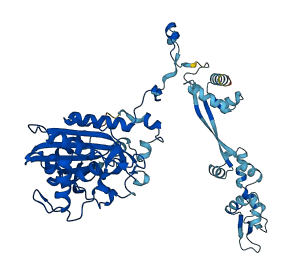
Descriptions
The autoinhibited protein was predicted that may have potential autoinhibitory elements via cis-regPred.
Autoinhibitory domains (AIDs)
Target domain |
|
Relief mechanism |
|
Assay |
cis-regPred |
Accessory elements
No accessory elements
Autoinhibited structure

Activated structure
1 structures for Q1JPX3
| Entry ID | Method | Resolution | Chain | Position | Source |
|---|---|---|---|---|---|
| AF-Q1JPX3-F1 | Predicted | AlphaFoldDB |
No variants for Q1JPX3
| Variant ID(s) | Position | Change | Description | Diseaes Association | Provenance |
|---|---|---|---|---|---|
| No variants for Q1JPX3 | |||||
No associated diseases with Q1JPX3
No regional properties for Q1JPX3
| Type | Name | Position | InterPro Accession |
|---|---|---|---|
| No domain, repeats, and functional sites for Q1JPX3 | |||
Functions
| Description | ||
|---|---|---|
| EC Number | 6.1.1.20 | Ligases forming aminoacyl-tRNA and related compounds |
| Subcellular Localization |
|
|
| PANTHER Family | ||
| PANTHER Subfamily | ||
| PANTHER Protein Class | ||
| PANTHER Pathway Category | No pathway information available | |
2 GO annotations of cellular component
| Name | Definition |
|---|---|
| cytoplasm | The contents of a cell excluding the plasma membrane and nucleus, but including other subcellular structures. |
| phenylalanine-tRNA ligase complex | An enzyme complex that catalyzes the ligation of phenylalanine to tRNA(Phe), forming L-phenylalanyl-tRNA(Phe). |
4 GO annotations of molecular function
| Name | Definition |
|---|---|
| ATP binding | Binding to ATP, adenosine 5'-triphosphate, a universally important coenzyme and enzyme regulator. |
| magnesium ion binding | Binding to a magnesium (Mg) ion. |
| phenylalanine-tRNA ligase activity | Catalysis of the reaction: ATP + L-phenylalanine + tRNA(Phe) = AMP + diphosphate + L-phenylalanyl-tRNA(Phe). |
| tRNA binding | Binding to a transfer RNA. |
3 GO annotations of biological process
| Name | Definition |
|---|---|
| anatomical structure development | The biological process whose specific outcome is the progression of an anatomical structure from an initial condition to its mature state. This process begins with the formation of the structure and ends with the mature structure, whatever form that may be including its natural destruction. An anatomical structure is any biological entity that occupies space and is distinguished from its surroundings. Anatomical structures can be macroscopic such as a carpel, or microscopic such as an acrosome. |
| phenylalanyl-tRNA aminoacylation | The process of coupling phenylalanine to phenylalanyl-tRNA, catalyzed by phenylalanyl-tRNA synthetase. The phenylalanyl-tRNA synthetase is a class-II synthetase. However, unlike other class II enzymes, The activated amino acid is transferred to the 2'-OH group of a phenylalanine-accepting tRNA. The 2'-O-aminoacyl-tRNA will ultimately migrate to the 3' position via transesterification. |
| protein heterotetramerization | The formation of a protein heterotetramer, a macromolecular structure consisting of four noncovalently associated subunits, of which not all are identical. |
4 homologous proteins in AiPD
| UniProt AC | Gene Name | Protein Name | Species | Evidence Code |
|---|---|---|---|---|
| Q5ZJQ2 | FARSA | Phenylalanine--tRNA ligase alpha subunit | Gallus gallus (Chicken) | PR |
| P08312 | pheS | Phenylalanine--tRNA ligase alpha subunit | Escherichia coli (strain K12) | PR |
| Q9Y285 | FARSA | Phenylalanine--tRNA ligase alpha subunit | Homo sapiens (Human) | PR |
| Q505J8 | Farsa | Phenylalanine--tRNA ligase alpha subunit | Rattus norvegicus (Rat) | PR |
| 10 | 20 | 30 | 40 | 50 | 60 |
| MADTGLLEAL | LQRVEQLDGG | VDSQDVSAAL | GVDHQLVVGA | VKSLQALGEV | ISAEQKSSKH |
| 70 | 80 | 90 | 100 | 110 | 120 |
| WELTGEGREI | AEQGSHEARV | FNAIPAEGLP | QNQLMKMASG | KVGFSKAMSN | KWIRLDKAHE |
| 130 | 140 | 150 | 160 | 170 | 180 |
| GGPRVFRTVE | SIEDTVRDKL | QLVQNGQSAK | LEEKEKNELK | KRKLLAEVTV | KSYWITKGNS |
| 190 | 200 | 210 | 220 | 230 | 240 |
| FSTTITKQET | ELTPEMIASG | NWKEKKFKPY | NFEAMGVAPD | CGHLHPLMKV | RTQFRQIFLE |
| 250 | 260 | 270 | 280 | 290 | 300 |
| MGFTEMPTNN | FIESSFWNFD | SLFQPQQHPA | RDQHDTFFIS | DPALAHEFPR | DYLERVKKVH |
| 310 | 320 | 330 | 340 | 350 | 360 |
| SEGGYGSQGY | KYDWKIEEAQ | KNLLRTHTTA | VSARMLYKLA | QQEKFTPVKY | FSIDRVFRNE |
| 370 | 380 | 390 | 400 | 410 | 420 |
| TLDATHLAEF | HQIEGVVADY | GLTLGNLMGV | LHQFFTKLGI | TKLRFKPAYN | PYTEPSMEVF |
| 430 | 440 | 450 | 460 | 470 | 480 |
| SYHEGLKKWV | EVGNSGVFRP | EMLLPMGLPE | GVSVIAWGLS | LERPTMIKYG | INNIRELVGH |
| 490 | |||||
| KVNLQMVYDS | PICRLDS |