Q1IGT7
Gene name |
PSEEN0139 |
Protein name |
Putative signal transduction protein GGDEF/EAL domain |
Names |
|
Species |
Solanum lycopersicum (Tomato) (Lycopersicon esculentum) |
KEGG Pathway |
pen:PSEEN0139 |
EC number |
3.1.1.11: Carboxylic ester hydrolases |
Protein Class |
|
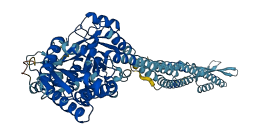
Descriptions
(Annotation from UniProt)
The PMEI region may act as an autoinhibitory domain.
Autoinhibitory domains (AIDs)
Target domain |
409-648 (EAL domain) |
Relief mechanism |
Ligand binding |
Assay |
|
Accessory elements
No accessory elements
Autoinhibited structure

Activated structure
1 structures for Q1IGT7
| Entry ID | Method | Resolution | Chain | Position | Source |
|---|---|---|---|---|---|
| AF-Q1IGT7-F1 | Predicted | AlphaFoldDB |
No variants for Q1IGT7
| Variant ID(s) | Position | Change | Description | Diseaes Association | Provenance |
|---|---|---|---|---|---|
| No variants for Q1IGT7 | |||||
No associated diseases with Q1IGT7
4 regional properties for Q1IGT7
Functions
| Description | ||
|---|---|---|
| EC Number | 3.1.1.11 | Carboxylic ester hydrolases |
| Subcellular Localization |
|
|
| PANTHER Family | ||
| PANTHER Subfamily | ||
| PANTHER Protein Class | ||
| PANTHER Pathway Category | No pathway information available | |
1 GO annotations of cellular component
| Name | Definition |
|---|---|
| integral component of membrane | The component of a membrane consisting of the gene products and protein complexes having at least some part of their peptide sequence embedded in the hydrophobic region of the membrane. |
No GO annotations of molecular function
| Name | Definition |
|---|---|
| No GO annotations for molecular function |
1 GO annotations of biological process
| Name | Definition |
|---|---|
| signal transduction | The cellular process in which a signal is conveyed to trigger a change in the activity or state of a cell. Signal transduction begins with reception of a signal (e.g. a ligand binding to a receptor or receptor activation by a stimulus such as light), or for signal transduction in the absence of ligand, signal-withdrawal or the activity of a constitutively active receptor. Signal transduction ends with regulation of a downstream cellular process, e.g. regulation of transcription or regulation of a metabolic process. Signal transduction covers signaling from receptors located on the surface of the cell and signaling via molecules located within the cell. For signaling between cells, signal transduction is restricted to events at and within the receiving cell. |
No homologous proteins in AiPD
| UniProt AC | Gene Name | Protein Name | Species | Evidence Code |
|---|---|---|---|---|
| No homologous proteins | ||||
| 10 | 20 | 30 | 40 | 50 | 60 |
| MTRVEDFFSK | QIDFCKRKKK | IYLAIVASVL | LVAAVIGVVA | GVKSHSKNSD | DHADIMAISS |
| 70 | 80 | 90 | 100 | 110 | 120 |
| SAHAIVKSAC | SNTLHPELCY | SAIVNVSDFS | KKVTSQKDVI | ELSLNITVKA | VRRNYYAVKE |
| 130 | 140 | 150 | 160 | 170 | 180 |
| LIKTRKGLTP | REKVALHDCL | ETMDETLDEL | HTAVEDLELY | PNKKSLKEHV | EDLKTLISSA |
| 190 | 200 | 210 | 220 | 230 | 240 |
| ITNQETCLDG | FSHDEADKKV | RKVLLKGQKH | VEKMCSNALA | MICNMTDTDI | ANEMKLSAPA |
| 250 | 260 | 270 | 280 | 290 | 300 |
| NNRKLVEDNG | EWPEWLSAGD | RRLLQSSTVT | PDVVVAADGS | GDYKTVSEAV | RKAPEKSSKR |
| 310 | 320 | 330 | 340 | 350 | 360 |
| YVIRIKAGVY | RENVDVPKKK | TNIMFMGDGK | SNTIITASRN | VQDGSTTFHS | ATVVRVAGKV |
| 370 | 380 | 390 | 400 | 410 | 420 |
| LARDITFQNT | AGASKHQAVA | LCVGSDLSAF | YRCDMLAYQD | TLYVHSNRQF | FVQCLVAGTV |
| 430 | 440 | 450 | 460 | 470 | 480 |
| DFIFGNGAAV | FQDCDIHARR | PGSGQKNMVT | AQGRTDPNQN | TGIVIQKCRI | GATSDLRPVQ |
| 490 | 500 | 510 | 520 | 530 | 540 |
| KSFPTYLGRP | WKEYSRTVIM | QSSITDVIQP | AGWHEWNGNF | ALDTLFYGEY | ANTGAGAPTS |
| 550 | 560 | 570 | 580 | ||
| GRVKWKGHKV | ITSSTEAQAY | TPGRFIAGGS | WLSSTGFPFS | LGL |