Q1HRV8
Gene name |
AAEL008004 |
Protein name |
Elongation of very long chain fatty acids protein AAEL008004 |
Names |
3-keto acyl-CoA synthase AAEL008004, Very-long-chain 3-oxoacyl-CoA synthase AAEL008004 |
Species |
Aedes aegypti (Yellowfever mosquito) (Culex aegypti) |
KEGG Pathway |
|
EC number |
2.3.1.199: Transferring groups other than amino-acyl groups |
Protein Class |
|
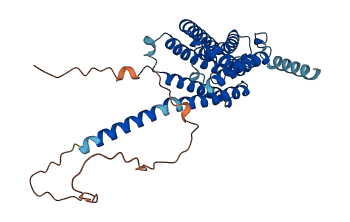
Descriptions
The autoinhibited protein was predicted that may have potential autoinhibitory elements via cis-regPred.
Autoinhibitory domains (AIDs)
Target domain |
|
Relief mechanism |
|
Assay |
cis-regPred |
Accessory elements
No accessory elements
Autoinhibited structure

Activated structure
1 structures for Q1HRV8
| Entry ID | Method | Resolution | Chain | Position | Source |
|---|---|---|---|---|---|
| AF-Q1HRV8-F1 | Predicted | AlphaFoldDB |
No variants for Q1HRV8
| Variant ID(s) | Position | Change | Description | Diseaes Association | Provenance |
|---|---|---|---|---|---|
| No variants for Q1HRV8 | |||||
No associated diseases with Q1HRV8
No regional properties for Q1HRV8
| Type | Name | Position | InterPro Accession |
|---|---|---|---|
| No domain, repeats, and functional sites for Q1HRV8 | |||
Functions
| Description | ||
|---|---|---|
| EC Number | 2.3.1.199 | Transferring groups other than amino-acyl groups |
| Subcellular Localization |
|
|
| PANTHER Family | ||
| PANTHER Subfamily | ||
| PANTHER Protein Class | ||
| PANTHER Pathway Category | No pathway information available | |
1 GO annotations of cellular component
| Name | Definition |
|---|---|
| integral component of endoplasmic reticulum membrane | The component of the endoplasmic reticulum membrane consisting of the gene products and protein complexes having at least some part of their peptide sequence embedded in the hydrophobic region of the membrane. |
2 GO annotations of molecular function
| Name | Definition |
|---|---|
| fatty acid elongase activity | Catalysis of the reaction: fatty acid (C-16 or longer) + 2-C = fatty acid (C-16 or longer + 2-C). |
| very-long-chain 3-ketoacyl-CoA synthase activity | Catalysis of the reaction: malonyl-CoA + a very-long-chain 2,3,4-saturated fatty acyl CoA = carbon dioxide + coenzyme A + a very-long-chain oxoacyl-CoA. |
1 GO annotations of biological process
| Name | Definition |
|---|---|
| fatty acid biosynthetic process | The chemical reactions and pathways resulting in the formation of a fatty acid, any of the aliphatic monocarboxylic acids that can be liberated by hydrolysis from naturally occurring fats and oils. Fatty acids are predominantly straight-chain acids of 4 to 24 carbon atoms, which may be saturated or unsaturated; branched fatty acids and hydroxy fatty acids also occur, and very long chain acids of over 30 carbons are found in waxes. |
No homologous proteins in AiPD
| UniProt AC | Gene Name | Protein Name | Species | Evidence Code |
|---|---|---|---|---|
| No homologous proteins | ||||
| 10 | 20 | 30 | 40 | 50 | 60 |
| MALIMKYIDS | MHHYMDKYGD | PRTKDWPLMS | SPFPTLALCL | GYVYLVKVLG | PRLMENRKPF |
| 70 | 80 | 90 | 100 | 110 | 120 |
| QLRNTLILYN | FVQVVFSAWL | FYEIGISGWL | TGHYNFRCQP | VDYSNHPKTL | RMVHACWWYY |
| 130 | 140 | 150 | 160 | 170 | 180 |
| FSKFTEFFDT | FFFVMRKKTS | QVSTLHVIHH | GCMPMSVWFG | VKFTPGGHST | FFGLLNTFVH |
| 190 | 200 | 210 | 220 | 230 | 240 |
| IVMYTYYLFT | AMGPQFQKYL | WWKKYLTSLQ | MVQFVAIMVH | AFQLLFIDCN | YPKAFVWWIG |
| 250 | 260 | 270 | 280 | 290 | 300 |
| MHAVMFLFLF | NEFYQSTYKA | TKRRRAAAAE | ARRLAAEEAK | LQNGSAVSSN | GSAITANGHH |
| 310 | 320 | 330 | 340 | 350 | |
| GKNGSVHHHS | NGSATSNGTS | LLSNGVGSNK | AADYYVRGDL | PAEIEITQRQ | PSSRNQVQ |